This also required adding a loop guard in case clone panics

Add specialization for copy

There is a better version for copy, so I've added specialization for that function
and hopefully that should speed it up even more.

Switch FromIter<slice::Iter> to use `to_vec`

Test different unrolling version for to_vec

Revert to impl

From benchmarking, it appears this version is faster
Add test for eval order for a+=b

Yes, the order of evaluation *does* change depending on the types of
the operands. Cursed, I know.

I've elected to place this test into `expr/compound-assignment` creating
both the `expr` directory and the `compound-assignment` directory. I
plan in a future PR to also move the `if` directory and the loose `if`
tests into `expr/if` and other similar cleanups of the `test/ui`
directory.

Future work: Test more than just `+=`, but all operators. I don't know
if using a macro to generate these tests cases would be okay or not,
but it'd be boilerplatey without it. I'm also confident you cannot
change the evaluation order of one operator without changing all of
them.

Future work: Additionally, test more than just `i32 += i32` for the
primitive version. I don't actually know the full set of primitive
implementations, but I imagine there's enough to cause a combinatorial
explosion with the previous future work item. Somewhere on the order of
one to two hundred individual functions.
Split each iterator adapter and source into individual modules

This PR creates individual modules for each iterator adapter and iterator source.

This is done to enhance the readability of corresponding modules (`adapters/mod.rs` and `sources.rs`) which were hard to navigate and read because of lots of repeated lines (e.g.: `adapters/mod.rs` was 3k lines long). This is also in line with some adapters which already had their own modules (`Flatten`, `FlatMap`, `Chain`, `Zip`, `Fuse`).

This PR also makes `Take`s adapter fields private (I have no idea why they were `pub(super)` before).

r? ``@LukasKalbertodt``
Consolidate exhaustiveness-related tests

I hunted for tests that only exercised the match exhaustiveness algorithm and regrouped them. I also improved integer-range tests since I had found them lacking while hacking around.
The interest is mainly so that one can pass `--test-args patterns` and catch most relevant tests.

r? `@varkor`
`@rustbot` modify labels: +A-exhaustiveness-checking
Yes, the order of evaluation *does* change depending on the types of
the operands. Cursed, I know.

I've elected to place this test into `expr/compound-assignment` creating
both the `expr` directory and the `compound-assignment` directory. I
plan in a future PR to also move the `if` directory and the loose `if`
tests into `expr/if` and other similar cleanups of the `test/ui`
directory.

Future work: Test more than just `+=`, but all operators. I don't know
if using a macro to generate these tests cases would be okay or not,
but it'd be boilerplatey without it. I'm also confident you cannot
change the evaluation order of one operator without changing all of
them.

Future work: Additionally, test more than just `i32 += i32` for the
primitive version. I don't actually know the full set of primitive
implementations, but I imagine there's enough to cause a combinatorial
explosion with the previous future work item. Somewhere on the order of
one to two hundred individual functions.
Get rid of some doctree items

They can be derived directly from the `hir::Item`, there's no special logic.

- TypeDef
- OpaqueTy
- Constant
- Static
- TraitAlias
- Enum
- Union
- Struct

Part of #78082 (the easiest part, I'm still debugging some other changes).
r? `@GuillaumeGomez`
Fix links to extern types in rustdoc (fixes#78777)
r? `@jyn514`
Fixes#78777.
The initial fix we tried was:
```diff
diff --git a/src/librustdoc/passes/collect_intra_doc_links.rs b/src/librustdoc/passes/collect_intra_doc_links.rs
index 8be9482acff..c4b7086fdb1 100644
--- a/src/librustdoc/passes/collect_intra_doc_links.rs
+++ b/src/librustdoc/passes/collect_intra_doc_links.rs
`@@` -433,8 +433,9 `@@` impl<'a, 'tcx> LinkCollector<'a, 'tcx> {
Res::PrimTy(prim) => Some(
self.resolve_primitive_associated_item(prim, ns, module_id, item_name, item_str),
),
- Res::Def(DefKind::Struct | DefKind::Union | DefKind::Enum | DefKind::TyAlias, did) => {
+ Res::Def(kind, did) if kind.ns() == Some(Namespace::TypeNS) => {
debug!("looking for associated item named {} for item {:?}", item_name, did);
+
// Checks if item_name belongs to `impl SomeItem`
let assoc_item = cx
.tcx
```
However, this caused traits to be matched, resulting in a panic when `resolve_associated_trait_item` is called further down in this function.
This PR also adds an error message for that panic. Currently it will look something like:
```rust
thread 'rustc' panicked at 'Not a type: DefIndex(8624)', compiler/rustc_metadata/src/rmeta/decoder.rs:951:32
```
I wasn't sure how to get a better debug output than `DefIndex(...)`, and am open to suggestions.
lint: Do not provide suggestions for non standard characters
Fixes#77273
Only provide suggestions if the case-fixed result is different than the original.
rustc_expand: Mark inner `#![test]` attributes as soft-unstable

Custom inner attributes are feature gated (https://github.com/rust-lang/rust/issues/54726) except for attributes having name `test` literally, which are not gated for historical reasons.

`#![test]` is an inner proc macro attribute, so it has all the issues described in https://github.com/rust-lang/rust/issues/54726 too.
This PR gates it with the `soft_unstable` lint.
BTreeMap: replace Root with NodeRef<Owned, ...>

`NodeRef<marker::Owned, …>` already exists as a representation of root nodes, and it makes more sense to alias `Root` to that than to reuse the space-efficient `BoxedNode` that is oblivious to height, where height is required.

r? `@Mark-Simulacrum`
Never inline naked functions
The `#[naked]` attribute disabled prologue / epilogue emission for the
function and it is responsibility of a developer to provide them. The
compiler is no position to inline such functions correctly.

Disable inlining of naked functions at LLVM and MIR level.
Closes#60919.
Add lint for panic!("{}")
This adds a lint that warns about `panic!("{}")`.
`panic!(msg)` invocations with a single argument use their argument as panic payload literally, without using it as a format string. The same holds for `assert!(expr, msg)`.
This lints checks if `msg` is a string literal (after expansion), and warns in case it contained braces. It suggests to insert `"{}", ` to use the message literally, or to add arguments to use it as a format string.
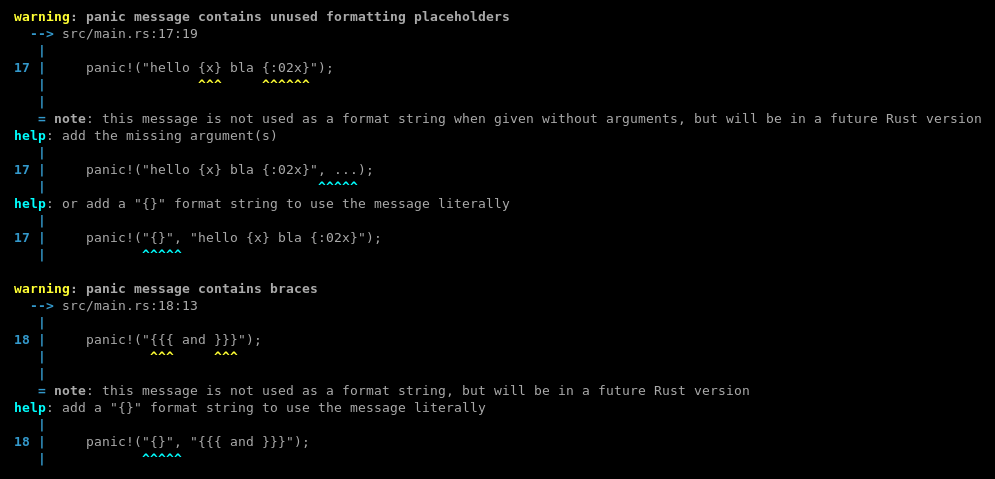
This lint is also a good starting point for adding warnings about `panic!(not_a_string)` later, once [`panic_any()`](https://github.com/rust-lang/rust/pull/74622) becomes a stable alternative.
The `#[naked]` attribute disabled prologue / epilogue emission for the
function and it is responsibility of a developer to provide them. The
compiler is no position to inline such functions correctly.
Disable inlining of naked functions at LLVM and MIR level.
Test drop order for (destructuring) assignments

Add a test that checks whether the drop order of `let` bindings is consistent with the drop order of the corresponding destructuring assignments.

Thanks to ```@RalfJung``` for the suggesting this test ([here](https://github.com/rust-lang/rust/pull/79016#issuecomment-727608732)) and an implementation!

r? ```@RalfJung```
add optimization fuel checks to some mir passes
Fixes#77402
Inserts a bunch of calls to `consider_optimizing`. Note that `consider_optimizing` is the method that actually decrements the fuel count, so the point at which it's called is when the optimization takes place, from a fuel perspective. This means that where we call it has some thought behind it:
1. We probably don't want to decrement the fuel count before other simple checks, otherwise we count an optimization as being performed even if nothing was mutated (ie. it returned early).
2. In cases like `InstCombine`, where we gather optimizations in a pass and then mutate values, we probably would rather skip the gathering pass for performance reasons rather than skip the mutations afterwards.




