Fix hygene issue when deriving Debug

The code for several of the core traits doesn't use hygenic macros.
This isn't a problem, except for the Debug trait, which is the only
one that uses a variable, named "builder".

Variables can't share names with unit structs, so attempting to
[derive(Debug)] on any type while a unit struct with the name
"builder" was in scope would result in an error.

This commit just changes the name of the variable to
"__debug_trait_builder", because I couldn't figure out how to get a
list of all unit structs in-scope from within the derive expansion
function. If someone wants to have a unit struct with
the exact name "__debug_trait_builder", they'll just have to do it
without a [derive(Debug)].

I also checked the implementations of the other built-in derives to
ensure they didn't declare any variables.
in which some labels and notes are upgraded to structured suggestions

(Meanwhile, a couple of parse-fail tests are moved to UI tests so that
the reader can see the new output, and an existing UI test is given a
more evocative name.)

r? @estebank
Two phase borrows rewrite

This definitely needs a careful review. Both @pnkfelix and @nikomatsakis  were involved with the design of this so they're natural choices here. I'm r?'ing @pnkfelix since they wrote the original two-phase borrow implementation. Also ping @KiChjang who expressed interest in working on this. I'm going to leave a few comments below pointing out some of the more dangerous changes I made (i.e. what I would like reviewers to pay special attention too.)

r? @pnkfelix
Required moving all fulldeps tests depending on `rand` to different locations as
now there's multiple `rand` crates that can't be implicitly linked against.
The code for several of the core traits doesn't use hygenic macros.
This isn't a problem, except for the Debug trait, which is the only
one that uses a variable, named "builder".

Variables can't share names with unit structs, so attempting to
[derive(Debug)] on any type while a unit struct with the name
"builder" was in scope would result in an error.

This commit just changes the name of the variable to
"__debug_trait_builder", because I couldn't figure out how to get a
list of all unit structs in-scope from within the derive expansion
function. If someone wants to have a unit struct with
the exact name "__debug_trait_builder", they'll just have to do it
without a [derive(Debug)].
travis: Upgrade OSX builders

This upgrades the OSX builders to the `xcode9.3-moar` image which has 3 cores as
opposed to the 2 that our builders currently have. Should help make those OSX
builds a bit speedier!
(Meanwhile, a couple of parse-fail tests are moved to UI tests so that
the reader can see the new output, and an existing UI test is given a
more evocative name.)
Use free regions when determining self type in `compare_impl_method`
The ExplicitSelf::determine function expects to be able to compare regions. However, when the compare_self_type error reporting code runs we haven't resolved bound regions yet. Thus we replace them with free regions first. Fixes#48276
Add relro-level tests

The `relro-level` debugging flag was added in #43170 which was merged in July 2017.  This PR moves this flag to be a proper codegen flag.
See #48431 for discussion as to why this was necessary and what we hoped to
accomplish. A brief summary:
   - the first implementation of 2-phase borrows was hard to limit in the way we
   wanted. That is, it was too good at accepting all 2-phase borrows rather than
   just autorefs =)
   - Numerous diagnostic regressions were introduced by 2-phase borrow support
   which were difficult to fix
Warn about ignored generic bounds in `for`
This adds a new lint to fix#42181. For consistency and to avoid code duplication, I also moved the existing "bounds in type aliases are ignored" here.
Questions to the reviewer:
* Is it okay to just remove a diagnostic error code like this? Should I instead keep the warning about type aliases where it is? The old code provided a detailed explanation of what's going on when asked, that information is now lost. On the other hand, `span_warn!` seems deprecated (after this patch, it has exactly one user left!).
* Did I miss any syntactic construct that can appear as `for` in the surface syntax? I covered function types (`for<'a> fn(...)`), generic traits (`for <'a> Fn(...)`, can appear both as bounds as as trait objects) and bounds (`for<'a> F: ...`).
* For the sake of backwards compatibility, this adds a warning, not an error. @nikomatsakis suggested an error in https://github.com/rust-lang/rust/issues/42181#issuecomment-306924389, but I feel that can only happen in a new epoch -- right?
Cc @eddyb
in which parentheses are suggested for should-have-been-tuple-patterns
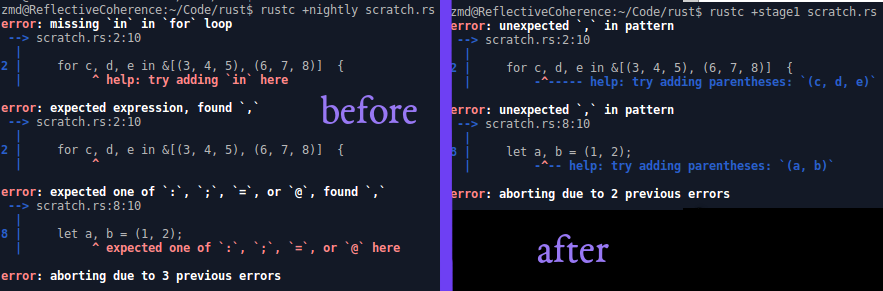
Programmers used to working in some other languages (such as Python or
Go) might expect to be able to destructure values with comma-separated
identifiers but no parentheses on the left side of an assignment.
Previously, the first name in such code would get parsed as a
single-indentifier pattern—recognizing, for example, the
`let a` in `let a, b = (1, 2);`—whereupon we would have a fatal syntax
error on seeing an unexpected comma rather than the expected semicolon
(all the way nearer to the end of `parse_full_stmt`).
Instead, let's look for that comma when parsing the pattern, and if we
see it, make-believe that we're parsing the remaining elements in a
tuple pattern, so that we can suggest wrapping it all in parentheses. We
need to do this in a separate wrapper method called on a "top-level"
pattern, rather than within
`parse_pat` itself, because `parse_pat` gets called recursively to parse
the sub-patterns within a tuple pattern.
~~We could also do this for `match` arms, `if let`, and `while let`, but
we elect not to in this patch, as it seems less likely for users to make
the mistake in those contexts.~~
Resolves#48492.
r? @petrochenkov
Programmers used to working in some other languages (such as Python or
Go) might expect to be able to destructure values with comma-separated
identifiers but no parentheses on the left side of an assignment.
Previously, the first name in such code would get parsed as a
single-indentifier pattern—recognizing, for example, the
`let a` in `let a, b = (1, 2);`—whereupon we would have a fatal syntax
error on seeing an unexpected comma rather than the expected semicolon
(all the way nearer to the end of `parse_full_stmt`).
Instead, let's look for that comma when parsing the pattern, and if we
see it, momentarily make-believe that we're parsing the remaining
elements in a tuple pattern, so that we can suggest wrapping it all in
parentheses. We need to do this in a separate wrapper method called on
the top-level pattern (or `|`-patterns) in a `let` statement, `for`
loop, `if`- or `while let` expression, or match arm rather than within
`parse_pat` itself, because `parse_pat` gets called recursively to parse
the sub-patterns within a tuple pattern.
Resolves#48492.
rustc: Fix ICE with `#[target_feature]` on module

This commit fixes an ICE in rustc when `#[target_feature]` was applied to items
other than functions due to the way the feature was validated.


