Add relro-level tests

The `relro-level` debugging flag was added in #43170 which was merged in July 2017.  This PR moves this flag to be a proper codegen flag.
First of all, the lint is specific for type aliases.  Second, it turns out the
bounds are not entirely ignored but actually used when accessing associated
types.  So change the wording of the lint, and adapt its name to reality.

The lint has never been on stable or beta, so renaming is safe.
Also, tweak the test for ignored type aliases such that replacing the type alias
by a newtype struct leads to a well-formed type definition, and errors when used
the way the type alias is used.
See #48431 for discussion as to why this was necessary and what we hoped to
accomplish. A brief summary:
   - the first implementation of 2-phase borrows was hard to limit in the way we
   wanted. That is, it was too good at accepting all 2-phase borrows rather than
   just autorefs =)
   - Numerous diagnostic regressions were introduced by 2-phase borrow support
   which were difficult to fix
Warn about ignored generic bounds in `for`
This adds a new lint to fix#42181. For consistency and to avoid code duplication, I also moved the existing "bounds in type aliases are ignored" here.
Questions to the reviewer:
* Is it okay to just remove a diagnostic error code like this? Should I instead keep the warning about type aliases where it is? The old code provided a detailed explanation of what's going on when asked, that information is now lost. On the other hand, `span_warn!` seems deprecated (after this patch, it has exactly one user left!).
* Did I miss any syntactic construct that can appear as `for` in the surface syntax? I covered function types (`for<'a> fn(...)`), generic traits (`for <'a> Fn(...)`, can appear both as bounds as as trait objects) and bounds (`for<'a> F: ...`).
* For the sake of backwards compatibility, this adds a warning, not an error. @nikomatsakis suggested an error in https://github.com/rust-lang/rust/issues/42181#issuecomment-306924389, but I feel that can only happen in a new epoch -- right?
Cc @eddyb
Since #47964 was merged, 64-bit mips started passing all structures
using 64-bit chunks regardless of their contents. The
repr-transparent-aggregates tests needs updating to cope with this.
in which parentheses are suggested for should-have-been-tuple-patterns
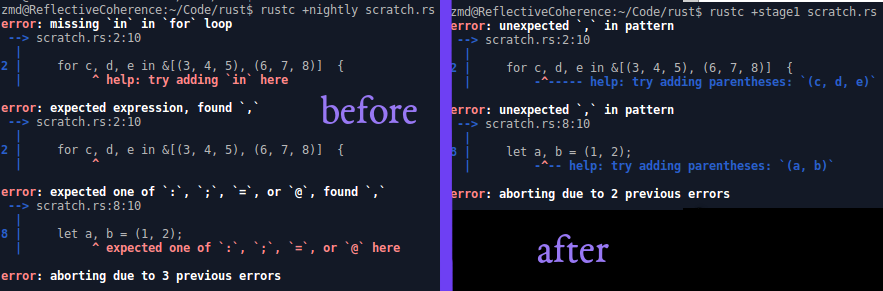
Programmers used to working in some other languages (such as Python or
Go) might expect to be able to destructure values with comma-separated
identifiers but no parentheses on the left side of an assignment.
Previously, the first name in such code would get parsed as a
single-indentifier pattern—recognizing, for example, the
`let a` in `let a, b = (1, 2);`—whereupon we would have a fatal syntax
error on seeing an unexpected comma rather than the expected semicolon
(all the way nearer to the end of `parse_full_stmt`).
Instead, let's look for that comma when parsing the pattern, and if we
see it, make-believe that we're parsing the remaining elements in a
tuple pattern, so that we can suggest wrapping it all in parentheses. We
need to do this in a separate wrapper method called on a "top-level"
pattern, rather than within
`parse_pat` itself, because `parse_pat` gets called recursively to parse
the sub-patterns within a tuple pattern.
~~We could also do this for `match` arms, `if let`, and `while let`, but
we elect not to in this patch, as it seems less likely for users to make
the mistake in those contexts.~~
Resolves#48492.
r? @petrochenkov
Programmers used to working in some other languages (such as Python or
Go) might expect to be able to destructure values with comma-separated
identifiers but no parentheses on the left side of an assignment.
Previously, the first name in such code would get parsed as a
single-indentifier pattern—recognizing, for example, the
`let a` in `let a, b = (1, 2);`—whereupon we would have a fatal syntax
error on seeing an unexpected comma rather than the expected semicolon
(all the way nearer to the end of `parse_full_stmt`).
Instead, let's look for that comma when parsing the pattern, and if we
see it, momentarily make-believe that we're parsing the remaining
elements in a tuple pattern, so that we can suggest wrapping it all in
parentheses. We need to do this in a separate wrapper method called on
the top-level pattern (or `|`-patterns) in a `let` statement, `for`
loop, `if`- or `while let` expression, or match arm rather than within
`parse_pat` itself, because `parse_pat` gets called recursively to parse
the sub-patterns within a tuple pattern.
Resolves#48492.
rustc: Fix ICE with `#[target_feature]` on module

This commit fixes an ICE in rustc when `#[target_feature]` was applied to items
other than functions due to the way the feature was validated.


