rustdoc: include external files in documentation (RFC 1990)
Part of https://github.com/rust-lang/rfcs/pull/1990 (needs work on the error reporting, which i'm deferring to after this initial PR)
cc #44732
Also fixes#42760, because the prep work for the error reporting made it easy to fix that at the same time.
impl Trait Lifetime Handling
This PR implements the updated strategy for handling `impl Trait` lifetimes, as described in [RFC 1951](https://github.com/rust-lang/rfcs/blob/master/text/1951-expand-impl-trait.md) (cc #42183).
With this PR, the `impl Trait` desugaring works as follows:
```rust
fn foo<T, 'a, 'b, 'c>(...) -> impl Foo<'a, 'b> { ... }
// desugars to
exists type MyFoo<ParentT, 'parent_a, 'parent_b, 'parent_c, 'a, 'b>: Foo<'a, 'b>;
fn foo<T, 'a, 'b, 'c>(...) -> MyFoo<T, 'static, 'static, 'static, 'a, 'b> { ... }
```
All of the in-scope (parent) generics are listed as parent generics of the anonymous type, with parent regions being replaced by `'static`. Parent regions referenced in the `impl Trait` return type are duplicated into the anonymous type's generics and mapped appropriately.
One case came up that wasn't specified in the RFC: it's possible to write a return type that contains multiple regions, neither of which outlives the other. In that case, it's not clear what the required lifetime of the output type should be, so we generate an error.
There's one remaining FIXME in one of the tests: `-> impl Foo<'a, 'b> + 'c` should be able to outlive both `'a` and `'b`, but not `'c`. Currently, it can't outlive any of them. @nikomatsakis and I have discussed this, and there are some complex interactions here if we ever allow `impl<'a, 'b> SomeTrait for AnonType<'a, 'b> { ... }`, so the plan is to hold off on this until we've got a better idea of what the interactions are here.
cc #34511.
Fixes#44727.
show macro backtrace with -Z flag
Fixes#39413 by adding a facility to restore the "old school" macro expansion backtraces (previously removed in 61865384b8).
The restored functionality is accessed through the flag `-Z external-macro-backtrace`. Errors showing the truncated backtraces will suggest this flag.
### Example
Code: <details>
`a/src/lib.rs`
```rust
#[macro_export]
macro_rules! a {
() => { a!(@) };
(@) => { a!(@@) };
(@@) => {
syntax error;
}
}
```
`b/src/main.rs`
```rust
#[macro_use] extern crate a;
macro_rules! b {
() => { b!(@) };
(@) => { b!(@@) };
(@@) => {
syntax error;
}
}
fn main() {
a!();
b!();
}
```
</details>
<br/><br/>
Running without env var (note: first error is from remote macro, second from local macro):
<details>
```
$ cargo +custom run
Compiling b v0.1.0
error: expected one of `!`, `.`, `::`, `;`, `?`, `{`, `}`, or an operator, found `error`
--> src/main.rs:12:5
|
12 | a!();
| ^^^^^
| |
| expected one of 8 possible tokens here
| unexpected token
|
= note: this error originates in a macro outside of the current crate (run with RUST_MACRO_BACKTRACE=1 for more info)
error: expected one of `!`, `.`, `::`, `;`, `?`, `{`, `}`, or an operator, found `error`
--> src/main.rs:7:16
|
7 | syntax error;
| -^^^^^ unexpected token
| |
| expected one of 8 possible tokens here
...
13 | b!();
| ----- in this macro invocation
error: aborting due to 2 previous errors
error: Could not compile `b`.
To learn more, run the command again with --verbose.
```
</details>
The output is the same as today, except for an addition to the note which aids discoverability of the new environment variable.
<br/><br/>
Running _with_ env var:
<details>
```
$ RUST_MACRO_BACKTRACE=1 cargo +custom run
Compiling b v0.1.0
error: expected one of `!`, `.`, `::`, `;`, `?`, `{`, `}`, or an operator, found `error`
--> <a macros>:1:72
|
1 | ( ) => { a ! ( @ ) } ; ( @ ) => { a ! ( @ @ ) } ; ( @ @ ) => { syntax error ;
| -^^^^^ unexpected token
| |
| expected one of 8 possible tokens here
src/main.rs:12:5: 12:10 note: in this expansion of a! (defined in <a macros>)
<a macros>:1:11: 1:20 note: in this expansion of a! (defined in <a macros>)
<a macros>:1:36: 1:47 note: in this expansion of a! (defined in <a macros>)
error: expected one of `!`, `.`, `::`, `;`, `?`, `{`, `}`, or an operator, found `error`
--> src/main.rs:7:16
|
7 | syntax error;
| -^^^^^ unexpected token
| |
| expected one of 8 possible tokens here
src/main.rs:12:5: 12:10 note: in this expansion of a! (defined in <a macros>)
<a macros>:1:11: 1:20 note: in this expansion of a! (defined in <a macros>)
<a macros>:1:36: 1:47 note: in this expansion of a! (defined in <a macros>)
error: expected one of `!`, `.`, `::`, `;`, `?`, `{`, `}`, or an operator, found `error`
--> src/main.rs:7:16
|
7 | syntax error;
| -^^^^^ unexpected token
| |
| expected one of 8 possible tokens here
src/main.rs:13:5: 13:10 note: in this expansion of b! (defined in src/main.rs)
src/main.rs:4:13: 4:18 note: in this expansion of b! (defined in src/main.rs)
src/main.rs:5:14: 5:20 note: in this expansion of b! (defined in src/main.rs)
error: aborting due to 2 previous errors
error: Could not compile `b`.
To learn more, run the command again with --verbose.
```
</details>
The output is hard to read, but better than nothing (and it's exactly what we used to have before the infamous `fix_multispans_in_std_macros`).
<br/><br/>
Wishlist:
- Save the actual source of macros in crate metadata, not just AST, so the output can be improved
- Hopefully this would allow line numbers in the trace as well
- Show the actual macro invocations in the traces
r? @nrc
show in docs whether the return type of a function impls Iterator/Read/Write
Closes#25928
This PR makes it so that when rustdoc documents a function, it checks the return type to see whether it implements a handful of specific traits. If so, it will print the impl and any associated types. Rather than doing this via a whitelist within rustdoc, i chose to do this by a new `#[doc]` attribute parameter, so things like `Future` could tap into this if desired.
### Known shortcomings
~~The printing of impls currently uses the `where` class over the whole thing to shrink the font size relative to the function definition itself. Naturally, when the impl has a where clause of its own, it gets shrunken even further:~~ (This is no longer a problem because the design changed and rendered this concern moot.)
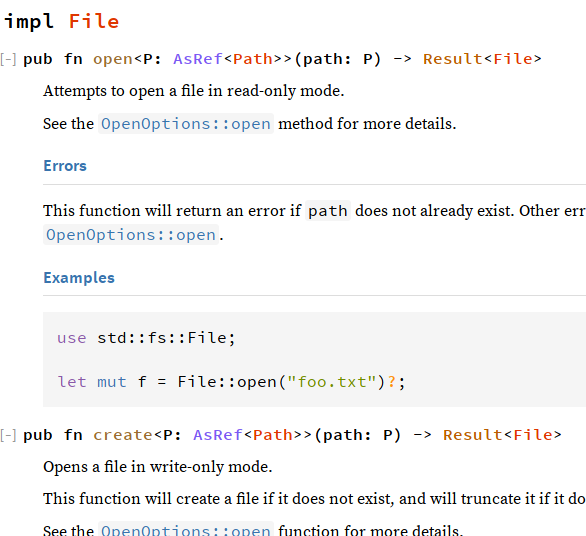
The lookup currently just looks at the top-level type, not looking inside things like Result or Option, which renders the spotlights on Read/Write a little less useful:
<details><summary>`File::{open, create}` don't have spotlight info (pic of old design)</summary>
</details>
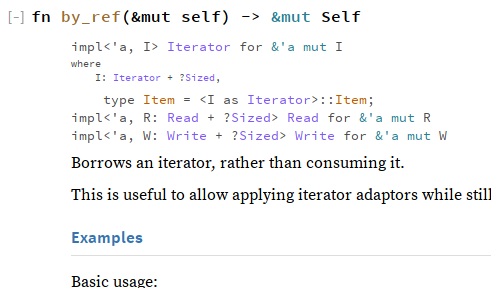
All three of the initially spotlighted traits are generically implemented on `&mut` references. Rustdoc currently treats a `&mut T` reference-to-a-generic as an impl on the reference primitive itself. `&mut Self` counts as a generic in the eyes of rustdoc. All this combines to create this lovely scene on `Iterator::by_ref`:
<details><summary>`Iterator::by_ref` spotlights Iterator, Read, and Write (pic of old design)</summary>
</details>
After this change, impl Trait existentials are
desugared to a new `abstract type` definition
paired with a set of lifetimes to apply.

In-scope generics are included as parents of the
`abstract type` generics. Parent regions are
replaced with static, and parent regions
referenced in the `impl Trait` type are duplicated
at the end of the `abstract type`'s generics.
Replace hir::TyImplTrait with TyImplTraitUniversal and
TyImplTraitExistential.

Add an ImplTraitContext enum to rustc::hir::lowering to track the kind
and allowedness of an impl Trait.

Significantly alter lowering to thread ImplTraitContext and one other
boolean parameter described below throughought much of lowering.

The other parameter is for tracking if lowering a function is in a trait
impl, as there is not enough information to otherwise know this
information during lowering otherwise.

This change also removes the checks from ast_ty_to_ty for impl trait
allowedness as they are now all taking place in HIR lowering.
rustc_driver: expose a way to override query providers in CompileController.

This API has been a long-time coming and will probably become the main method for custom drivers (that is, binaries other than `rustc` itself that use `librustc_driver`) to adapt the compiler's behavior.
rustdoc: add #[allow(unused)] to every doctest
More information in #45750 - this is behavior that was documented but not actually implemented.
I also reordered how outer attributes are applied to doctests. Previously, attributes from `#![doc(test(attr(...)))]` would be applied *after* attributes from within the test itself, meaning if a doctest tried to override lints that would be set crate-wide, it wouldn't work at all. This gives a better scope of how lints can be applied.
Closes#45750
rustdoc: Fix duplicated impls with generics

The same type can appear multiple times in impls so we need to use a set
to avoid adding it multiple times.

Fixes: #45584
Copy all `AsciiExt` methods to the primitive types directly in order to deprecate it later

**EDIT:** [this PR is ready now](https://github.com/rust-lang/rust/pull/44042#issuecomment-333883548). I edited this post to reflect the current status of discussion, which is (apart from code review) pretty much settled.

---

This is my current progress in order to prepare stabilization of #39658. As discussed there (and in #39659), the idea is to deprecated `AsciiExt` and copy all methods to the type directly. Apparently there isn't really a reason to have those methods in an extension trait¹.

~~This is **work in progress**: copy&pasting code while slightly modifying the documentation isn't the most exciting thing to do. Therefore I wanted to already open this WIP PR after doing basically 1/4 of the job (copying methods to `&[u8]`, `char` and `&str` is still missing) to get some feedback before I continue. Some questions possibly worth discussing:~~

1. ~~Does everyone agree that deprecating `AsciiExt` is a good idea? Does everyone agree with the goal of this PR?~~ => apparently yes
2. ~~Are my changes OK so far? Did I do something wrong?~~
3. ~~The issue of the unstable-attribute is currently set to 0. I would wait until you say "Ok" to the whole thing, then create a tracking issue and then insert the correct issue id. Is that ok?~~
4. ~~I tweaked `eq_ignore_ascii_case()`: it now takes the argument `other: u8` instead of `other: &u8`. The latter was enforced by the trait. Since we're not bound to a trait anymore, we can drop the reference, ok?~~ => I reverted this, because the interface has to match the `AsciiExt` interface exactly.

¹ ~~Could it be that we can't write `impl [u8] {}`? This might be the reason for `AsciiExt`. If that is the case: is there a good reason we can't write such an impl block? What can we do instead?~~ => we couldn't at the time this PR was opened, but Simon made it possible.

/cc @SimonSapin @zackw
We don't want to stabilize them now already. The goal of this set of
commits is just to add inherent methods to the four types. Stabilizing
all of those methods can be done later.
Many AsciiExt imports have become useless thanks to the inherent ascii
methods added in the last commits. These were removed. In some places, I
fully specified the ascii method being called to enforce usage of the
AsciiExt trait. Note that some imports are not removed but tagged with
a `#[cfg(stage0)]` attribute. This is necessary, because certain ascii
methods are not yet available in stage0. All those imports will be
removed later.

Additionally, failing tests were fixed. The test suite should exit
successfully now.




