Fix order of implementations in the "implementations on foreign types" section
Fixes#117391.
We forgot to run the `sort_by_cached_key` on this section. This fixes it.
r? `@notriddle`
Clean up unchecked_math, separate out unchecked_shifts

Tracking issue: #85122

Changes:

1. Remove `const_inherent_unchecked_arith` flag and make const-stability flags the same as the method feature flags. Given the number of other unsafe const fns already stabilised, it makes sense to just stabilise these in const context when they're stabilised.
2. Move `unchecked_shl` and `unchecked_shr` into a separate `unchecked_shifts` flag, since the semantics for them are unclear and they'll likely be stabilised separately as a result.
3. Add an `unchecked_neg` method exclusively to signed integers, under the `unchecked_neg` flag. This is because it's a new API and probably needs some time to marinate before it's stabilised, and while it *would* make sense to have a similar version for unsigned integers since `checked_neg` also exists for those there is absolutely no case where that would be a good idea, IMQHO.

The longer-term goal here is to prepare the `unchecked_math` methods for an FCP and stabilisation since they've existed for a while, their semantics are clear, and people seem in favour of stabilising them.
Rollup of 5 pull requests

Successful merges:

 - #113241 (rustdoc: Document lack of object safety on affected traits)
 - #117388 (Turn const_caller_location from a query to a hook)
 - #117417 (Add a stable MIR visitor)
 - #117439 (prepopulate opaque ty storage before using it)
 - #117451 (Add support for pre-unix-epoch file dates on Apple platforms (#108277))

r? `@ghost`
`@rustbot` modify labels: rollup
rustdoc: Document lack of object safety on affected traits
Closes#85138
I saw the issue didn't have any recent activity, if there is another MR for it I missed it.
I want the issue to move forward so here is my proposition.
It takes some space just before the "Implementors" section and only if the trait is **not** object
safe since it is the only case where special care must be taken in some cases and this has the
benefit of avoiding generation of HTML in (I hope) the common case.
Accept less invalid Rust in rustdoc

pulled out of https://github.com/rust-lang/rust/pull/117213 where this change was already approved

This only affects rustdoc, and has up to [20% perf regressions in rustdoc](https://github.com/rust-lang/rust/pull/117213#issuecomment-1785776288). These are unavoidable, as we are simply doing more checks now, but it's part of the longer term plan of making rustdoc more resistant to ICEs by only accepting valid Rust code.
Store #[deprecated] attribute's `since` value in parsed form

This PR implements the first followup bullet listed in https://github.com/rust-lang/rust/pull/117148#issue-1960240108.

We centralize error handling to the attribute parsing code in `compiler/rustc_attr/src/builtin.rs`, and thereby remove some awkward error codepaths from later phases of compilation that had to make sense of these #\[deprecated\] attributes, namely `compiler/rustc_passes/src/stability.rs` and `compiler/rustc_middle/src/middle/stability.rs`.
improve and fix `x install`
Fix: Write access check of `prefix` and `sysconfdir` when DESTDIR is present.
Improvement: Instead of repeatedly reading `DESTDIR` within each `fn prepare_dir` usage, read it once and pass it to the `fn prepare_dir`.
Fixes#117203
rustdoc: elide cross-crate default generic arguments
Elide cross-crate generic arguments if they coincide with their default.
TL;DR: Most notably, no more `Box<…, Global>` in `std`'s docs, just `Box<…>` from now on.
Fixes#80379.
Also helps with #44306. Follow-up to #103885, #107637.
r? ``@ghost``
update which targets we test Miri on

I hope this doesn't cost too much time; running only the "pass" tests should be reasonably fast (1-2 minutes on my system).

Fixes https://github.com/rust-lang/rust/issues/117167
Fix: Write access check of `prefix` and `sysconfdir`
when DESTDIR is present.

Improvement: Instead of repeatedly reading `DESTDIR` within
each `fn prepare_dir` usage, read it once and pass it to
the `fn prepare_dir`.

Signed-off-by: onur-ozkan <work@onurozkan.dev>
By storing the unparsed values in `Config` and then parsing them within
`run_compiler`, the parsing functions can use the main symbol interner,
and not create their own short-lived interners.

This change also eliminates the need for one `EarlyErrorHandler` in
rustdoc, because parsing errors can be reported by another, slightly
later `EarlyErrorHandler`.
pass `CODEGEN_BACKENDS` to docker

The backends to build are now defined in the `CODEGEN_BACKENDS` env var. It's correctly set in CI, but wasn't passed to docker, hence cg_clif wasn't actually built in #81746.

r? `@Kobzol:` I locally tried `CODEGEN_BACKENDS="cranelift" DEPLOY=1 src/ci/docker/run.sh dist-x86_64-linux` and this change was enough for `ci/run.sh` to read the env var.

So I'll try as-is and we'll see.
See through aggregates in GVN

This PR is extracted from https://github.com/rust-lang/rust/pull/111344

The first 2 commit are cleanups to avoid repeated work. I propose to stop removing useless assignments as part of this pass, and let a later `SimplifyLocals` do it. This makes tests easier to read (among others).

The next 3 commits add a constant folding mechanism to the GVN pass, presented in https://github.com/rust-lang/rust/pull/116012. ~This pass is designed to only use global allocations, to avoid any risk of accidental modification of the stored state.~

The following commits implement opportunistic simplifications, in particular:
- projections of aggregates: `MyStruct { x: a }.x` gets replaced by `a`, works with enums too;
- projections of arrays: `[a, b][0]` becomes `a`;
- projections of repeat expressions: `[a; N][x]` becomes `a`;
- transform arrays of equal operands into a repeat rvalue.

Fixes https://github.com/rust-lang/miri/issues/3090

r? `@oli-obk`
rustdoc: Use `ThinVec` in `GenericParamDefKind`

This should hopefully reduce memory usage and improve performance since
these vectors are often empty (and `GenericParamDefKind` is constructed *a lot*).
add bootstrap flag `--skip-stage0-validation`

This change introduces the `--skip-stage0-validation` flag, which permits the use of any desired version of the stage0 compiler without verifying its version.

Additionally, stage0 compiler validation check is reverted(#115103) to its default enabled state.

Helps to #115065

r? Mark-Simulacrum
This should hopefully reduce memory usage and improve performance since
these vectors are often empty (and `GenericParamDefKind` is constructed
*a lot*).
Rollup of 5 pull requests

Successful merges:

 - #115773 (tvOS simulator support on Apple Silicon for rustc)
 - #117162 (Remove `cfg_match` from the prelude)
 - #117311 (-Zunpretty help: add missing possible values)
 - #117316 (Mark constructor of `BinaryHeap` as const fn)
 - #117319 (explain why we don't inline when target features differ)

r? `@ghost`
`@rustbot` modify labels: rollup
change default output mode of `BootstrapCommand`
`SuppressOnSuccess` on `BootstrapCommand` is a problematic default mode as it affects the logs during the bootstrapping (as shown in the screenshot below). The default behavior should be to print everything unless we explicitly modify the behavior within build steps.
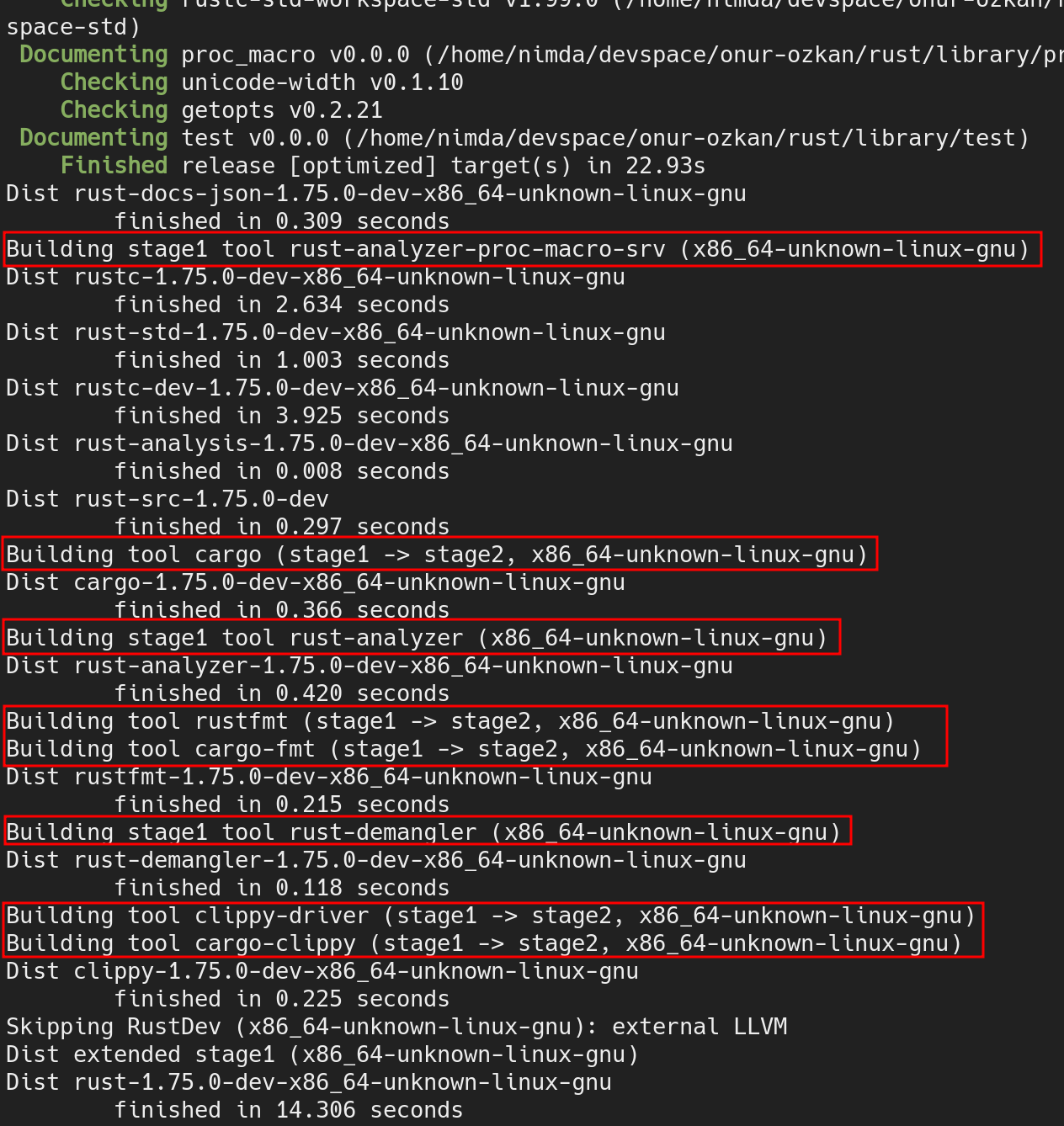
Fixes#117315
cc `@Kobzol`
Add support for i586-unknown-netbsd as target.

This restricts instructions to those offered by Pentium, to support e.g. AMD Geode.

There is already an entry for this target in the NetBSD platform support page at

  src/doc/rustc/src/platform-support/netbsd.md

...so this should forestall its removal.

Additional fixes are needed for some vendored modules, this is the changes in the rust compiler core itself.
tvOS simulator support on Apple Silicon for rustc

Closes or is a subtask of #115692.

# Tier 3 Target Policy

At this tier, the Rust project provides no official support for a target, so we place minimal requirements on the introduction of targets.

> * A tier 3 target must have a designated developer or developers (the "target maintainers") on record to be CCed when issues arise regarding the target. (The mechanism to track and CC such developers may evolve over time.)

See [`src/doc/rustc/src/platform-support/apple-tvos.md`](4ab4d48ee5/src/doc/rustc/src/platform-support/apple-tvos.md)

> * Targets must use naming consistent with any existing targets; for instance, a target for the same CPU or OS as an existing Rust target should use the same name for that CPU or OS. Targets should normally use the same names and naming conventions as used elsewhere in the broader ecosystem beyond Rust (such as in other toolchains), unless they have a very good reason to diverge. Changing the name of a target can be highly disruptive, especially once the target reaches a higher tier, so getting the name right is important even for a tier 3 target.
>     * Target names should not introduce undue confusion or ambiguity unless absolutely necessary to maintain ecosystem compatibility. For example, if the name of the target makes people extremely likely to form incorrect beliefs about what it targets, the name should be changed or augmented to disambiguate it.
>     * If possible, use only letters, numbers, dashes and underscores for the name. Periods (.) are known to cause issues in Cargo.

This naming scheme matches `$ARCH-$VENDOR-$OS-$ABI` (I think `sim` is the ABI here) which is matches the iOS apple silicon simulator (`aarch64-apple-ios-sim`). [There is some discussion about renaming some apple simulator targets](https://github.com/rust-lang/rust/issues/115692#issuecomment-1712931910) to match the `-sim` suffix but that is outside the scope of this PR.

> * Tier 3 targets may have unusual requirements to build or use, but must not create legal issues or impose onerous legal terms for the Rust project or for Rust developers or users.
>
>    * The target must not introduce license incompatibilities.
>    * Anything added to the Rust repository must be under the standard Rust license (MIT OR Apache-2.0).
>    * The target must not cause the Rust tools or libraries built for any other host (even when supporting cross-compilation to the target) to depend on any new dependency less permissive than the Rust licensing policy. This applies whether the dependency is a Rust crate that would require adding new license exceptions (as specified by the tidy tool in the rust-lang/rust repository), or whether the dependency is a native library or binary. In other words, the introduction of the target must not cause a user installing or running a version of Rust or the Rust tools to be subject to any new license requirements.
>    * Compiling, linking, and emitting functional binaries, libraries, or other code for the target (whether hosted on the target itself or cross-compiling from another target) must not depend on proprietary (non-FOSS) libraries. Host tools built for the target itself may depend on the ordinary runtime libraries supplied by the platform and commonly used by other applications built for the target, but those libraries must not be required for code generation for the target; cross-compilation to the target must not require such libraries at all. For instance, rustc built for the target may depend on a common proprietary C runtime library or console output library, but must not depend on a proprietary code generation library or code optimization library. Rust's license permits such combinations, but the Rust project has no interest in maintaining such combinations within the scope of Rust itself, even at tier 3.
>    * "onerous" here is an intentionally subjective term. At a minimum, "onerous" legal/licensing terms include but are not limited to: non-disclosure requirements, non-compete requirements, contributor license agreements (CLAs) or equivalent, "non-commercial"/"research-only"/etc terms, requirements conditional on the employer or employment of any particular Rust developers, revocable terms, any requirements that create liability for the Rust project or its developers or users, or any requirements that adversely affect the livelihood or prospects of the Rust project or its developers or users.

This contribution is fully available under the standard Rust license with no additional legal restrictions whatsoever. This PR does not introduce any new dependency less permissive than the Rust license policy.

The new targets do not depend on proprietary libraries.

> * Tier 3 targets should attempt to implement as much of the standard libraries as possible and appropriate (core for most targets, alloc for targets that can support dynamic memory allocation, std for targets with an operating system or equivalent layer of system-provided functionality), but may leave some code unimplemented (either unavailable or stubbed out as appropriate), whether because the target makes it impossible to implement or challenging to implement. The authors of pull requests are not obligated to avoid calling any portions of the standard library on the basis of a tier 3 target not implementing those portions.

This new target implements as much of the standard library as the other tvOS targets do.

> * The target must provide documentation for the Rust community explaining how to build for the target, using cross-compilation if possible. If the target supports running binaries, or running tests (even if they do not pass), the documentation must explain how to run such binaries or tests for the target, using emulation if possible or dedicated hardware if necessary.

I have added the target to the other tvOS targets in [`src/doc/rustc/src/platform-support/apple-tvos.md`](4ab4d48ee5/src/doc/rustc/src/platform-support/apple-tvos.md)

> * Neither this policy nor any decisions made regarding targets shall create any binding agreement or estoppel by any party. If any member of an approving Rust team serves as one of the maintainers of a target, or has any legal or employment requirement (explicit or implicit) that might affect their decisions regarding a target, they must recuse themselves from any approval decisions regarding the target's tier status, though they may otherwise participate in discussions.
>    * This requirement does not prevent part or all of this policy from being cited in an explicit contract or work agreement (e.g. to implement or maintain support for a target). This requirement exists to ensure that a developer or team responsible for reviewing and approving a target does not face any legal threats or obligations that would prevent them from freely exercising their judgment in such approval, even if such judgment involves subjective matters or goes beyond the letter of these requirements.
> * Tier 3 targets must not impose burden on the authors of pull requests, or other developers in the community, to maintain the target. In particular, do not post comments (automated or manual) on a PR that derail or suggest a block on the PR based on a tier 3 target. Do not send automated messages or notifications (via any medium, including via ``@)`` to a PR author or others involved with a PR regarding a tier 3 target, unless they have opted into such messages.
>    * Backlinks such as those generated by the issue/PR tracker when linking to an issue or PR are not considered a violation of this policy, within reason. However, such messages (even on a separate repository) must not generate notifications to anyone involved with a PR who has not requested such notifications.
> * Patches adding or updating tier 3 targets must not break any existing tier 2 or tier 1 target, and must not knowingly break another tier 3 target without approval of either the compiler team or the maintainers of the other tier 3 target.
>    * In particular, this may come up when working on closely related targets, such as variations of the same architecture with different features. Avoid introducing unconditional uses of features that another variation of the target may not have; use conditional compilation or runtime detection, as appropriate, to let each target run code supported by that target.

I acknowledge these requirements and intend to ensure that they are met.

This target does not touch any existing tier 2 or tier 1 targets and should not break any other targets.


