When rustdoc lints were changed to be tool lints, the `rustdoc` group
was removed, leading to spurious warnings like

```
warning: unknown lint: `rustdoc`
```

The lint group still worked when rustdoc ran, since rustdoc added the group itself.

This renames the group to `rustdoc::all` for consistency with
`clippy::all` and the rest of the rustdoc lints.
Shorten html::render

The `mod.rs` for librustdoc's `html::render` was over 3,000 lines. This PR reduces it to around 2,300 by
1. Moving `Context` and associated `impl`s to a separate file
2. Moving the `print_item` function and its helpers to a separate file
3. Moving `write_shared` and `write_minify` to their own file

Related to issue #60302.
Edit 1: `SharedContext` and related `impl`s is only 72 lines and so will not be moved.
Pass `CrateNum` by value instead of by reference

It's more idiomatic to pass a small Copy type by value and `CrateNum` is
half the size of `&CrateNum` on 64-bit systems. The memory use change is
almost certainly insignificant, but why not!
Improve page load performance in rustdoc

Add an explicit height to icons (which already had an explicit width) to allow browsers to lay out the page more accurately before the icons have been loaded. https://web.dev/optimize-cls/.

Add min-width: 115px to the crate search dropdown. When the HTML first loads, this dropdown includes only the text "All crates." Later, JS loads the items underneath it, some of which are wider. That causes the dropdown to get wider, causing a distracting reflow. This sets a min-width based on the size that the dropdown eventually becomes based on the crates on doc.rust-lang.org, reducing page movement during load.

Add font-display: swap. Per https://web.dev/font-display/, this prevents "flash of invisible text" during load by using a system font until the custom font is available. I've noticed this flash of invisible text occasionally when reading Rust docs. Note that users without cached fonts will see text, and then see it reflow. For `docs.rust-lang.org`, [setting caching headers will help a lot](https://github.com/rust-lang/simpleinfra/issues/62).

Generated output at https://jacob.hoffman-andrews.com/rust/flow-improvements/std/string/struct.String.html.
It's more idiomatic to pass a small Copy type by value and `CrateNum` is
half the size of `&CrateNum` on 64-bit systems. The memory use change is
almost certainly insignificant, but why not!
On most platforms and browsers, `sans-serif` is equivalent to Arial.
However, on Firefox on Ubuntu (and possibly other Linuxes), `sans-serif`
is DejaVu Sans, a much wider font. This creates a larger shift in text
when the custom fonts finally load. Arial is a web-safe font, and
specifying it explicitly gives us more cross-platform consistency, as
well as reducing the layout shift that happens when fonts load.
Add font-display: swap. Per https://web.dev/font-display/, this prevents
"flash of invisible text" during load by using a system font until the
custom font is available. I've noticed this flash of invisible text
occasionally when reading Rust docs.

Add an explicit height to icons (which already had an explicit width)
to allow browsers to lay out the page more accurately before the icons
have been loaded. https://web.dev/optimize-cls/.

Add min-width: 115px to the crate search dropdown. When the HTML first
loads, this dropdown includes only the text "All crates." Later, JS
loads the items underneath it, some of which are wider. That causes
the dropdown to get wider, causing a distracting reflow. This sets a
min-width based on the size that the dropdown eventually becomes based
on the crates on doc.rust-lang.org, reducing page movement during load.
Instead of being loaded on every page, the JS search index is now
loaded when either (a) there is a `?search=` param, or (b) the search
input is focused.

This saves both CPU and bandwidth. As of Feb 2021,
https://doc.rust-lang.org/search-index1.50.0.js is 273,838 bytes
gzipped or 2,544,939 bytes uncompressed. Evaluating it takes 445 ms
of CPU time in Chrome 88 on a i7-10710U CPU (out of a total ~2,100
ms page reload).

Generate separate JS file with crate names.

This is much smaller than the full search index, and is used in the "hot
path" to draw the page. In particular it's used to crate the dropdown
for the search bar, and to append a list of crates to the sidebar (on
some pages).

Skip early search that can bypass 500ms timeout.

This was occurring when someone had typed some text during the load of
search-index.js. Their query was usually not ready to execute, and the
search itself is fairly expensive, delaying the overall load, which
delayed the input / keyup events, which delayed eventually executing the
query.
- Move MISSING_CRATE_LEVEL_DOCS to rustdoc directly
- Update documentation

This also takes the opportunity to make the `no-crate-level-doc-lint`
test more specific.
- Use `register_renamed` when rustdoc is running so the lint will still
  be active and use a structured suggestion
- Test the behavior for rustc, not just for rustdoc (because it differs)
- Rename `broken_intra_doc_links` to `rustdoc::broken_intra_doc_links`
- Ensure that the old lint names still work and give deprecation errors
- Register lints even when running doctests

  Otherwise, all `rustdoc::` lints would be ignored.

- Register all existing lints as removed

  This unfortunately doesn't work with `register_renamed` because tool
  lints have not yet been registered when rustc is running. For similar
  reasons, `check_backwards_compat` doesn't work either. Call
  `register_removed` directly instead.

- Fix fallout

  + Rustdoc lints for compiler/
  + Rustdoc lints for library/

Note that this does *not* suggest `rustdoc::broken_intra_doc_links` for
`rustdoc::intra_doc_link_resolution_failure`, since there was no time
when the latter was valid.
Remove the dummy cache in `DocContext`; delete RenderInfo

The same information is available everywhere; the only reason the dummy
cache was needed is because it was previously stored in three different
places. This consolidates the info a bit so the cache in `DocContext` is
used throughout. As a bonus, it also completely removes `RenderInfo`.

- Return a `Cache` from `run_global_ctxt`, not `RenderInfo`
- Remove the unused `render_info` from `run_renderer`
- Remove RenderInfo altogether

Helps with https://github.com/rust-lang/rust/pull/82014. The next step is to move the `populate()` call before the `collect_intra_doc_links` pass, which currently breaks because a) lots of the cache is populated in early passes, and b) intra_doc_links itself sets some info with `register_res`. I'm working on separate PR for that to avoid making too many big changes at once.

r? `@GuillaumeGomez`
Always compile rustdoc with debug logging enabled when `download-rustc` is set

Previously, logging at DEBUG or below would always be silenced, because
rustc compiles tracing with the `static_max_level_info` feature. That
makes sense for release artifacts, but not for developing rustdoc.

Instead, this compiles two different versions of tracing: one in the
release artifacts, distributed in the sysroot, and a new version
compiled by rustdoc. Since `rustc_driver` is always linked to the
version of sysroot, this copy/pastes `init_env_logging` into rustdoc.

To avoid compiling an unnecessary version of tracing when
`download-rustc` isn't set, this adds a new `using-ci-artifacts`
feature for rustdoc and passes that feature in bootstrap.

Addresses https://github.com/rust-lang/rust/issues/81930. This builds on https://github.com/rust-lang/rust/pull/79540.

r? `@Mark-Simulacrum`
Previously, `JsonRenderer::after_krate` called `krate.version.clone()`.
The problem was it did that after the version was already moved into the
cache, so it would always be None. The fix was to get the version from
the cache instead.
The same information is available everywhere; the only reason the dummy
cache was needed is because it waas previously stored in three different
places. This consolidates the info a bit so the cache in `DocContext` is
used throughout. As a bonus, it means `renderinfo` is used much much
less.

- Return a `Cache` from `run_global_ctxt`, not `RenderInfo`
- Remove the unused `render_info` from `run_renderer`
- Remove RefCell around `inlined`
- Add intra-doc links
Previously, logging at DEBUG or below would always be silenced, because
rustc compiles tracing with the `static_max_level_info` feature. That
makes sense for release artifacts, but not for developing rustdoc.

Instead, this compiles two different versions of tracing: one in the
release artifacts, distributed in the sysroot, and a new version
compiled by rustdoc. Since `rustc_driver` is always linked to the
version of sysroot, this copy/pastes `init_env_logging` into rustdoc.

The builds the second version of tracing unconditionally; see the code
for details on why.
Remove unnecessary `self_ty` parameter to `get_blanket_impls`

It can be calculated when necessary at the callsite, there's no need to
pass it separately.

This also renames `param_env_def_id` to `item_def_id`.

cc `@eddyb`
Remove the x86_64-rumprun-netbsd target
Herein we remove the target from the compiler and the code from libstd intended to support the now-defunct rumprun project.
Closes#81514
Add ARIA role to sidebar toggle in Rustdoc
This indicates that the div is an interactive element, and makes the sidebar toggle "clickable" in assistive technologies.
Example of Vimium after this change has been applied (see the issue mentioned below for a screenshot of before):
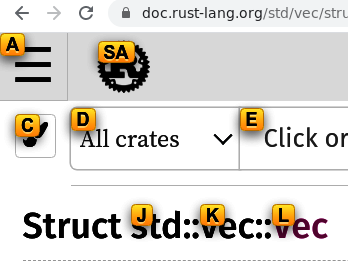
Fixes#82582
Revert "Update normalize.css to 8.0.1"
Reverts rust-lang/rust#82313
Fixes#82548Fixes#82542
``@jsha:`` I'm reverting until we can come up with a new version which is fully working.
r? ``@jyn514``


