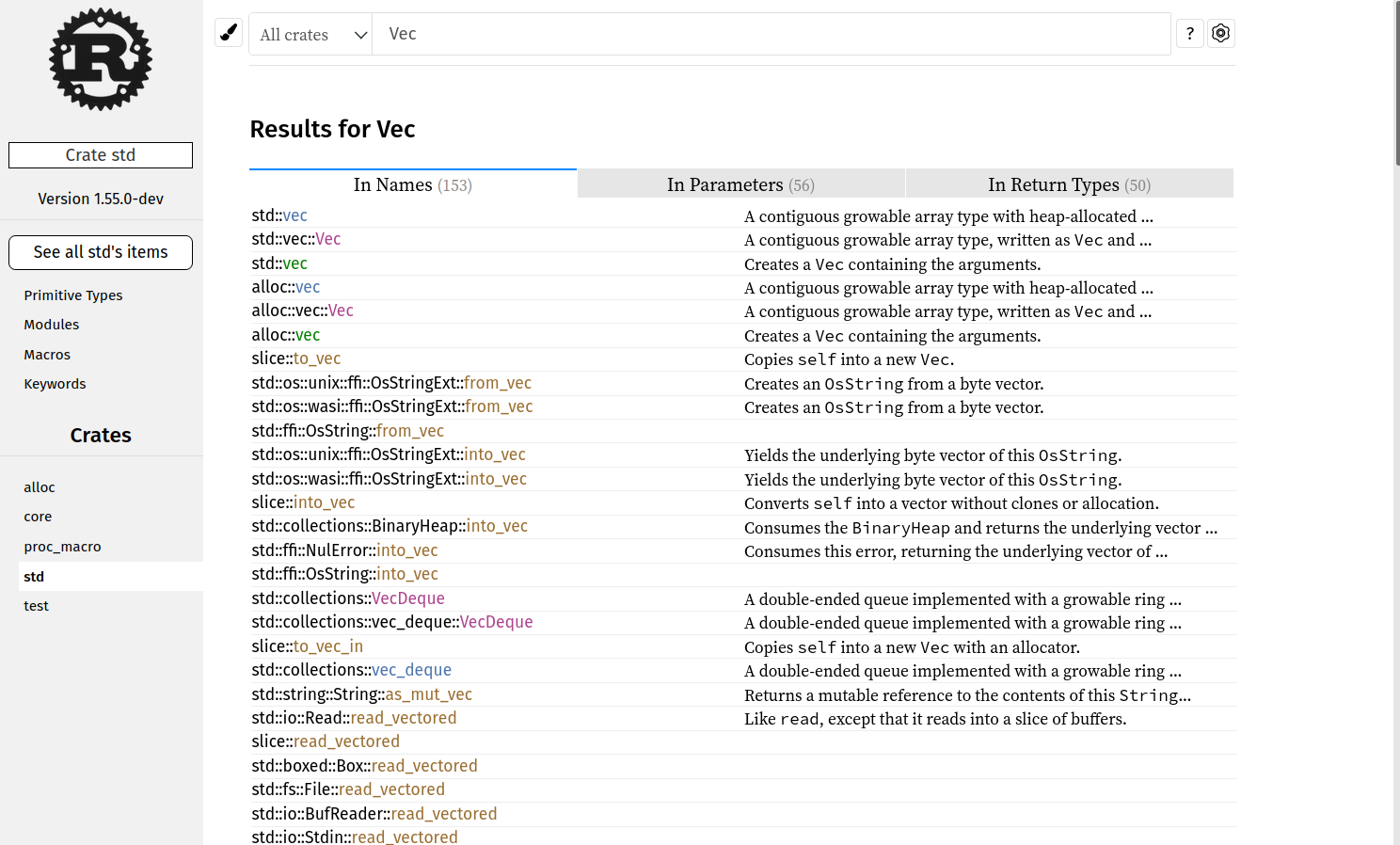
Fix table in docblocks
"Overwrite" of #88702.
Instead of adding a z-index to the sidebar (which only hides the issue, doesn't fix it), I wrap `<table>` elements inside a `<div>` and limit all chidren of `.docblock` elements' width to prevent having the scrollbar on the whole doc block.

Thanks `@nbdd0121` for `overflow-x: auto;`. ;)
r? `@notriddle`
`rustdoc`: compute correct line number for indented rust code blocks.

This PR fixes a bug in `rustdoc` where it computes the wrong line number for indented rust code blocks (and subsequent blocks) it finds in markdown strings. To fix this issue, we decrement the line number if we find characters between the code block and the preceding line ending. I noticed this issue as I was trying to use `rustdoc` to extract examples from The Rust Reference and run them through the [Rust Model Checker](https://github.com/model-checking/rmc).
It was accidentally changed to use `opts()` in #86451.

I also renamed `opts()` to `main_body_opts()` to make this kind of
accidental change less likely.
Refactor Markdown length-limited summary implementation

This PR is a new approach to #79749.

This PR refactors the implementation of `markdown_summary_with_limit()`,
separating the logic of determining when the limit has been reached from
the actual rendering process.

The main advantage of the new approach is that it guarantees that all
HTML tags are closed, whereas the previous implementation could generate
tags that were never closed. It also ensures that no empty tags are
generated (e.g., `<em></em>`).

The new implementation consists of a general-purpose struct
`HtmlWithLimit` that manages the length-limiting logic and a function
`markdown_summary_with_limit()` that renders Markdown to HTML using the
struct.

r? `@GuillaumeGomez`
This commit refactors the implementation of
`markdown_summary_with_limit()`, separating the logic of determining
when the limit has been reached from the actual rendering process.

The main advantage of the new approach is that it guarantees that all
HTML tags are closed, whereas the previous implementation could generate
tags that were never closed. It also ensures that no empty tags are
generated (e.g., `<em></em>`).

The new implementation consists of a general-purpose struct
`HtmlWithLimit` that manages the length-limiting logic and a function
`markdown_summary_with_limit()` that renders Markdown to HTML using the
struct.
I noticed that `Pin::new()`'s search summary looked off, and I realized
that the reason is that it has inline code containing `Pin<P>`, which is
not escaped and thus renders as a paragraph tag!
In rustdoc's main.js, we had an onclick handler for the whole document
that would dispatch to handlers for various elements. This change
attaches the handlers to the elements that trigger them, instead.
This simplfies the code and avoids reimplementing the browser's bubbling
functionality.

As part of this change, change from a class to an id for help button.

Move the handlers and associated code for highlighting source lines into
source-script.js (and factor out a shared regex).
There was no need to clone `id_map` because it was reset before each
item was rendered. `deref_id_map` was not reset, but it was keyed by
`DefId` and thus was unlikely to have collisions (at least for now).

Now we just clone the fields that need to be cloned, and instead create
fresh versions of the others.
- Rename `broken_intra_doc_links` to `rustdoc::broken_intra_doc_links`
- Ensure that the old lint names still work and give deprecation errors
- Register lints even when running doctests

  Otherwise, all `rustdoc::` lints would be ignored.

- Register all existing lints as removed

  This unfortunately doesn't work with `register_renamed` because tool
  lints have not yet been registered when rustc is running. For similar
  reasons, `check_backwards_compat` doesn't work either. Call
  `register_removed` directly instead.

- Fix fallout

  + Rustdoc lints for compiler/
  + Rustdoc lints for library/

Note that this does *not* suggest `rustdoc::broken_intra_doc_links` for
`rustdoc::intra_doc_link_resolution_failure`, since there was no time
when the latter was valid.
[librustdoc] Only split lang string on `,`, ` `, and `\t`

Split markdown lang strings into tokens on `,`.

The previous behavior was to split lang strings into tokens on any
character that wasn't a `_`, `_`, or alphanumeric.

This is a potentially breaking change, so please scrutinize! See discussion in #78344.

I noticed some test cases that made me wonder if there might have been some reason for the original behavior:

```
t("{.no_run .example}", false, true, Ignore::None, true, false, false, false, v(), None);
t("{.sh .should_panic}", true, false, Ignore::None, false, false, false, false, v(), None);
t("{.example .rust}", false, false, Ignore::None, true, false, false, false, v(), None);
t("{.test_harness .rust}", false, false, Ignore::None, true, true, false, false, v(), None);
```

It seemed pretty peculiar to specifically test lang strings in braces, with all the tokens prefixed by `.`.

I did some digging, and it looks like the test cases were added way back in [this commit from 2014](3fef7a74ca) by `@skade.`

It looks like they were added just to make sure that the splitting was permissive, and aren't testing that those strings in particular are accepted.

Closes https://github.com/rust-lang/rust/issues/78344.
Before:

    The Rust Standard LibraryThe Rust Standard Library is the foundation of portable Rust software, a set of minimal and battle-tested shared abstractions for the broader Rust ecosystem. It offers core types, like `Vec<T>` and `Option<T>`, library-defined operations on language primitives, standard macros, I/O and multithreading, among many other things.

After:

    The Rust Standard Library
Only split doctest lang strings on `,`, ` `, and `\t`. Additionally, to
preserve backwards compatibility with pandoc-style langstrings, strip a
surrounding `{}`, and remove leading `.`s from each token.

Prior to this change, doctest lang strings were split on all
non-alphanumeric characters except `-` or `_`, which limited future
extensions to doctest lang string tokens, for example using `=` for
key-value tokens.

This is a breaking change, although it is not expected to be disruptive,
because lang strings using separators other than `,` and ` ` are not
very common