Add test for #44953
Added the requested test - trying to see if it passes; my local build fails, but not sure why - the nightly shows this output, but in my build the compilation error changed.
Fixes#44953.
typeck aggregate rvalues in MIR type checker

This branch is an attempt to land content by @spastorino and @Nashenas88 that was initially landed on nll-master while we waited for https://github.com/rust-lang/rust/pull/45825 to land.

The biggest change it contains is that it extends the MIR type-checker to also type-check MIR aggregate rvalues (at least partially). Specifically, it checks that the operands provided for each field have the right type.

It does not yet check that their well-formedness predicates are met. That is https://github.com/rust-lang/rust/issues/45827. It also does not check other kinds of rvalues (that is https://github.com/rust-lang/rust/issues/45959). @spastorino is working on those issues now.

r? @arielb1
Implement in-band lifetime bindings
TODO (perhaps in a future PR): Should we ban explicit instantiation of generics with in-band lifetimes, or is it uncontroversial to just append them to the end of the lifetimes list?
Fixes#46042, cc #44524.
r? @nikomatsakis
Use the proper term when using non-existing variant
When using a non-existing variant, function or associated item, refer to
the proper term, instead of defaulting to "associated item" in
diagnostics.
Fix#28972.
```
error[E0599]: no variant named `Quux` found for type `Foo` in the current scope
--> file.rs:7:9
|
7 | Foo::Quux(..) =>(),
| ^^^^^^^^^^^^^
```
I also added some comments explaining what is going on. In short, the
changes in question do not, in fact, affect the`TypeckTables` in any
semantic way. However, altering the order of lowering can cause it
appear to affect the `TypeckTables`: if we lower generics before the
body, then the `HirId` for things in the body will be affected. In
this case, we are now lowering the generics etc
*after* the body, so the hash no longer changes. This seems good.
Prevent fmt::Arguments from being shared across threads
Fixes#45197
This is a **breaking change**! Without doing this it's very easy to create race conditions.
There's probably a way to do this without breaking valid use cases, but it would require quite an overhaul of the formatting machinery.
rustdoc: include external files in documentation (RFC 1990)
Part of https://github.com/rust-lang/rfcs/pull/1990 (needs work on the error reporting, which i'm deferring to after this initial PR)
cc #44732
Also fixes#42760, because the prep work for the error reporting made it easy to fix that at the same time.
MIR-borrowck: Some minor fixes
- Remove parens when printing dereference (fix#45185)
- Change argument type of `autoderef` to `bool`
- Change argument type of `field_index` to `Field`
move closure kind, signature into `ClosureSubsts`

Instead of using side-tables, store the closure-kind and signature in the substitutions themselves. This has two key effects:

- It means that the closure's type changes as inference finds out more things, which is very nice.
    - As a result, it avoids the need for the `freshen_closure_like` code (though we still use it for generators).
- It avoids cyclic closures calls.
    - These were never meant to be supported, precisely because they make a lot of the fancy inference that we do much more complicated. However, due to an oversight, it was previously possible -- if challenging -- to create a setup where a closure *directly* called itself (see e.g. #21410).

We have to see what the effect of this change is, though. Needs a crater run. Marking as [WIP] until that has been assessed.

r? @arielb1
clean the Debug impl for CrateNum and DefId

Just a tiny quality-of-life improvement because I got tired of noisy debug logs.

```
before: DefId { krate: CrateNum(11), index: DefIndex(0:6) => foo[8787]::Mapper[0]::OtherType[0] } }
after: {crate11:0:6 ~ foo[8787]::Mapper[0]::OtherType[0]})
```

r? @michaelwoerister
dead code lint to say "never constructed" for variants
As reported in #19140, #44083, and #44565, some users were confused when
the dead-code lint reported an enum variant to be "unused" when it was
matched on (but not constructed). This wording change makes it clearer
that the lint is in fact checking for construction.
We continue to say "used" for all other items (it's tempting to say
"called" for functions and methods, but this turns out not to be
correct: functions can be passed as arguments and the dead-code lint
isn't special-casing that or anything).
Resolves#19140.
r? @pnkfelix
update let-expressions hash test to use `except`

A part of #44924, this PR updated let-expressions test using `except`.

cc @michaelwoerister
r? @nikomatsakis
impl Trait Lifetime Handling
This PR implements the updated strategy for handling `impl Trait` lifetimes, as described in [RFC 1951](https://github.com/rust-lang/rfcs/blob/master/text/1951-expand-impl-trait.md) (cc #42183).
With this PR, the `impl Trait` desugaring works as follows:
```rust
fn foo<T, 'a, 'b, 'c>(...) -> impl Foo<'a, 'b> { ... }
// desugars to
exists type MyFoo<ParentT, 'parent_a, 'parent_b, 'parent_c, 'a, 'b>: Foo<'a, 'b>;
fn foo<T, 'a, 'b, 'c>(...) -> MyFoo<T, 'static, 'static, 'static, 'a, 'b> { ... }
```
All of the in-scope (parent) generics are listed as parent generics of the anonymous type, with parent regions being replaced by `'static`. Parent regions referenced in the `impl Trait` return type are duplicated into the anonymous type's generics and mapped appropriately.
One case came up that wasn't specified in the RFC: it's possible to write a return type that contains multiple regions, neither of which outlives the other. In that case, it's not clear what the required lifetime of the output type should be, so we generate an error.
There's one remaining FIXME in one of the tests: `-> impl Foo<'a, 'b> + 'c` should be able to outlive both `'a` and `'b`, but not `'c`. Currently, it can't outlive any of them. @nikomatsakis and I have discussed this, and there are some complex interactions here if we ever allow `impl<'a, 'b> SomeTrait for AnonType<'a, 'b> { ... }`, so the plan is to hold off on this until we've got a better idea of what the interactions are here.
cc #34511.
Fixes#44727.
show macro backtrace with -Z flag
Fixes#39413 by adding a facility to restore the "old school" macro expansion backtraces (previously removed in 61865384b8).
The restored functionality is accessed through the flag `-Z external-macro-backtrace`. Errors showing the truncated backtraces will suggest this flag.
### Example
Code: <details>
`a/src/lib.rs`
```rust
#[macro_export]
macro_rules! a {
() => { a!(@) };
(@) => { a!(@@) };
(@@) => {
syntax error;
}
}
```
`b/src/main.rs`
```rust
#[macro_use] extern crate a;
macro_rules! b {
() => { b!(@) };
(@) => { b!(@@) };
(@@) => {
syntax error;
}
}
fn main() {
a!();
b!();
}
```
</details>
<br/><br/>
Running without env var (note: first error is from remote macro, second from local macro):
<details>
```
$ cargo +custom run
Compiling b v0.1.0
error: expected one of `!`, `.`, `::`, `;`, `?`, `{`, `}`, or an operator, found `error`
--> src/main.rs:12:5
|
12 | a!();
| ^^^^^
| |
| expected one of 8 possible tokens here
| unexpected token
|
= note: this error originates in a macro outside of the current crate (run with RUST_MACRO_BACKTRACE=1 for more info)
error: expected one of `!`, `.`, `::`, `;`, `?`, `{`, `}`, or an operator, found `error`
--> src/main.rs:7:16
|
7 | syntax error;
| -^^^^^ unexpected token
| |
| expected one of 8 possible tokens here
...
13 | b!();
| ----- in this macro invocation
error: aborting due to 2 previous errors
error: Could not compile `b`.
To learn more, run the command again with --verbose.
```
</details>
The output is the same as today, except for an addition to the note which aids discoverability of the new environment variable.
<br/><br/>
Running _with_ env var:
<details>
```
$ RUST_MACRO_BACKTRACE=1 cargo +custom run
Compiling b v0.1.0
error: expected one of `!`, `.`, `::`, `;`, `?`, `{`, `}`, or an operator, found `error`
--> <a macros>:1:72
|
1 | ( ) => { a ! ( @ ) } ; ( @ ) => { a ! ( @ @ ) } ; ( @ @ ) => { syntax error ;
| -^^^^^ unexpected token
| |
| expected one of 8 possible tokens here
src/main.rs:12:5: 12:10 note: in this expansion of a! (defined in <a macros>)
<a macros>:1:11: 1:20 note: in this expansion of a! (defined in <a macros>)
<a macros>:1:36: 1:47 note: in this expansion of a! (defined in <a macros>)
error: expected one of `!`, `.`, `::`, `;`, `?`, `{`, `}`, or an operator, found `error`
--> src/main.rs:7:16
|
7 | syntax error;
| -^^^^^ unexpected token
| |
| expected one of 8 possible tokens here
src/main.rs:12:5: 12:10 note: in this expansion of a! (defined in <a macros>)
<a macros>:1:11: 1:20 note: in this expansion of a! (defined in <a macros>)
<a macros>:1:36: 1:47 note: in this expansion of a! (defined in <a macros>)
error: expected one of `!`, `.`, `::`, `;`, `?`, `{`, `}`, or an operator, found `error`
--> src/main.rs:7:16
|
7 | syntax error;
| -^^^^^ unexpected token
| |
| expected one of 8 possible tokens here
src/main.rs:13:5: 13:10 note: in this expansion of b! (defined in src/main.rs)
src/main.rs:4:13: 4:18 note: in this expansion of b! (defined in src/main.rs)
src/main.rs:5:14: 5:20 note: in this expansion of b! (defined in src/main.rs)
error: aborting due to 2 previous errors
error: Could not compile `b`.
To learn more, run the command again with --verbose.
```
</details>
The output is hard to read, but better than nothing (and it's exactly what we used to have before the infamous `fix_multispans_in_std_macros`).
<br/><br/>
Wishlist:
- Save the actual source of macros in crate metadata, not just AST, so the output can be improved
- Hopefully this would allow line numbers in the trace as well
- Show the actual macro invocations in the traces
r? @nrc
show in docs whether the return type of a function impls Iterator/Read/Write
Closes#25928
This PR makes it so that when rustdoc documents a function, it checks the return type to see whether it implements a handful of specific traits. If so, it will print the impl and any associated types. Rather than doing this via a whitelist within rustdoc, i chose to do this by a new `#[doc]` attribute parameter, so things like `Future` could tap into this if desired.
### Known shortcomings
~~The printing of impls currently uses the `where` class over the whole thing to shrink the font size relative to the function definition itself. Naturally, when the impl has a where clause of its own, it gets shrunken even further:~~ (This is no longer a problem because the design changed and rendered this concern moot.)
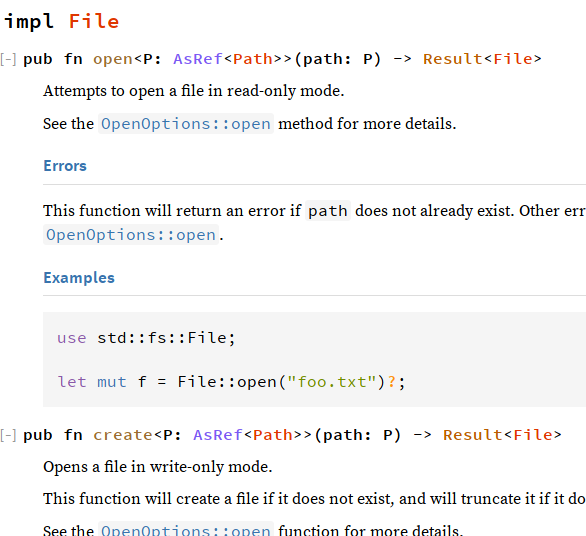
The lookup currently just looks at the top-level type, not looking inside things like Result or Option, which renders the spotlights on Read/Write a little less useful:
<details><summary>`File::{open, create}` don't have spotlight info (pic of old design)</summary>
</details>
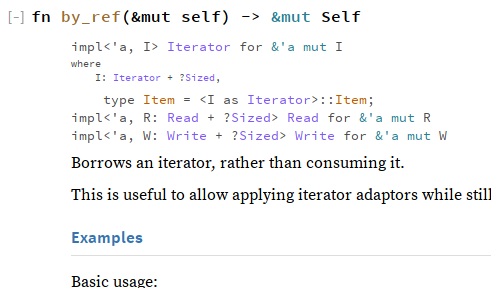
All three of the initially spotlighted traits are generically implemented on `&mut` references. Rustdoc currently treats a `&mut T` reference-to-a-generic as an impl on the reference primitive itself. `&mut Self` counts as a generic in the eyes of rustdoc. All this combines to create this lovely scene on `Iterator::by_ref`:
<details><summary>`Iterator::by_ref` spotlights Iterator, Read, and Write (pic of old design)</summary>
</details>
std: Add a new wasm32-unknown-unknown target

This commit adds a new target to the compiler: wasm32-unknown-unknown. This target is a reimagining of what it looks like to generate WebAssembly code from Rust. Instead of using Emscripten which can bring with it a weighty runtime this instead is a target which uses only the LLVM backend for WebAssembly and a "custom linker" for now which will hopefully one day be direct calls to lld.

Notable features of this target include:

* There is zero runtime footprint. The target assumes nothing exists other than the wasm32 instruction set.
* There is zero toolchain footprint beyond adding the target. No custom linker is needed, rustc contains everything.
* Very small wasm modules can be generated directly from Rust code using this target.
* Most of the standard library is stubbed out to return an error, but anything related to allocation works (aka `HashMap`, `Vec`, etc).
* Naturally, any `#[no_std]` crate should be 100% compatible with this new target.

This target is currently somewhat janky due to how linking works. The "linking" is currently unconditional whole program LTO (aka LLVM is being used as a linker). Naturally that means compiling programs is pretty slow! Eventually though this target should have a linker.

This target is also intended to be quite experimental. I'm hoping that this can act as a catalyst for further experimentation in Rust with WebAssembly. Breaking changes are very likely to land to this target, so it's not recommended to rely on it in any critical capacity yet. We'll let you know when it's "production ready".

### Building yourself

First you'll need to configure the build of LLVM and enable this target

```
$ ./configure --target=wasm32-unknown-unknown --set llvm.experimental-targets=WebAssembly
```

Next you'll want to remove any previously compiled LLVM as it needs to be rebuilt with WebAssembly support. You can do that with:

```
$ rm -rf build
```

And then you're good to go! A `./x.py build` should give you a rustc with the appropriate libstd target.

### Test support

Currently testing-wise this target is looking pretty good but isn't complete. I've got almost the entire `run-pass` test suite working with this target (lots of tests ignored, but many passing as well). The `core` test suite is [still getting LLVM bugs fixed](https://reviews.llvm.org/D39866) to get that working and will take some time. Relatively simple programs all seem to work though!

In general I've only tested this with a local fork that makes use of LLVM 5 rather than our current LLVM 4 on master. The LLVM 4 WebAssembly backend AFAIK isn't broken per se but is likely missing bug fixes available on LLVM 5. I'm hoping though that we can decouple the LLVM 5 upgrade and adding this wasm target!

### But the modules generated are huge!

It's worth nothing that you may not immediately see the "smallest possible wasm module" for the input you feed to rustc. For various reasons it's very difficult to get rid of the final "bloat" in vanilla rustc (again, a real linker should fix all this). For now what you'll have to do is:

    cargo install --git https://github.com/alexcrichton/wasm-gc
    wasm-gc foo.wasm bar.wasm

And then `bar.wasm` should be the smallest we can get it!

---

In any case for now I'd love feedback on this, particularly on the various integration points if you've got better ideas of how to approach them!
This commit adds a new target to the compiler: wasm32-unknown-unknown. This
target is a reimagining of what it looks like to generate WebAssembly code from
Rust. Instead of using Emscripten which can bring with it a weighty runtime this
instead is a target which uses only the LLVM backend for WebAssembly and a
"custom linker" for now which will hopefully one day be direct calls to lld.

Notable features of this target include:

* There is zero runtime footprint. The target assumes nothing exists other than
  the wasm32 instruction set.
* There is zero toolchain footprint beyond adding the target. No custom linker
  is needed, rustc contains everything.
* Very small wasm modules can be generated directly from Rust code using this
  target.
* Most of the standard library is stubbed out to return an error, but anything
  related to allocation works (aka `HashMap`, `Vec`, etc).
* Naturally, any `#[no_std]` crate should be 100% compatible with this new
  target.

This target is currently somewhat janky due to how linking works. The "linking"
is currently unconditional whole program LTO (aka LLVM is being used as a
linker). Naturally that means compiling programs is pretty slow! Eventually
though this target should have a linker.

This target is also intended to be quite experimental. I'm hoping that this can
act as a catalyst for further experimentation in Rust with WebAssembly. Breaking
changes are very likely to land to this target, so it's not recommended to rely
on it in any critical capacity yet. We'll let you know when it's "production
ready".

---

Currently testing-wise this target is looking pretty good but isn't complete.
I've got almost the entire `run-pass` test suite working with this target (lots
of tests ignored, but many passing as well). The `core` test suite is still
getting LLVM bugs fixed to get that working and will take some time. Relatively
simple programs all seem to work though!

---

It's worth nothing that you may not immediately see the "smallest possible wasm
module" for the input you feed to rustc. For various reasons it's very difficult
to get rid of the final "bloat" in vanilla rustc (again, a real linker should
fix all this). For now what you'll have to do is:

    cargo install --git https://github.com/alexcrichton/wasm-gc
    wasm-gc foo.wasm bar.wasm

And then `bar.wasm` should be the smallest we can get it!

---

In any case for now I'd love feedback on this, particularly on the various
integration points if you've got better ideas of how to approach them!



