Make useless_ptr_null_checks smarter about some std functions
This teaches the `useless_ptr_null_checks` lint that some std functions can't ever return null pointers, because they need to point to valid data, get references as input, etc.
This is achieved by introducing an `#[rustc_never_returns_null_ptr]` attribute and adding it to these std functions (gated behind bootstrap `cfg_attr`).
Later on, the attribute could maybe be used to tell LLVM that the returned pointer is never null. I don't expect much impact of that though, as the functions are pretty shallow and usually the input data is already never null.
Follow-up of PR #113657Fixes#114442
Add alignment to the NPO guarantee
This PR [changes](https://github.com/rust-lang/rust/pull/114845#discussion_r1294363357) "same size" to "same size and alignment" in the option module's null pointer optimization docs in <https://doc.rust-lang.org/std/option/#representation>.
As far as I know, this has been true for a long time in the actual rustc implementation, but it's not in the text of those docs, so I figured I'd bring this up to FCP it.
I also see no particular reason that we'd ever *want* to have higher alignment on these. In many of the cases it's impossible, as the minimum alignment is already the size of the type, but even if we *could* do things like on 32-bit we could say that `NonZeroU64` is 4-align but `Option<NonZeroU64>` is 8-align, I just don't see any value in doing that, so feel completely fine closing this door for the few things on which the NPO is already guaranteed. These are basically all primitives, and should end up with the same size & alignment as those primitives.
(There's no layout guarantee for something like `Option<[u8; 3]>`, where it'd be at least plausible to consider raising the alignment from 1 to 4 on, say, some hypothetical target that doesn't have efficient unaligned 4-byte load/stores. And even if we ever did start to offer some kind of guarantee around such a type, I doubt we'd put it under the "null pointer" optimization header.)
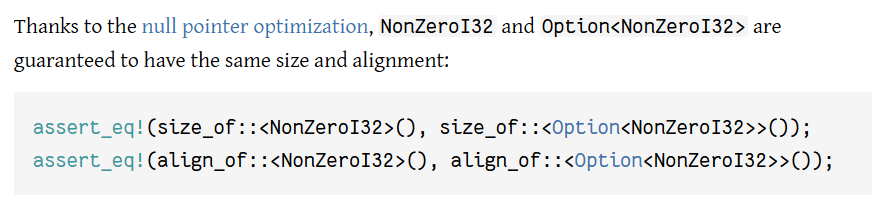
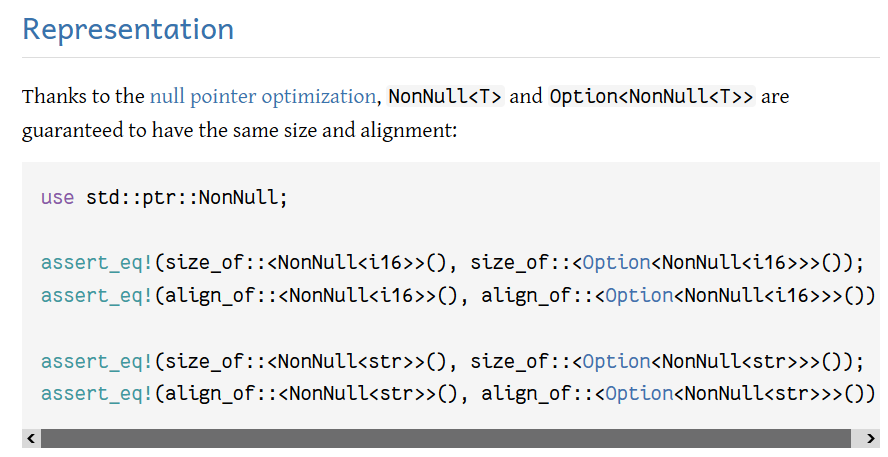
Screenshots for the new examples:
`const`-stablilize `NonNull::as_ref`

A bunch of pointer to reference methods have been made unstably const some time ago in #91823 under the feature gate `const_ptr_as_ref`.
Out of these, `NonNull::as_ref` can be implemented as a `const fn` in stable rust today, so i hereby propose to const stabilize this function only.

Tracking issue: #91822

``@rustbot`` label +T-libs-api -T-libs
Add `implement_via_object` to `rustc_deny_explicit_impl` to control object candidate assembly

Some built-in traits are special, since they are used to prove facts about the program that are important for later phases of compilation such as codegen and CTFE. For example, the `Unsize` trait is used to assert to the compiler that we are able to unsize a type into another type. It doesn't have any methods because it doesn't actually *instruct* the compiler how to do this unsizing, but this is later used (alongside an exhaustive match of combinations of unsizeable types) during codegen to generate unsize coercion code.

Due to this, these built-in traits are incompatible with the type erasure provided by object types. For example, the existence of `dyn Unsize<T>` does not mean that the compiler is able to unsize `Box<dyn Unsize<T>>` into `Box<T>`, since `Unsize` is a *witness* to the fact that a type can be unsized, and it doesn't actually encode that unsizing operation in its vtable as mentioned above.

The old trait solver gets around this fact by having complex control flow that never considers object bounds for certain built-in traits:
2f896da247/compiler/rustc_trait_selection/src/traits/select/candidate_assembly.rs (L61-L132)

However, candidate assembly in the new solver is much more lovely, and I'd hate to add this list of opt-out cases into the new solver. Instead of maintaining this complex and hard-coded control flow, instead we can make this a property of the trait via a built-in attribute. We already have such a build attribute that's applied to every single trait that we care about: `rustc_deny_explicit_impl`. This PR adds `implement_via_object` as a meta-item to that attribute that allows us to opt a trait out of object-bound candidate assembly as well.

r? `@lcnr`
Uplift `clippy::cast_ref_to_mut` lint

This PR aims at uplifting the `clippy::cast_ref_to_mut` lint into rustc.

## `cast_ref_to_mut`

(deny-by-default)

The `cast_ref_to_mut` lint checks for casts of `&T` to `&mut T` without using interior mutability.

### Example

```rust,compile_fail
fn x(r: &i32) {
    unsafe {
        *(r as *const i32 as *mut i32) += 1;
    }
}
```

### Explanation

Casting `&T` to `&mut T` without interior mutability is undefined behavior, as it's a violation of Rust reference aliasing requirements.

-----

Mostly followed the instructions for uplifting a clippy lint described here: https://github.com/rust-lang/rust/pull/99696#pullrequestreview-1134072751

`@rustbot` label: +I-lang-nominated
r? compiler

-----

For Clippy:

changelog: Moves: Uplifted `clippy::cast_ref_to_mut` into rustc
Currently, slice iterators over ZSTs store `end = start.wrapping_byte_add(len)`.

That's slightly convenient for `is_empty`, but kinda annoying for pretty much everything else -- see bugs like 42789, for example.

This PR instead changes it to just `end = ptr::invalid(len)` instead.

That's easier to think about (IMHO, at least) as well as easier to represent.


