Embed MSVC .natvis files into .pdbs and mangle debuginfo for &str, *T, and [T].
No idea if these changes are reasonable - please feel free to suggest changes/rewrites. And these are some of my first real commits to any rust codebase - *don't* be gentle, and nitpick away, I need to learn! ;)
### Overview
Embedding `.natvis` files into `.pdb`s allows MSVC (and potentially other debuggers) to automatically pick up the visualizers without having to do any additional configuration (other than to perhaps add the relevant .pdb paths to symbol search paths.)
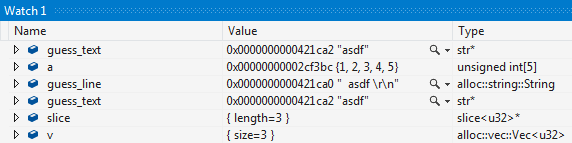
The native debug engine for MSVC parses the type names, making various C++ish assumptions about what they mean and adding various limitations to valid type names. `&str` cannot be matched against a visualizer, but if we emit `str&` instead, it'll be recognized as a reference to a `str`, solving the problem. `[T]` is similarly problematic, but emitting `slice<T>` instead works fine as it looks like a template. I've been unable to get e.g. `slice<u32>&` to match visualizers in VS2015u3, so I've gone with `str*` and `slice<u32>*` instead.
### Possible Issues
* I'm not sure if `slice<T>` is a great mangling for `[T]` or if I should worry about name collisions.
* I'm not sure if `linker.rs` is the right place to be enumerating natvis files.
* I'm not sure if these type name mangling changes should actually be MSVC specific. I recall seeing gdb visualizer tests that might be broken if made more general? I'm hesitant to mess with them without a gdb install. But perhaps I'm just wracking up technical debt.
Should I try `pacman -S mingw-w64-x86_64-gdb` and to make things consistent?
* I haven't touched `const` / `mut` yet, and I'm worried MSVC might trip up on `mut` or their placement.
* I may like terse oneliners too much.
* I don't know if there's broader implications for messing with debug type names here.
* I may have been mistaken about bellow test failures being ignorable / unrelated to this changelist.
### Test Failures on `x86_64-pc-windows-gnu`
```
---- [debuginfo-gdb] debuginfo-gdb\associated-types.rs stdout ----
thread '[debuginfo-gdb] debuginfo-gdb\associated-types.rs' panicked at 'gdb not available but debuginfo gdb debuginfo test requested', src\tools\compiletest\src\runtest.rs:48:16
note: Run with `RUST_BACKTRACE=1` for a backtrace.
[...identical panic causes omitted...]
---- [debuginfo-gdb] debuginfo-gdb\vec.rs stdout ----
thread '[debuginfo-gdb] debuginfo-gdb\vec.rs' panicked at 'gdb not available but debuginfo gdb debuginfo test requested', src\tools\compiletest\src\runtest.rs:48:16
```
### Relevant Issues
* https://github.com/rust-lang/rust/issues/40460 Metaissue for Visual Studio debugging Rust
* https://github.com/rust-lang/rust/issues/36503 Investigate natvis for improved msvc debugging
* https://github.com/PistonDevelopers/VisualRust/issues/160 Debug visualization of Rust data structures
### Pretty Pictures

Fix GDB pretty-printer for tuples and pointers
Names of children should not be the same, because GDB uses them to distinguish the children.
|Before|After|
|---|---|
|||
`main.rs`
```rust
enum Test {
Zero,
One(i32),
Two(i32, String),
Three(i32, String, Vec<String>),
}
fn main() {
let tuple = (1, 2, "Asdfgh");
let zero = Test::Zero;
let one = Test::One(10);
let two = Test::Two(42, "Qwerty".to_owned());
let three = Test::Three(9000,
"Zxcvbn".to_owned(),
vec!["lorem".to_owned(), "ipsum".to_owned(), "dolor".to_owned()]);
println!(""); // breakpoint here
}
```
`launch.json`
```json
{
"version": "0.2.0",
"configurations": [
{
"type": "gdb",
"request": "launch",
"gdbpath": "rust-gdb",
"name": "Launch Program",
"valuesFormatting": "prettyPrinters", //this requires plugin Native Debug >= 0.20.0
"target": "./target/debug/test_pretty_printers",
"cwd": "${workspaceRoot}"
}
]
}
```
Use a class without children() method for printing empty structs.
Presence of this method makes GDB's variable objects interface act like
if the struct had children.
travis: Parallelize tests on Android

Currently our slowest test suite on android, run-pass, takes over 5 times longer
than the x86_64 component (~400 -> ~2200s). Typically QEMU emulation does indeed
add overhead, but not 5x for this kind of workload. One of the slowest parts of
the Android process is that *compilation* happens serially. Tests themselves
need to run single-threaded on the emulator (due to how the test harness works)
and this forces the compiles themselves to be single threaded.

Now Travis gives us more than one core per machine, so it'd be much better if we
could take advantage of them! The emulator itself is still fundamentally
single-threaded, but we should see a nice speedup by sending binaries for it to
run much more quickly.

It turns out that we've already got all the toos to do this in-tree. The
qemu-test-{server,client} that are in use for the ARM Linux testing are a
perfect match for the Android emulator. This commit migrates the custom adb
management code in compiletest/rustbuild to the same qemu-test-{server,client}
implementation that ARM Linux uses.

This allows us to lift the parallelism restriction on the compiletest test
suites, namely run-pass. Consequently although we'll still basically run the
tests themselves in single threaded mode we'll be able to compile all of them in
parallel, keeping the pipeline much more full hopefully and using more cores for
the work at hand. Additionally the architecture here should be a bit speedier as
it should have less overhead than adb which is a whole new process on both the
host and the emulator!

Locally on an 8 core machine I've seen the run-pass test suite speed up from
taking nearly an hour to only taking 5 minutes. I don't think we'll see quite a
drastic speedup on Travis but I'm hoping this change can place the Android tests
well below 2 hours instead of just above 2 hours.

Because the client/server here are now repurposed for more than just QEMU,
they've been renamed to `remote-test-{server,client}`.

Note that this PR does not currently modify how debuginfo tests are executed on
Android. While parallelizable it wouldn't be quite as easy, so that's left to
another day. Thankfull that test suite is much smaller than the run-pass test
suite.
Currently our slowest test suite on android, run-pass, takes over 5 times longer
than the x86_64 component (~400 -> ~2200s). Typically QEMU emulation does indeed
add overhead, but not 5x for this kind of workload. One of the slowest parts of
the Android process is that *compilation* happens serially. Tests themselves
need to run single-threaded on the emulator (due to how the test harness works)
and this forces the compiles themselves to be single threaded.

Now Travis gives us more than one core per machine, so it'd be much better if we
could take advantage of them! The emulator itself is still fundamentally
single-threaded, but we should see a nice speedup by sending binaries for it to
run much more quickly.

It turns out that we've already got all the tools to do this in-tree. The
qemu-test-{server,client} that are in use for the ARM Linux testing are a
perfect match for the Android emulator. This commit migrates the custom adb
management code in compiletest/rustbuild to the same qemu-test-{server,client}
implementation that ARM Linux uses.

This allows us to lift the parallelism restriction on the compiletest test
suites, namely run-pass. Consequently although we'll still basically run the
tests themselves in single threaded mode we'll be able to compile all of them in
parallel, keeping the pipeline much more full and using more cores for the work
at hand. Additionally the architecture here should be a bit speedier as it
should have less overhead than adb which is a whole new process on both the host
and the emulator!

Locally on an 8 core machine I've seen the run-pass test suite speed up from
taking nearly an hour to only taking 6 minutes. I don't think we'll see quite a
drastic speedup on Travis but I'm hoping this change can place the Android tests
well below 2 hours instead of just above 2 hours.

Because the client/server here are now repurposed for more than just QEMU,
they've been renamed to `remote-test-{server,client}`.

Note that this PR does not currently modify how debuginfo tests are executed on
Android. While parallelizable it wouldn't be quite as easy, so that's left to
another day. Thankfully that test suite is much smaller than the run-pass test
suite.

As a final fix I discovered that the ARM and Android test suites were actually
running all library unit tests (e.g. stdtest, coretest, etc) twice. I've
corrected that to only run tests once which should also give a nice boost in
overall cycle time here.
Recently we switched from the win32 MinGW toolchain to the pthreads-based
toolchain. We ship `gcc.exe` from this toolchain with the `rust-mingw` package
in the standard distribution but the pthreads version of `gcc.exe` depends on
`libwinpthread-1.dll`. While we're shipping this DLL for the compiler to depend
on we're not shipping it for gcc. As a workaround just copy the dll to gcc.exe
location and don't attempt to share for now.

cc https://github.com/rust-lang/rust/issues/31840#issuecomment-297478538





