This change has two advantages:

1. It makes the possible states clearer, and it makes it impossible to
   construct invalid states, such as a blanket impl that is also an auto
   trait impl.

2. It shrinks the size of `Impl` a bit, since now there is only one
   field, rather than two.
rustdoc: Add `DocVisitor` and use it where possible

`DocFolder` allows transforming the docs, accomplished by making its methods take and return types by-value. However, several of the rustdoc `DocFolder` impls only *visit* the docs; they don't change anything. Passing around types by-value is thus unnecessary, confusing, and potentially inefficient for those impls.

`DocVisitor` is very similar to `DocFolder`, except that its methods take shared references and return nothing (i.e., the unit type). This should both be more efficient and make the code clearer.

There is an additional reason to add `DocVisitor`, too. As part of my cleanup of `external_traits`, I'm planning to add a `fn cache(&mut self) -> &mut Cache` method to `DocFolder` so that `external_traits` can be retrieved explicitly from the `Cache`, rather than implicitly via `Crate.external_traits` (which is an `Rc<RefCell<...>>`). However, some of the `DocFolder` impls that could be turned into `DocVisitor` impls only have a shared reference to the `Cache`, because they are used during rendering. (They have to access the `Cache` via `html::render::Context.shared.cache`, which involves an `Rc`.)

Since `DocVisitor` does not mutate any of the types it's visiting, its equivalent `cache()` method will only need a shared reference to the `Cache`, avoiding the problem described above.

r? `@GuillaumeGomez`
cc `@jyn514`
rustdoc: Compute some fields of `clean::Crate` on-demand to reduce size

`clean::Crate` is frequently moved by-value -- for example, in `DocFolder`
implementations -- so reducing its size should improve performance.

This PR reduces the size of `clean::Crate` from 168 bytes to 104 bytes.

r? `@jyn514`
Show all Deref implementations recursively
Fixes#87783.
This is a re-implementation of #80653, so taking the original PR comment:
This changes `rustdoc` to recursively follow `Deref` targets so that methods from all levels are added to the rendered output. This implementation displays the methods from all levels in the expanded state with separate sections for each level.
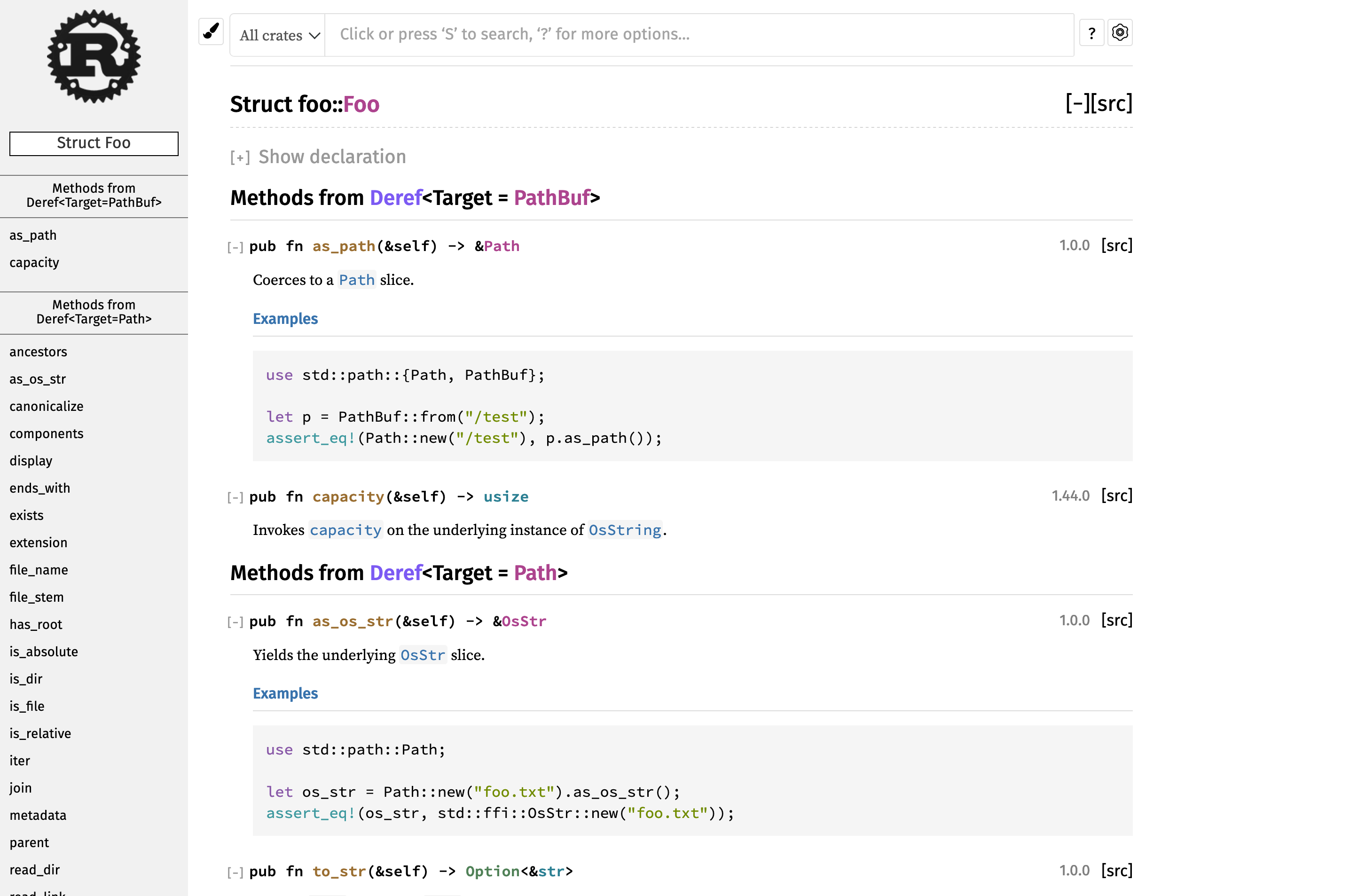
cc `@camelid`
r? `@jyn514`
It is only used in one place; `src` was about a third of `Crate`'s total
size; `Crate` is frequently moved by-value; and `src` can be easily
computed on-demand.
rustdoc: Use TTF based font instead of OTF for CJK glyphs to improve readability
Due to Windows' implementation of font rendering, OpenType fonts can be distorted. So the existing font, Noto Sans KR, is not very readable on Windows. This PR improves readability of Korean glyphs on Windows.
## Before

## After

The fonts included in this PR are licensed under the SIL Open Font License and generated with these commands:
```sh
pyftsubset NanumBarunGothic.ttf \
--unicodes=U+AC00-D7AF,U+1100-11FF,U+3130-318F,U+A960-A97F,U+D7B0-D7FF \
--output-file=NanumBarunGothic.ttf.woff --flavor=woff
```
```sh
pyftsubset NanumBarunGothic.ttf \
--unicodes=U+AC00-D7AF,U+1100-11FF,U+3130-318F,U+A960-A97F,U+D7B0-D7FF \
--output-file=NanumBarunGothic.ttf.woff2 --flavor=woff2
```
r? ``@GuillaumeGomez``
It should be preferred over `def_id_no_primitives()`, so it should have
a shorter name. I also put it before `def_id_no_primitives()` so that it
shows up first in the docs.
The old name was confusing because it's easy to assume that using
`def_id()` is fine, but in some situations it's incorrect. In general,
`def_id_full()` should be preferred, so `def_id_full()` should have a
shorter name. That will happen in the next commit.
Now that it's only implemented for `Type`, using inherent methods
instead means that imports are no longer necessary. Also, `GetDefId` is
only meant to be used with `Type`, so it shouldn't be a trait.
Move top part of print_item to Tera templates

Part of #84419.

This moves the first line of each item page (E.g. `Struct foo::Bar .... 1.0.0 [-][src]` into a Tera template.

I also moved template initialization into its own module and added a small macro to reduce duplication and opportunity for errors.
Make cfg imply doc(cfg)

This is a reopening of #79341, rebased and modified a bit (we made a lot of refactoring in rustdoc's types so they needed to be reflected in this PR as well):

 * `hidden_cfg` is now in the `Cache` instead of `DocContext` because `cfg` information isn't stored anymore on `clean::Attributes` type but instead computed on-demand, so we need this information in later parts of rustdoc.
 * I removed the `bool_to_options` feature (which makes the code a bit simpler to read for `SingleExt` trait implementation.
 * I updated the version for the feature.

There is only one thing I couldn't figure out: [this comment](https://github.com/rust-lang/rust/pull/79341#discussion_r561855624)

> I think I'll likely scrap the whole `SingleExt` extension trait as the diagnostics for 0 and >1 items should be different.

How/why should they differ?

EDIT: this part has been solved, the current code was fine, just needed a little simplification.

cc `@Nemo157`
r? `@jyn514`

Original PR description:

This is only active when the `doc_cfg` feature is active.

The implicit cfg can be overridden via `#[doc(cfg(...))]`, so e.g. to hide a `#[cfg]` you can use something like:

```rust
#[cfg(unix)]
#[doc(cfg(all()))]
pub struct Unix;
```

By adding `#![doc(cfg_hide(foobar))]` to the crate attributes the cfg `#[cfg(foobar)]` (and _only_ that _exact_ cfg) will not be implicitly treated as a `doc(cfg)` to render a message in the documentation.
* Move call location logic from function constructor to rendering
* Fix issue with macro spans in scraping examples
* Clean up example loading logic

Documentation / newtype for DecorationInfo

Fix line number display

Serialize edition of call site, other small cleanup





