Allow partially moved values in match
This PR attempts to unify the behaviour between `let _ = PLACE`, `let _: TY = PLACE;` and `match PLACE { _ => {} }`.
The logical conclusion is that the `match` version should not check for uninitialised places nor check that borrows are still live.
The `match PLACE {}` case is handled by keeping a `FakeRead` in the unreachable fallback case to verify that `PLACE` has a legal value.
Schematically, `match PLACE { arms }` in surface rust becomes in MIR:
```rust
PlaceMention(PLACE)
match PLACE {
// Decision tree for the explicit arms
arms,
// An extra fallback arm
_ => {
FakeRead(ForMatchedPlace, PLACE);
unreachable
}
}
```
`match *borrow { _ => {} }` continues to check that `*borrow` is live, but does not read the value.
`match *borrow {}` both checks that `*borrow` is live, and fake-reads the value.
Continuation of ~https://github.com/rust-lang/rust/pull/102256~ ~https://github.com/rust-lang/rust/pull/104844~
Fixes https://github.com/rust-lang/rust/issues/99180https://github.com/rust-lang/rust/issues/53114
Prepare the `bootstrap` tool for the new check-cfg syntax

This PR prepare the `bootstrap` tool for the [new check-cfg syntax](https://github.com/rust-lang/rust/pull/111072) as well as the according [changes to Cargo](https://github.com/rust-lang/cargo/pull/12845).

~~Note that while the new syntax can technically available on stage > 2, we actually cannot use it since we need a cargo version that supports the new syntax which won't happen until the next beta bump (if I understand everything correctly).~~

r? bootstrap
Store #[stable] attribute's `since` value in structured form

Followup to https://github.com/rust-lang/rust/pull/116773#pullrequestreview-1680913901.

Prior to this PR, if you wrote an improper `since` version in a `stable` attribute, such as `#[stable(feature = "foo", since = "wat.0")]`, rustc would emit a diagnostic saying **_'since' must be a Rust version number, such as "1.31.0"_** and then throw out the whole `stable` attribute as if it weren't there. This strategy had 2 problems, both fixed in this PR:

1. If there was also a `#[deprecated]` attribute on the same item, rustc would want to enforce that the stabilization version is older than the deprecation version. This involved reparsing the `stable` attribute's `since` version, with a diagnostic **_invalid stability version found_** if it failed to parse. Of course this diagnostic was unreachable because an invalid `since` version would have already caused the `stable` attribute to be thrown out. This PR deletes that unreachable diagnostic.

2. By throwing out the `stable` attribute when `since` is invalid, you'd end up with a second diagnostic saying **_function has missing stability attribute_** even though your function is not missing a stability attribute. This PR preserves the `stable` attribute even when `since` cannot be parsed, avoiding the misleading second diagnostic.

Followups I plan to try next:

- Do the same for the `since` value of `#[deprecated]`.

- See whether it makes sense to also preserve `stable` and/or `unstable` attributes when they contain an invalid `feature`. What redundant/misleading diagnostics can this eliminate? What problems arise from not having a usable feature name for some API, in the situation that we're already failing compilation, so not concerned about anything that happens in downstream code?
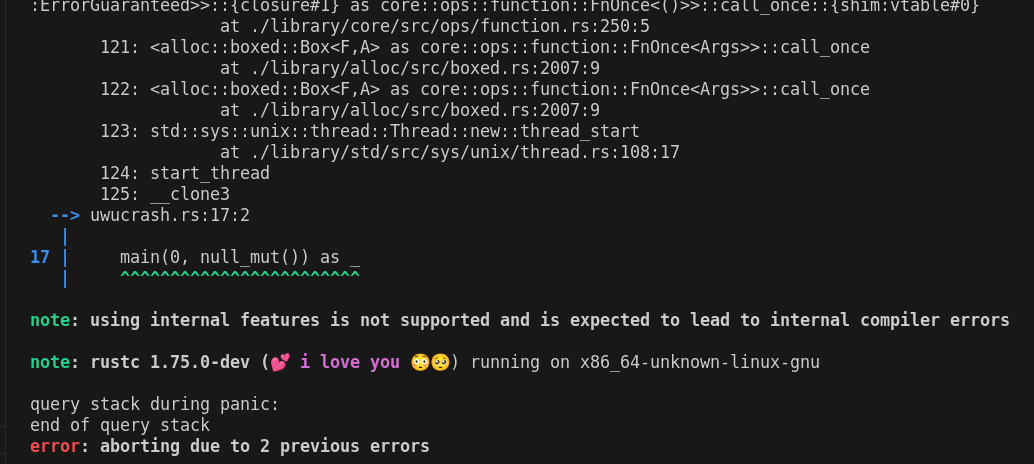
Stop telling people to submit bugs for internal feature ICEs
This keeps track of usage of internal features, and changes the message to instead tell them that using internal features is not supported.
I thought about several ways to do this but now used the explicit threading of an `Arc<AtomicBool>` through `Session`. This is not exactly incremental-safe, but this is fine, as this is set during macro expansion, which is pre-incremental, and also only affects the output of ICEs, at which point incremental correctness doesn't matter much anyways.
See [MCP 620.](https://github.com/rust-lang/compiler-team/issues/596)
Rename AsyncCoroutineKind to CoroutineSource

pulled out of https://github.com/rust-lang/rust/pull/116447

Also refactors the printing infra of `CoroutineSource` to be ready for easily extending it with a `Gen` variant for `gen` blocks
This keeps track of usage of internal features, and changes the message
to instead tell them that using internal features is not supported.

See MCP 620.
Rollup of 7 pull requests

Successful merges:

 - #117111 (Remove support for alias `-Z instrument-coverage`)
 - #117141 (Require target features to match exactly during inlining)
 - #117152 (Fix unwrap suggestion for async fn)
 - #117154 (implement C ABI lowering for CSKY)
 - #117159 (Work around the fact that `check_mod_type_wf` may spuriously return `ErrorGuaranteed`)
 - #117163 (compiletest: Display compilation errors in mir-opt tests)
 - #117173 (Make `Iterator` a lang item)

r? `@ghost`
`@rustbot` modify labels: rollup
compiletest: Display compilation errors in mir-opt tests

Previously when compilation failed the `check_mir_dump` would panic first, so we would never display the compiler output.
Work around the fact that `check_mod_type_wf` may spuriously return `ErrorGuaranteed`

Even if that error is only emitted by `check_mod_item_types`.

fixes https://github.com/rust-lang/rust/issues/117153

A cleaner refactoring would merge/chain these queries in ways that ensure we only actually get an `ErrorGuaranteed` if there was an error emitted.
Validate `feature` and `since` values inside `#[stable(…)]`

Previously the string passed to `#[unstable(feature = "...")]` would be validated as an identifier, but not `#[stable(feature = "...")]`. In the standard library there were `stable` attributes containing the empty string, and kebab-case string, neither of which should be allowed.

Pre-existing validation of `unstable`:

```rust
// src/lib.rs

#![allow(internal_features)]
#![feature(staged_api)]
#![unstable(feature = "kebab-case", issue = "none")]

#[unstable(feature = "kebab-case", issue = "none")]
pub struct Struct;
```

```console
error[E0546]: 'feature' is not an identifier
 --> src/lib.rs:5:1
  |
5 | #![unstable(feature = "kebab-case", issue = "none")]
  | ^^^^^^^^^^^^^^^^^^^^^^^^^^^^^^^^^^^^^^^^^^^^^^^^^^^^
```

For an `unstable` attribute, the need for an identifier is obvious because the downstream code needs to write a `#![feature(...)]` attribute containing that identifier. `#![feature(kebab-case)]` is not valid syntax and `#![feature(kebab_case)]` would not work if that is not the name of the feature.

Having a valid identifier even in `stable` is less essential but still useful because it allows for informative diagnostic about the stabilization of a feature. Compare:

```rust
// src/lib.rs

#![allow(internal_features)]
#![feature(staged_api)]
#![stable(feature = "kebab-case", since = "1.0.0")]

#[stable(feature = "kebab-case", since = "1.0.0")]
pub struct Struct;
```

```rust
// src/main.rs

#![feature(kebab_case)]

use repro::Struct;

fn main() {}
```

```console
error[E0635]: unknown feature `kebab_case`
 --> src/main.rs:3:12
  |
3 | #![feature(kebab_case)]
  |            ^^^^^^^^^^
```

vs the situation if we correctly use `feature = "snake_case"` and `#![feature(snake_case)]`, as enforced by this PR:

```console
warning: the feature `snake_case` has been stable since 1.0.0 and no longer requires an attribute to enable
 --> src/main.rs:3:12
  |
3 | #![feature(snake_case)]
  |            ^^^^^^^^^^
  |
  = note: `#[warn(stable_features)]` on by default
```
Windows: Support sub-millisecond sleep
Use `CreateWaitableTimerExW` with `CREATE_WAITABLE_TIMER_HIGH_RESOLUTION`. Does not work before Windows 10, version 1803 so in that case we fallback to using `Sleep`.
I've created a `WaitableTimer` type so it can one day be adapted to also support waiting to an absolute time (which has been talked about). Note though that it currently returns `Err(())` because we can't do anything with the errors other than fallback to the old `Sleep`. Feel free to tell me to do errors properly. It just didn't seem worth constructing an `io::Error` if we're never going to surface it to the user. And it *should* all be infallible anyway unless the OS is too old to support it.
Closes#43376
report `unused_import` for empty reexports even it is pub
Fixes#116032
An easy fix. r? `@petrochenkov`
(Discovered this issue while reviewing #115993.)
coverage: Add UI tests for values accepted by `-Cinstrument-coverage`

I wanted to clean up the code in `parse_instrument_coverage`, but it occurred to me that we currently don't have any UI tests for the various stable and unstable values supported by this flag.

---

Normally it might be overkill to individually test all the different variants of `on`/`off`, but in this case the parsing of those values is mixed in with some other custom code, so I think it's worthwhile being thorough.
Avoid a `track_errors` by bubbling up most errors from `check_well_formed`

I believe `track_errors` is mostly papering over issues that a sufficiently convoluted query graph can hit. I made this change, while the actual change I want to do is to stop bailing out early on errors, and instead use this new `ErrorGuaranteed` to invoke `check_well_formed` for individual items before doing all the `typeck` logic on them.

This works towards resolving https://github.com/rust-lang/rust/issues/97477 and various other ICEs, as well as allowing us to use parallel rustc more (which is currently rather limited/bottlenecked due to the very sequential nature in which we do `rustc_hir_analysis::check_crate`)

cc `@SparrowLii` `@Zoxc` for the new `try_par_for_each_in` function
add a `csky-unknown-linux-gnuabiv2hf` target

This is the rustc side changes to support csky based Linux target(`csky-unknown-linux-gnuabiv2`).

Tier 3 policy:

> A tier 3 target must have a designated developer or developers (the "target maintainers") on record to be CCed when issues arise regarding the target. (The mechanism to track and CC such developers may evolve over time.)

I pledge to do my best maintaining it.

> Targets must use naming consistent with any existing targets; for instance, a target for the same CPU or OS as an existing Rust target should use the same name for that CPU or OS. Targets should normally use the same names and naming conventions as used elsewhere in the broader ecosystem beyond Rust (such as in other toolchains), unless they have a very good reason to diverge. Changing the name of a target can be highly disruptive, especially once the target reaches a higher tier, so getting the name right is important even for a tier 3 target.

This `csky`  section is the arch name and the `unknown-linux` section is the same as other linux target, and `gnuabiv2` is from the  cross-compile toolchain of  `gcc`. the `hf`means hardfloat.

> Target names should not introduce undue confusion or ambiguity unless absolutely necessary to maintain ecosystem compatibility. For example, if the name of the target makes people extremely likely to form incorrect beliefs about what it targets, the name should be changed or augmented to disambiguate it.

I think the explanation in platform support doc is enough to make this aspect clear.

> Tier 3 targets may have unusual requirements to build or use, but must not create legal issues or impose onerous legal terms for the Rust project or for Rust developers or users.

It's using open source tools only.

> The target must not introduce license incompatibilities.

No new license

> Anything added to the Rust repository must be under the standard Rust license (MIT OR Apache-2.0).

Understood.

> The target must not cause the Rust tools or libraries built for any other host (even when supporting cross-compilation to the target) to depend on any new dependency less permissive than the Rust licensing policy. This applies whether the dependency is a Rust crate that would require adding new license exceptions (as specified by the tidy tool in the rust-lang/rust repository), or whether the dependency is a native library or binary. In other words, the introduction of the target must not cause a user installing or running a version of Rust or the Rust tools to be subject to any new license requirements.

There are no new dependencies/features required.

> Compiling, linking, and emitting functional binaries, libraries, or other code for the target (whether hosted on the target itself or cross-compiling from another target) must not depend on proprietary (non-FOSS) libraries. Host tools built for the target itself may depend on the ordinary runtime libraries supplied by the platform and commonly used by other applications built for the target, but those libraries must not be required for code generation for the target; cross-compilation to the target must not require such libraries at all. For instance, rustc built for the target may depend on a common proprietary C runtime library or console output library, but must not depend on a proprietary code generation library or code optimization library. Rust's license permits such combinations, but the Rust project has no interest in maintaining such combinations within the scope of Rust itself, even at tier 3.

As previously said it's using open source tools only.

> "onerous" here is an intentionally subjective term. At a minimum, "onerous" legal/licensing terms include but are not limited to: non-disclosure requirements, non-compete requirements, contributor license agreements (CLAs) or equivalent, "non-commercial"/"research-only"/etc terms, requirements conditional on the employer or employment of any particular Rust developers, revocable terms, any requirements that create liability for the Rust project or its developers or users, or any requirements that adversely affect the livelihood or prospects of the Rust project or its developers or users.

There are no such terms present/

> Neither this policy nor any decisions made regarding targets shall create any binding agreement or estoppel by any party. If any member of an approving Rust team serves as one of the maintainers of a target, or has any legal or employment requirement (explicit or implicit) that might affect their decisions regarding a target, they must recuse themselves from any approval decisions regarding the target's tier status, though they may otherwise participate in discussions.

I'm not the reviewer here.

> This requirement does not prevent part or all of this policy from being cited in an explicit contract or work agreement (e.g. to implement or maintain support for a target). This requirement exists to ensure that a developer or team responsible for reviewing and approving a target does not face any legal threats or obligations that would prevent them from freely exercising their judgment in such approval, even if such judgment involves subjective matters or goes beyond the letter of these requirements.

I'm not the reviewer here.

> Tier 3 targets should attempt to implement as much of the standard libraries as possible and appropriate (core for most targets, alloc for targets that can support dynamic memory allocation, std for targets with an operating system or equivalent layer of system-provided functionality), but may leave some code unimplemented (either unavailable or stubbed out as appropriate), whether because the target makes it impossible to implement or challenging to implement. The authors of pull requests are not obligated to avoid calling any portions of the standard library on the basis of a tier 3 target not implementing those portions.

It supports for std

> The target must provide documentation for the Rust community explaining how to build for the target, using cross-compilation if possible. If the target supports running binaries, or running tests (even if they do not pass), the documentation must explain how to run such binaries or tests for the target, using emulation if possible or dedicated hardware if necessary.

I have added the documentation, and I think it's clear.

> Tier 3 targets must not impose burden on the authors of pull requests, or other developers in the community, to maintain the target. In particular, do not post comments (automated or manual) on a PR that derail or suggest a block on the PR based on a tier 3 target. Do not send automated messages or notifications (via any medium, including via ``@)`` to a PR author or others involved with a PR regarding a tier 3 target, unless they have opted into such messages.

Understood.

> Backlinks such as those generated by the issue/PR tracker when linking to an issue or PR are not considered a violation of this policy, within reason. However, such messages (even on a separate repository) must not generate notifications to anyone involved with a PR who has not requested such notifications.

Understood.

> Patches adding or updating tier 3 targets must not break any existing tier 2 or tier 1 target, and must not knowingly break another tier 3 target without approval of either the compiler team or the maintainers of the other tier 3 target.

I believe I didn't break any other target.

> In particular, this may come up when working on closely related targets, such as variations of the same architecture with different features. Avoid introducing unconditional uses of features that another variation of the target may not have; use conditional compilation or runtime detection, as appropriate, to let each target run code supported by that target.

I think there are no such problems in this PR.


