In a scenario like
```
struct Type;
pub trait Trait {
fn function(&mut self)
where
Self: Sized;
}
impl Trait for Type {
fn function(&mut self) {}
}
fn main() {
(&mut Type as &mut dyn Trait).function();
}
```
the problem is Sized, not the mutability of self. Thus don't emit the
"you need &T instead of &mut T" note, or the other way around, as all
it does is just invert the mutability of whatever was supplied.
Fixes#103622.
use the correct `Reveal` during validation

supersedes #105454. Deals with https://github.com/rust-lang/rust/issues/105009#issuecomment-1342395333, not closing #105009 as the ICE may leak into beta

The issue was the following:
- we optimize the mir, using `Reveal::All`
- some optimization relies on the hidden type of an opaque type
- we then validate using `Reveal::UserFacing` again which is not able to observe the hidden type

r? `@jackh726`
Dont silently ignore rustdoc errors

I applied the suggestions from https://github.com/rust-lang/rust/pull/104995 and also checked the rustdoc-ui error but couldn't reproduce it.

r? `@notriddle`
Improve Rustdoc scrape-examples UI
This PR combines a few different improvements to the scrape-examples UI. See a live demo here: https://willcrichton.net/misc/scrape-examples/small-first-example/clap/struct.Arg.html
### 1. The first scraped example now takes up significantly less screen height.
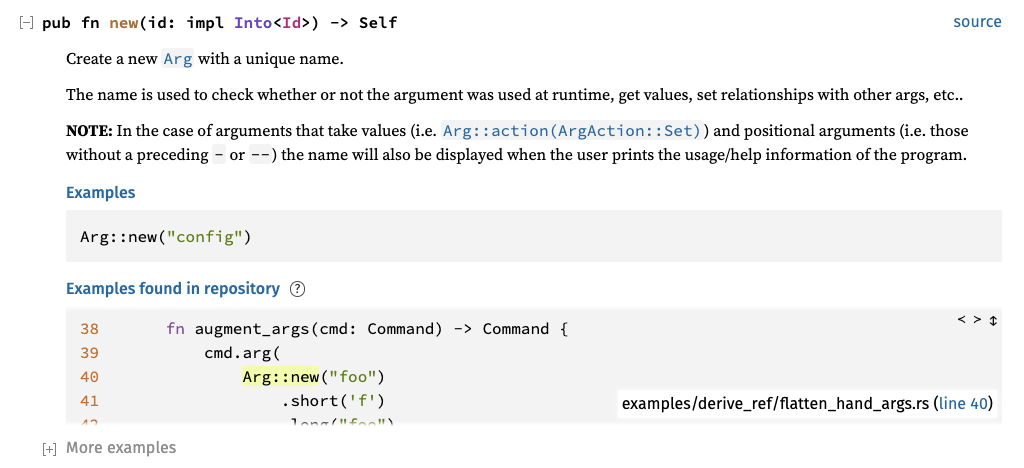
Inserting the first scraped example takes up a lot of vertical screen space. I don't want this addition to overwhelm users, so I decided to reduce the height of the initial example in two ways: (A) the default un-expanded height is reduced from 240px (10 LOC) to 120px (5 LOC), and (B) the link to the example is now positioned *over* the example instead of *atop* the example (only on desktop though, not mobile). The changes to `scrape-examples.js` and `rustdoc.css` implement this fix.
Here is what an example docblock now looks like:
### 2. Expanding all docblocks will not expand "More examples".
The "More examples blocks" are huge, so fully expanding everything on the page would take up too much vertical space. The changes to `main.js` implement this fix. This is tested in `scrape-examples-toggle.goml`.
### 3. Examples from binary crates are sorted higher than examples from library crates.
Code that is written as an example of an API is probably better for learning than code that happens to use an API, but isn't intended for pedagogic purposes. Unfortunately Rustc doesn't know whether a particular crate comes from an example target (only Cargo knows this). But we can at least create a proxy that prefers examples from binary crates over library crates, which we know from `--crate-type`.
This change is implemented by adding a new field `bin_crate` in `Options` (see `config.rs`). An `is_bin` field has been added to the scraped examples metadata (see `scrape_examples.rs`). Then the example sorting metric uses `is_bin` as the first entry of a lexicographic sort on `(is_bin, example_size, display_name)` (see `render/mod.rs`).
Note that in the future we can consider adding another flag like `--scrape-examples-cargo-target` that would pass target information from Cargo into the example metadata. But I'm proposing a less intrusive change for now.
### 4. The scrape-examples help page has been updated to reflect the latest Cargo interface.
See `scrape-examples-help.md`.
r? `@notriddle`
P.S. once this PR and rust-lang/cargo#11450 are merged, then I think the scrape-examples feature is officially ready for deployment on docs.rs!
Rollup of 10 pull requests

Successful merges:

 - #104922 (Detect long types in E0308 and write them to disk)
 - #105120 (kmc-solid: `std::sys` code maintenance)
 - #105255 (Make nested RPIT inherit the parent opaque's generics.)
 - #105317 (make retagging work even with 'unstable' places)
 - #105405 (Stop passing -export-dynamic to wasm-ld.)
 - #105408 (Add help for `#![feature(impl_trait_in_fn_trait_return)]`)
 - #105423 (Use `Symbol` for the crate name instead of `String`/`str`)
 - #105433 (CI: add missing line continuation marker)
 - #105434 (Fix warning when libcore is compiled with no_fp_fmt_parse)
 - #105441 (Remove `UnsafetyState`)

Failed merges:

r? `@ghost`
`@rustbot` modify labels: rollup
In order for LLVM to correctly generate debuginfo for msvc, we sometimes
need to spill arguments to the stack and perform some direct & indirect
offsets into the value. Previously, this code always performed those
actions, even when not required as LLVM would clean it up during
optimization.

However, when MIR inlining is enabled, this can cause problems as the
operations occur prior to the spilled value being initialized. To solve
this, we first calculate the necessary offsets using just the type which
is side-effect free and does not alter the LLVM IR. Then, if we are in a
situation which requires us to generate the LLVM IR (and this situation
only occurs for arguments, not local variables) then we perform the same
calculation again, this time generating the appropriate LLVM IR as we
go.
This commit adds LLVM Kernel Control Flow Integrity (KCFI) support to
the Rust compiler. It initially provides forward-edge control flow
protection for operating systems kernels for Rust-compiled code only by
aggregating function pointers in groups identified by their return and
parameter types. (See llvm/llvm-project@cff5bef.)

Forward-edge control flow protection for C or C++ and Rust -compiled
code "mixed binaries" (i.e., for when C or C++ and Rust -compiled code
share the same virtual address space) will be provided in later work as
part of this project by identifying C char and integer type uses at the
time types are encoded (see Type metadata in the design document in the
tracking issue #89653).

LLVM KCFI can be enabled with -Zsanitizer=kcfi.

Co-authored-by: bjorn3 <17426603+bjorn3@users.noreply.github.com>
Add help for `#![feature(impl_trait_in_fn_trait_return)]`

This adds a new variant `ImplTraitContext::FeatureGated`, so we can
generalize the help for `return_position_impl_trait_in_trait` to also
work for `impl_trait_in_fn_trait_return`.

cc #99697
make retagging work even with 'unstable' places

This is based on top of https://github.com/rust-lang/rust/pull/105301. Only the last two commits are new.

While investigating https://github.com/rust-lang/unsafe-code-guidelines/issues/381 I realized that we would have caught this issue much earlier if the add_retag pass wouldn't bail out on assignments of the form `*ptr = ...`.

So this PR changes our retag strategy:
- When a new reference is created via `Rvalue::Ref` (or a raw ptr via `Rvalue::AddressOf`), we do the retagging as part of just executing that address-taking operation.
- For everything else, we still insert retags -- these retags basically serve to ensure that references stored in local variables (and their fields) are always freshly tagged, so skipping this for assignments like `*ptr = ...` is less egregious.
r? ```@oli-obk```
Detect long types in E0308 and write them to disk

On type error with long types, print an abridged type and write the full type to disk.

Print the widest possible short type while still fitting in the terminal.
Currently, LLVM profiling runtime counter relocation cannot be
used by rust during LTO because symbols are being internalized
before all symbol information is known.

This mode makes LLVM emit a __llvm_profile_counter_bias symbol
which is referenced by the profiling initialization, which itself
is pulled in by the rust driver here [1].

It is enabled with -Cllvm-args=-runtime-counter-relocation for
platforms which are opt-in to this mode like Linux. On these
platforms there will be no link error, rather just surprising
behavior for a user which request runtime counter relocation.
The profiling runtime will not see that symbol go on as if it
were never there. On Fuchsia, the profiling runtime must have
this symbol which will cause a hard link error.

As an aside, I don't have enough context as to why rust's LTO
model is how it is. AFAICT, the internalize pass is only safe
to run at link time when all symbol information is actually
known, this being an example as to why. I think special casing
this symbol as a known one that LLVM can emit which should not
have it's visbility de-escalated should be fine given how
seldom this pattern of defining an undefined symbol to get
initilization code pulled in is. From a quick grep,
__llvm_profile_runtime is the only symbol that rustc does this
for.

[1] 0265a3e93b/compiler/rustc_codegen_ssa/src/back/linker.rs (L598)
normalize before handling simple checks for evaluatability of `ty::Const`

`{{{{{{{ N }}}}}}}` is desugared into a `ConstKind::Unevaluated` for an anonymous `const` item so when calling `is_const_evaluatable` on it we skip the `ConstKind::Param(_) => Ok(())` arm which is incorrect.
This adds a new variant `ImplTraitContext::FeatureGated`, so we can
generalize the help for `return_position_impl_trait_in_trait` to also
work for `impl_trait_in_fn_trait_return`.


