Update cargo

14 commits in aa6872140ab0fa10f641ab0b981d5330d419e927..974eb438da8ced6e3becda2bbf63d9b643eacdeb
2020-07-23 13:46:27 +0000 to 2020-07-29 16:15:05 +0000
- Fix O0 build scripts by default without `[profile.release]` (rust-lang/cargo#8560)
- Emphasize git dependency version locking behavior. (rust-lang/cargo#8561)
- Update lock file encodings on changes (rust-lang/cargo#8554)
- Fix sporadic lto test failures. (rust-lang/cargo#8559)
- build-std: Fix libraries paths following upstream (rust-lang/cargo#8558)
- Flag git http errors as maybe spurious (rust-lang/cargo#8553)
- Display builtin aliases with `cargo --list` (rust-lang/cargo#8542)
- Check manifest for requiring nonexistent features (rust-lang/cargo#7950)
- Clarify test name filter usage (rust-lang/cargo#8552)
- Revert Cargo Book changes for default edition (rust-lang/cargo#8551)
- Prepare for not defaulting to master branch for git deps (rust-lang/cargo#8522)
- Include `+` for crates.io feature requirements in the Cargo Book section on features (rust-lang/cargo#8547)
- Update termcolor and fwdansi versions (rust-lang/cargo#8540)
- Cargo book nitpick in Manifest section (rust-lang/cargo#8543)
This commit is a proof-of-concept for switching the standard library's
backtrace symbolication mechanism on most platforms from libbacktrace to
gimli. The standard library's support for `RUST_BACKTRACE=1` requires
in-process parsing of object files and DWARF debug information to
interpret it and print the filename/line number of stack frames as part
of a backtrace.

Historically this support in the standard library has come from a
library called "libbacktrace". The libbacktrace library seems to have
been extracted from gcc at some point and is written in C. We've had a
lot of issues with libbacktrace over time, unfortunately, though. The
library does not appear to be actively maintained since we've had
patches sit for months-to-years without comments. We have discovered a
good number of soundness issues with the library itself, both when
parsing valid DWARF as well as invalid DWARF. This is enough of an issue
that the libs team has previously decided that we cannot feed untrusted
inputs to libbacktrace. This also doesn't take into account the
portability of libbacktrace which has been difficult to manage and
maintain over time. While possible there are lots of exceptions and it's
the main C dependency of the standard library right now.

For years it's been the desire to switch over to a Rust-based solution
for symbolicating backtraces. It's been assumed that we'll be using the
Gimli family of crates for this purpose, which are targeted at safely
and efficiently parsing DWARF debug information. I've been working
recently to shore up the Gimli support in the `backtrace` crate. As of a
few weeks ago the `backtrace` crate, by default, uses Gimli when loaded
from crates.io. This transition has gone well enough that I figured it
was time to start talking seriously about this change to the standard
library.

This commit is a preview of what's probably the best way to integrate
the `backtrace` crate into the standard library with the Gimli feature
turned on. While today it's used as a crates.io dependency, this commit
switches the `backtrace` crate to a submodule of this repository which
will need to be updated manually. This is not done lightly, but is
thought to be the best solution. The primary reason for this is that the
`backtrace` crate needs to do some pretty nontrivial filesystem
interactions to locate debug information. Working without `std::fs` is
not an option, and while it might be possible to do some sort of
trait-based solution when prototyped it was found to be too unergonomic.
Using a submodule allows the `backtrace` crate to build as a submodule
of the `std` crate itself, enabling it to use `std::fs` and such.

Otherwise this adds new dependencies to the standard library. This step
requires extra attention because this means that these crates are now
going to be included with all Rust programs by default. It's important
to note, however, that we're already shipping libbacktrace with all Rust
programs by default and it has a bunch of C code implementing all of
this internally anyway, so we're basically already switching
already-shipping functionality to Rust from C.

* `object` - this crate is used to parse object file headers and
  contents. Very low-level support is used from this crate and almost
  all of it is disabled. Largely we're just using struct definitions as
  well as convenience methods internally to read bytes and such.

* `addr2line` - this is the main meat of the implementation for
  symbolication. This crate depends on `gimli` for DWARF parsing and
  then provides interfaces needed by the `backtrace` crate to turn an
  address into a filename / line number. This crate is actually pretty
  small (fits in a single file almost!) and mirrors most of what
  `dwarf.c` does for libbacktrace.

* `miniz_oxide` - the libbacktrace crate transparently handles
  compressed debug information which is compressed with zlib. This crate
  is used to decompress compressed debug sections.

* `gimli` - not actually used directly, but a dependency of `addr2line`.

* `adler32`- not used directly either, but a dependency of
  `miniz_oxide`.

The goal of this change is to improve the safety of backtrace
symbolication in the standard library, especially in the face of
possibly malformed DWARF debug information. Even to this day we're still
seeing segfaults in libbacktrace which could possibly become security
vulnerabilities. This change should almost entirely eliminate this
possibility whilc also paving the way forward to adding more features
like split debug information.

Some references for those interested are:

* Original addition of libbacktrace - #12602
* OOM with libbacktrace - #24231
* Backtrace failure due to use of uninitialized value - #28447
* Possibility to feed untrusted data to libbacktrace - #21889
* Soundness fix for libbacktrace - #33729
* Crash in libbacktrace - #39468
* Support for macOS, never merged - ianlancetaylor/libbacktrace#2
* Performance issues with libbacktrace - #29293, #37477
* Update procedure is quite complicated due to how many patches we
  need to carry - #50955
* Libbacktrace doesn't work on MinGW with dynamic libs - #71060
* Segfault in libbacktrace on macOS - #71397

Switching to Rust will not make us immune to all of these issues. The
crashes are expected to go away, but correctness and performance may
still have bugs arise. The gimli and `backtrace` crates, however, are
actively maintained unlike libbacktrace, so this should enable us to at
least efficiently apply fixes as situations come up.
Clean up some uses of logging in ui tests

The removed test can't possibly trigger anything today as we don't have logging in libstd.

The `exec-env` flag was mistakenly used for adding env vars to rustc invocations both in test and in the test suite and there were some accidental renames from RUST_LOG to RUSTC_LOG that I reverted.
Changes:
- preparation for potential rustfmt 1.4.19 (#4283)
- chore: backport 8157a3f0afe978d3e953420577f8344db7e905bf
- deps: bump rustc-ap to v669
- deps: bump rustc-ap-* to v668
- deps: bump rustc-ap* to v666
- Use correct span for match arms with the leading pipe and attributes (#3975)
Revert libbacktrace -> gimli
This reverts 4cbd265c11028f8d7b8513db3cc1e8d7a36d8964 (and technically 79673d3009 but it's made empty by previous reverts).
The current plan is to land this PR as a temporary change, so that we can get a better handle on the regressions introduced by it. Trying to fix/examine them in master is difficult, and we want to be better able to evaluate them without impact to other PRs being landed in the mean time.
That said, it is currently *my* belief that gimli, in one form or another, will need to land sometime soon. I think it's quite likely that it may slip a week or two, but I would personally push for re-landing it then "regardless" of the regressions. We should try to focus efforts on understanding and removing as much of the performance impact as possible, as everyone pretty much agrees that it should be quite minimal (and entirely in the linker, basically).
r? @nnethercote
build: Remove unnecessary `cargo:rerun-if-env-changed` annotations

... and a couple of related cleanups.

rustc and cargo now track the majority of env var dependencies automatically (https://github.com/rust-lang/cargo/pull/8421), so the annotations are no longer necessary.
Polymorphization
This PR implements an analysis to detect when functions could remain polymorphic during code generation.
Fixes#46477
r? @eddyb
cc @rust-lang/wg-mir-opt @nikomatsakis @pnkfelix
This commit modifies the `substitute_normalize_and_test_predicates`
query, renaming it to `impossible_predicates` and only checking
predicates which do not require substs. By making this change,
polymorphization doesn't have to explicitly support vtables.

Signed-off-by: David Wood <david@davidtw.co>
Add myself to toolstate change notifications for rustfmt

I'd like to get the toolstate change notifications for rustfmt as well so that I'll know when things break.

Have spoken with @topecongiro about this offline already.
More intra-doc links, add explicit exception list to linkchecker

Fixes the broken links behind #32553

Progress on #32130 and #32129 except for a small number of links. Instead of whitelisting entire files, I've changed the code to whitelist specific links in specific files, and added a comment requesting people explain the reasons they add exceptions. I'm not sure if we should close those issues in favor of the already filed intra-doc link issues.
This makes extract_lldb_version has the same version type like
extract_gdb_version.

This is technically a breaking change for rustc-dev users.
But note that rustc-dev is a nightly component.
Generating the coverage map
@tmandry @wesleywiser
rustc now generates the coverage map and can support (limited)
coverage report generation, at the function level.
Example commands to generate a coverage report:
```shell
$ BUILD=$HOME/rust/build/x86_64-unknown-linux-gnu
$ $BUILD/stage1/bin/rustc -Zinstrument-coverage \
$HOME/rust/src/test/run-make-fulldeps/instrument-coverage/main.rs
$ LLVM_PROFILE_FILE="main.profraw" ./main
called
$ $BUILD/llvm/bin/llvm-profdata merge -sparse main.profraw -o main.profdata
$ $BUILD/llvm/bin/llvm-cov show --instr-profile=main.profdata main
```
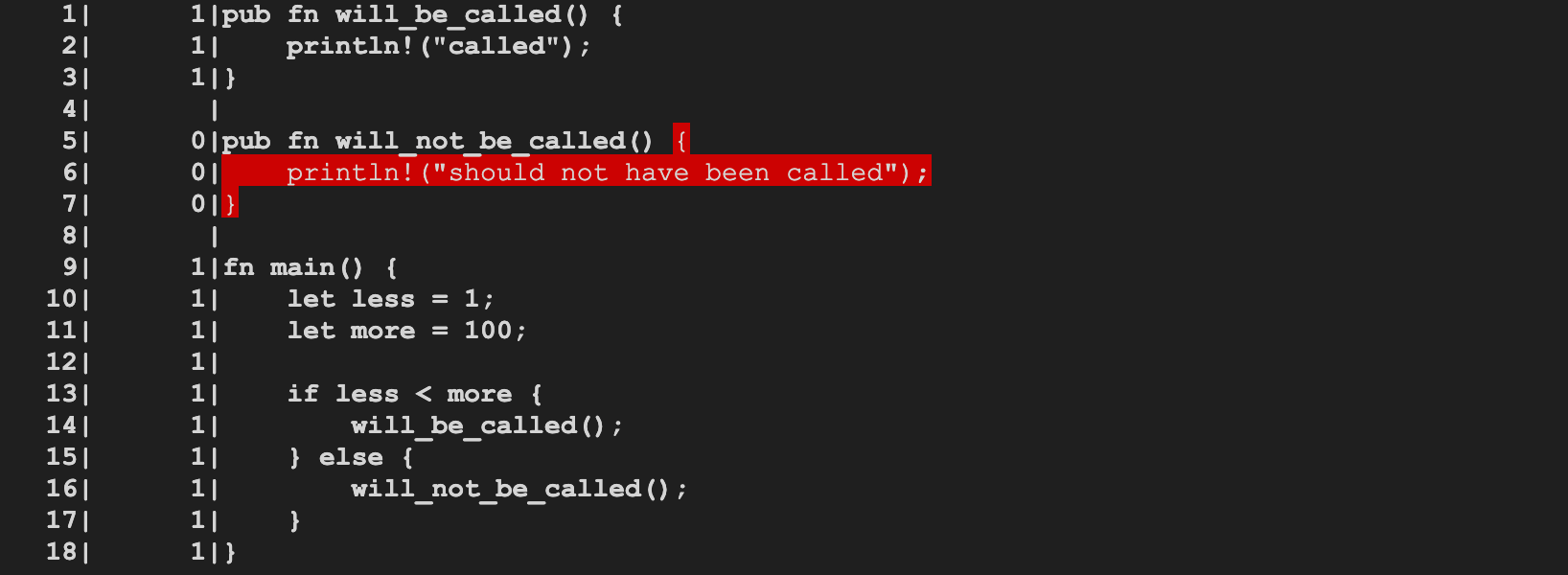
r? @wesleywiser
Rust compiler MCP rust-lang/compiler-team#278
Relevant issue: #34701 - Implement support for LLVMs code coverage instrumentation
rustc_metadata: Make crate loading fully speculative

Instead of reporting `span_err`s on the spot crate loading errors are now wrapped into the `CrateError` enum and returned, so they are reported only at the top level `resolve_crate` call, and not reported at all if we are resolving speculatively with `maybe_resolve_crate`.

As a result we can attempt loading crates for error recovery (e.g. import suggestions) without any risk of producing extra errors.
Also, this means better separation between error reporting and actual logic.

Fixes https://github.com/rust-lang/rust/issues/55103
Fixes https://github.com/rust-lang/rust/issues/56590
std: Switch from libbacktrace to gimli

This commit is a proof-of-concept for switching the standard library's
backtrace symbolication mechanism on most platforms from libbacktrace to
gimli. The standard library's support for `RUST_BACKTRACE=1` requires
in-process parsing of object files and DWARF debug information to
interpret it and print the filename/line number of stack frames as part
of a backtrace.

Historically this support in the standard library has come from a
library called "libbacktrace". The libbacktrace library seems to have
been extracted from gcc at some point and is written in C. We've had a
lot of issues with libbacktrace over time, unfortunately, though. The
library does not appear to be actively maintained since we've had
patches sit for months-to-years without comments. We have discovered a
good number of soundness issues with the library itself, both when
parsing valid DWARF as well as invalid DWARF. This is enough of an issue
that the libs team has previously decided that we cannot feed untrusted
inputs to libbacktrace. This also doesn't take into account the
portability of libbacktrace which has been difficult to manage and
maintain over time. While possible there are lots of exceptions and it's
the main C dependency of the standard library right now.

For years it's been the desire to switch over to a Rust-based solution
for symbolicating backtraces. It's been assumed that we'll be using the
Gimli family of crates for this purpose, which are targeted at safely
and efficiently parsing DWARF debug information. I've been working
recently to shore up the Gimli support in the `backtrace` crate. As of a
few weeks ago the `backtrace` crate, by default, uses Gimli when loaded
from crates.io. This transition has gone well enough that I figured it
was time to start talking seriously about this change to the standard
library.

This commit is a preview of what's probably the best way to integrate
the `backtrace` crate into the standard library with the Gimli feature
turned on. While today it's used as a crates.io dependency, this commit
switches the `backtrace` crate to a submodule of this repository which
will need to be updated manually. This is not done lightly, but is
thought to be the best solution. The primary reason for this is that the
`backtrace` crate needs to do some pretty nontrivial filesystem
interactions to locate debug information. Working without `std::fs` is
not an option, and while it might be possible to do some sort of
trait-based solution when prototyped it was found to be too unergonomic.
Using a submodule allows the `backtrace` crate to build as a submodule
of the `std` crate itself, enabling it to use `std::fs` and such.

Otherwise this adds new dependencies to the standard library. This step
requires extra attention because this means that these crates are now
going to be included with all Rust programs by default. It's important
to note, however, that we're already shipping libbacktrace with all Rust
programs by default and it has a bunch of C code implementing all of
this internally anyway, so we're basically already switching
already-shipping functionality to Rust from C.

* `object` - this crate is used to parse object file headers and
  contents. Very low-level support is used from this crate and almost
  all of it is disabled. Largely we're just using struct definitions as
  well as convenience methods internally to read bytes and such.

* `addr2line` - this is the main meat of the implementation for
  symbolication. This crate depends on `gimli` for DWARF parsing and
  then provides interfaces needed by the `backtrace` crate to turn an
  address into a filename / line number. This crate is actually pretty
  small (fits in a single file almost!) and mirrors most of what
  `dwarf.c` does for libbacktrace.

* `miniz_oxide` - the libbacktrace crate transparently handles
  compressed debug information which is compressed with zlib. This crate
  is used to decompress compressed debug sections.

* `gimli` - not actually used directly, but a dependency of `addr2line`.

* `adler32`- not used directly either, but a dependency of
  `miniz_oxide`.

The goal of this change is to improve the safety of backtrace
symbolication in the standard library, especially in the face of
possibly malformed DWARF debug information. Even to this day we're still
seeing segfaults in libbacktrace which could possibly become security
vulnerabilities. This change should almost entirely eliminate this
possibility whilc also paving the way forward to adding more features
like split debug information.

Some references for those interested are:

* Original addition of libbacktrace - #12602
* OOM with libbacktrace - #24231
* Backtrace failure due to use of uninitialized value - #28447
* Possibility to feed untrusted data to libbacktrace - #21889
* Soundness fix for libbacktrace - #33729
* Crash in libbacktrace - #39468
* Support for macOS, never merged - ianlancetaylor/libbacktrace#2
* Performance issues with libbacktrace - #29293, #37477
* Update procedure is quite complicated due to how many patches we
  need to carry - #50955
* Libbacktrace doesn't work on MinGW with dynamic libs - #71060
* Segfault in libbacktrace on macOS - #71397

Switching to Rust will not make us immune to all of these issues. The
crashes are expected to go away, but correctness and performance may
still have bugs arise. The gimli and `backtrace` crates, however, are
actively maintained unlike libbacktrace, so this should enable us to at
least efficiently apply fixes as situations come up.

---

I want to note that my purpose for creating a PR here is to start a conversation about this. I think that all the various pieces are in place that this is compelling enough that I think this transition should be talked about seriously. There are a number of items which still need to be addressed before actually merging this PR, however:

* [ ] `gimli` needs to be published to crates.io
* [ ] `addr2line` needs a publish
* [ ] `miniz_oxide` needs a publish
* [ ] Tests probably shouldn't recommend the `gimli` crate's traits for implementing
* [ ] The `backtrace` crate's branch changes need to be merged to the master branch (https://github.com/rust-lang/backtrace-rs/pull/349)
* [ ] The support for `libbacktrace` on some platforms needs to be audited to see if we should support more strategies in the gimli implementation - https://github.com/rust-lang/backtrace-rs/issues/325, https://github.com/rust-lang/backtrace-rs/issues/326, https://github.com/rust-lang/backtrace-rs/issues/350, https://github.com/rust-lang/backtrace-rs/issues/351

Most of the merging/publishing I'm not actively pushing on right now. It's a bit wonky for crates to support libstd so I'm holding off on pulling the trigger everywhere until there's a bit more discussion about how to go through with this. Namely https://github.com/rust-lang/backtrace-rs/pull/349 I'm going to hold off merging until we decide to go through with the submodule strategy.

In any case this is a pretty major change, so I suspect that the compiler team is likely going to be interested in this. I don't mean to force changes by dumping a bunch of code by any means. Integration of external crates into the standard library is so difficult I wanted to have a proof-of-concept to review while talking about whether to do this at all (hence the PR), but I'm more than happy to follow any processes needed to merge this. I must admit though that I'm not entirely sure myself at this time what the process would be to decide to merge this, so I'm hoping others can help me figure that out!


