check stability of macro invocations
I haven't implemented tests yet but this should be a pretty solid prototype. I think as-implemented it will also stability-check macro invocations in the same crate, dunno if we want that or not.
I don't know if we want this to go through `rustc::middle::stability` or not, considering the information there wouldn't be available at the time of macro expansion (even for external crates, right?).
r? @nrc
closes#34079
cc @petrochenkov @durka @jseyfried #38356
Fix ICE on malformed plugin attributes
See #48941 for some discussion.
This bug had several duplicate reports which were never closed as dupes:
Fixes#47612Fixes#48387Fixes#48941Fixes#48982
They are disallowed because they have different precedence than
expressions. I assume parenthesis in pattern will be soon stabilized and
thus write that as suggestion directly.
Stabilise feature(never_type). Introduce feature(exhaustive_patterns)

This stabilizes `!`, removing the feature gate as well as the old defaulting-to-`()` behavior. The pattern exhaustiveness checks which were covered by `feature(never_type)` have been moved behind a new `feature(exhaustive_patterns)` gate.
Replace feature(never_type) with feature(exhaustive_patterns).
feature(exhaustive_patterns) only covers the pattern-exhaustives checks
that used to be covered by feature(never_type)
(Meanwhile, a couple of parse-fail tests are moved to UI tests so that
the reader can see the new output, and an existing UI test is given a
more evocative name.)
Warn about ignored generic bounds in `for`
This adds a new lint to fix#42181. For consistency and to avoid code duplication, I also moved the existing "bounds in type aliases are ignored" here.
Questions to the reviewer:
* Is it okay to just remove a diagnostic error code like this? Should I instead keep the warning about type aliases where it is? The old code provided a detailed explanation of what's going on when asked, that information is now lost. On the other hand, `span_warn!` seems deprecated (after this patch, it has exactly one user left!).
* Did I miss any syntactic construct that can appear as `for` in the surface syntax? I covered function types (`for<'a> fn(...)`), generic traits (`for <'a> Fn(...)`, can appear both as bounds as as trait objects) and bounds (`for<'a> F: ...`).
* For the sake of backwards compatibility, this adds a warning, not an error. @nikomatsakis suggested an error in https://github.com/rust-lang/rust/issues/42181#issuecomment-306924389, but I feel that can only happen in a new epoch -- right?
Cc @eddyb
in which parentheses are suggested for should-have-been-tuple-patterns
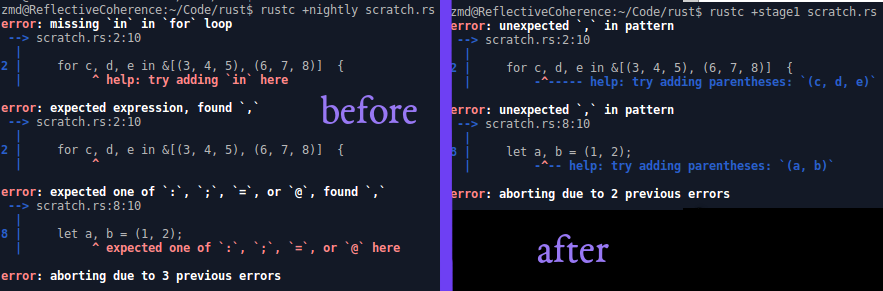
Programmers used to working in some other languages (such as Python or
Go) might expect to be able to destructure values with comma-separated
identifiers but no parentheses on the left side of an assignment.
Previously, the first name in such code would get parsed as a
single-indentifier pattern—recognizing, for example, the
`let a` in `let a, b = (1, 2);`—whereupon we would have a fatal syntax
error on seeing an unexpected comma rather than the expected semicolon
(all the way nearer to the end of `parse_full_stmt`).
Instead, let's look for that comma when parsing the pattern, and if we
see it, make-believe that we're parsing the remaining elements in a
tuple pattern, so that we can suggest wrapping it all in parentheses. We
need to do this in a separate wrapper method called on a "top-level"
pattern, rather than within
`parse_pat` itself, because `parse_pat` gets called recursively to parse
the sub-patterns within a tuple pattern.
~~We could also do this for `match` arms, `if let`, and `while let`, but
we elect not to in this patch, as it seems less likely for users to make
the mistake in those contexts.~~
Resolves#48492.
r? @petrochenkov
Programmers used to working in some other languages (such as Python or
Go) might expect to be able to destructure values with comma-separated
identifiers but no parentheses on the left side of an assignment.
Previously, the first name in such code would get parsed as a
single-indentifier pattern—recognizing, for example, the
`let a` in `let a, b = (1, 2);`—whereupon we would have a fatal syntax
error on seeing an unexpected comma rather than the expected semicolon
(all the way nearer to the end of `parse_full_stmt`).
Instead, let's look for that comma when parsing the pattern, and if we
see it, momentarily make-believe that we're parsing the remaining
elements in a tuple pattern, so that we can suggest wrapping it all in
parentheses. We need to do this in a separate wrapper method called on
the top-level pattern (or `|`-patterns) in a `let` statement, `for`
loop, `if`- or `while let` expression, or match arm rather than within
`parse_pat` itself, because `parse_pat` gets called recursively to parse
the sub-patterns within a tuple pattern.
Resolves#48492.
Also move the check for not having type parameters into ast_validation.

I was not sure what to do with compile-fail/issue-23046.rs: The issue looks like
maybe the bounds actually played a role in triggering the ICE, but that seems
unlikely given that the compiler seems to entirely ignore them.  However, I
couldn't find a testcase without the bounds, so I figured the best I could do is
to just remove the bounds and make sure at least that keeps working.


