Add stubs in IR and ABI for `f16` and `f128`

This is the very first step toward the changes in https://github.com/rust-lang/rust/pull/114607 and the [`f16` and `f128` RFC](https://rust-lang.github.io/rfcs/3453-f16-and-f128.html). It adds the types to `rustc_type_ir::FloatTy` and `rustc_abi::Primitive`, and just propagates those out as `unimplemented!` stubs where necessary.

These types do not parse yet so there is no feature gate, and it should be okay to use `unimplemented!`.

The next steps will probably be AST support with parsing and the feature gate.

r? `@compiler-errors`
cc `@Nilstrieb` suggested breaking the PR up in https://github.com/rust-lang/rust/pull/120645#issuecomment-1925900572
Safe Transmute: Revise safety analysis

This PR migrates `BikeshedIntrinsicFrom` to a simplified safety analysis (described [here](https://github.com/rust-lang/project-safe-transmute/issues/15)) that does not rely on analyzing the visibility of types and fields.

The revised analysis treats primitive types as safe, and user-defined types as potentially carrying safety invariants. If Rust gains explicit (un)safe fields, this PR is structured so that it will be fairly easy to thread support for those annotations into the analysis.

Notably, this PR removes the `Context` type parameter from `BikeshedIntrinsicFrom`. Most of the files changed by this PR are just UI tests tweaked to accommodate the removed parameter.

r? `@compiler-errors`
rustc: Fix wasm64 metadata object files
It looks like LLD will detect object files being either 32 or 64-bit depending on any memory present. LLD will additionally reject 32-bit objects during a 64-bit link. Previously metadata objects did not have any memories in them which led LLD to conclude they were 32-bit objects which broke 64-bit targets for wasm.
This commit fixes this by ensuring that for 64-bit targets there's a memory object present to get LLD to detect it's a 64-bit target. Additionally this commit moves away from a hand-crafted wasm encoder to the `wasm-encoder` crate on crates.io as the complexity grows for the generated object file.
Closes#121460
Detect empty leading where clauses on type aliases

1. commit: refactor the AST of type alias where clauses
   * I could no longer bear the look of `.0.1` and `.1.0`
   * Arguably moving `split` out of `TyAlias` into a substruct might not make that much sense from a semantic standpoint since it reprs an index into `TyAlias.predicates` but it's alright and it cleans up the usage sites of `TyAlias`
2. commit: fix an oversight: An empty leading where clause is still a leading where clause
   * semantically reject empty leading where clauses on lazy type aliases
     * e.g., on `#![feature(lazy_type_alias)] type X where = ();`
   * make empty leading where clauses on assoc types trigger lint `deprecated_where_clause_location`
     * e.g., `impl Trait for () { type X where = (); }`
Emitter cleanups

Some cleanups I made when reading emitter code. In particular, `HumanEmitter` and `JsonEmitter` have gone from three constructors to one.

r? `@oli-obk`
Count stashed errors again

Stashed diagnostics are such a pain. Their "might be emitted, might not" semantics messes with lots of things.

#120828 and #121206 made some big changes to how they work, improving some things, but still leaving some problems, as seen by the issues caused by #121206. This PR aims to fix all of them by restricting them in a way that eliminates the "might be emitted, might not" semantics while still allowing 98% of their benefit. Details in the individual commit logs.

r? `@oli-obk`
bootstrap/format: send larger batches to rustfmt

This helps on systems with low core counts. To benchmark this I made a lot of files be modified:
```
for FILE in $(find compiler/ -name "*.rs"); do echo "// end of the file" >>$FILE; done
```
Then I ran
```
hyperfine "./x.py fmt -j1" -w 1 -r 4
```
Before this patch:
```
Benchmark 1: ./x.py fmt -j1
  Time (mean ± σ):      3.426 s ±  0.032 s    [User: 4.681 s, System: 1.376 s]
  Range (min … max):    3.389 s …  3.462 s    4 runs
```
With this patch:
```
Benchmark 1: ./x.py fmt -j1
  Time (mean ± σ):      2.530 s ±  0.054 s    [User: 4.042 s, System: 0.467 s]
  Range (min … max):    2.452 s …  2.576 s    4 runs
```
I removed it in #121206 because I thought thought it wasn't necessary.
But then I had to add an `emit_stashed_diagnostics` call elsewhere in
rustfmt to avoid the assertion failure (which took two attempts to get
right, #121487 and #121615), and now there's an assertion failure in
clippy as well (https://github.com/rust-lang/rust-clippy/issues/12364).

So this commit just reinstates the call in `DiagCtxtInner::drop`. It
also reverts the rustfmt changes from #121487 and #121615, though it
keeps the tests added for those PRs.
Stashed errors used to be counted as errors, but could then be
cancelled, leading to `ErrorGuaranteed` soundness holes. #120828 changed
that, closing the soundness hole. But it introduced other difficulties
because you sometimes have to account for pending stashed errors when
making decisions about whether errors have occured/will occur and it's
easy to overlook these.
This commit aims for a middle ground.
- Stashed errors (not warnings) are counted immediately as emitted
errors, avoiding the possibility of forgetting to consider them.
- The ability to cancel (or downgrade) stashed errors is eliminated, by
disallowing the use of `steal_diagnostic` with errors, and introducing
the more restrictive methods `try_steal_{modify,replace}_and_emit_err`
that can be used instead.
Other things:
- `DiagnosticBuilder::stash` and `DiagCtxt::stash_diagnostic` now both
return `Option<ErrorGuaranteed>`, which enables the removal of two
`delayed_bug` calls and one `Ty::new_error_with_message` call. This is
possible because we store error guarantees in
`DiagCtxt::stashed_diagnostics`.
- Storing the guarantees also saves us having to maintain a counter.
- Calls to the `stashed_err_count` method are no longer necessary
alongside calls to `has_errors`, which is a nice simplification, and
eliminates two more `span_delayed_bug` calls and one FIXME comment.
- Tests are added for three of the four fixed PRs mentioned below.
- `issue-121108.rs`'s output improved slightly, omitting a non-useful
error message.
Fixes#121451.
Fixes#121477.
Fixes#121504.
Fixes#121508.
Use `LitKind::Err` for malformed floats

#121120 changed `StringReader::cook_lexer_literal` to return `LitKind::Err` for malformed integer literals. This commit does the same for float literals, for consistency.

r? ``@fmease``
[rustdoc] Prevent inclusion of whitespace character after macro_rules ident
Discovered this bug randomly when looking at:
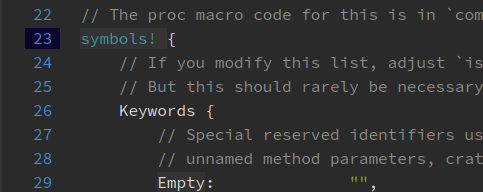
We were too eagerly trying to merge tokens that shouldn't be merged together (for example if you have a code comment followed by a code comment, we merge them in one attribute to reduce the DOM size).
r? ``@notriddle``
Diagnostic renaming

Renaming various diagnostic types from `Diagnostic*` to `Diag*`. Part of https://github.com/rust-lang/compiler-team/issues/722. There are more to do but this is enough for one PR.

r? `@davidtwco`
The C wrapper program represents a typical use case (linking
C libraries with Rust libraries) but it was not made explicit how
this was supposed to work in the usage example.

Also: correct a table alignment error for hexagon-unknown-none-elf on the
general platform support doc.
Rollup of 12 pull requests

Successful merges:

 - #120051 (Add `display` method to `OsStr`)
 - #121226 (Fix issues in suggesting importing extern crate paths)
 - #121423 (Remove the `UntranslatableDiagnosticTrivial` lint.)
 - #121527 (unix_sigpipe: Simple fixes and improvements in tests)
 - #121572 (Add test case for primitive links in alias js)
 - #121661 (Changing some attributes to only_local.)
 - #121680 (Fix link generation for foreign macro in jump to definition feature)
 - #121686 (Adjust printing for RPITITs)
 - #121691 (handle unavailable creation time as `io::ErrorKind::Unsupported`)
 - #121695 (Split rustc_type_ir to avoid rustc_ast from depending on it)
 - #121698 (CFI: Fix typo in test file names)
 - #121702 (Process alias-relate obligations in CoerceUnsized loop)

r? `@ghost`
`@rustbot` modify labels: rollup
Fix link generation for foreign macro in jump to definition feature

The crate name is already added to the link so it shouldn't be added a second time for local foreign macros.

r? ``@notriddle``
It's a specialized form of the `UntranslatableDiagnostic` lint that is
deny-by-default.

Now that `UntranslatableDiagnostic` has been changed from
allow-by-default to deny-by-default, the trivial variant is no longer
needed.
Add a new `wasm32-wasi-preview2` target

This is the initial implementation of the MCP https://github.com/rust-lang/compiler-team/issues/694 creating a new tier 3 target `wasm32-wasi-preview2`. That MCP has been seconded and will most likely be approved in a little over a week from now. For more information on the need for this target, please read the [MCP](https://github.com/rust-lang/compiler-team/issues/694).

There is one aspect of this PR that will become insta-stable once these changes reach a stable compiler:
* A new `target_family` named `wasi` is introduced. This target family incorporates all wasi targets including `wasm32-wasi` and its derivative `wasm32-wasi-preview1-threads`. The difference between `target_family = wasi` and `target_os = wasi` will become much clearer when `wasm32-wasi` is renamed to `wasm32-wasi-preview1` and the `target_os` becomes `wasm32-wasi-preview1`. You can read about this target rename in [this MCP](https://github.com/rust-lang/compiler-team/issues/695) which has also been seconded and will hopefully be officially approved soon.

Additional technical details include:
* Both `std::sys::wasi_preview2` and `std::os::wasi_preview2` have been created and mostly use `#[path]` annotations on their submodules to reach into the existing `wasi` (soon to be `wasi_preview1`) modules. Over time the differences between `wasi_preview1` and `wasi_preview2` will grow and most like all `#[path]` based module aliases will fall away.
* Building `wasi-preview2` relies on a [`wasi-sdk`](https://github.com/WebAssembly/wasi-sdk) in the same way that `wasi-preview1` does (one must include a `wasi-root` path in the `Config.toml` pointing to sysroot included in the wasi-sdk). The target should build against [wasi-sdk v21](https://github.com/WebAssembly/wasi-sdk/releases/tag/wasi-sdk-21) without modifications. However, the wasi-sdk itself is growing [preview2 support](https://github.com/WebAssembly/wasi-sdk/pull/370) so this might shift rapidly. We will be following along quickly to make sure that building the target remains possible as the wasi-sdk changes.
* This requires a [patch to libc](https://github.com/rylev/rust-libc/tree/wasm32-wasi-preview2) that we'll need to land in conjunction with this change. Until that patch lands the target won't actually build.
rename 'try' intrinsic to 'catch_unwind'

The intrinsic has nothing to do with `try` blocks, and corresponds to the stable `catch_unwind` function, so this makes a lot more sense IMO.

Also rename Miri's special function while we are at it, to reflect the level of abstraction it works on: it's an unwinding mechanism, on which Rust implements panics.


