This commit allocates a builder to running wasm32 tests on Travis. Not all test
suites pass right now so this is starting out with just the run-pass and the
libcore test suites. This'll hopefully give us a pretty broad set of coverage
for integration in rustc itself as well as a somewhat broad coverage of the llvm
backend itself through integration/unit tests.
Mir Borrowck: Parity with Ast for E0384 (Cannot assign twice to immutable)
- Closes#45199
- Don't allow assigning to dropped immutable variables
- Show the "first assignment" note on the first assignment that can actually come before the second assignment.
- Make "first assignment" notes point to function parameters if needed.
- Don't show a "first assignment" note if the first and second assignment have the same span (in a loop). This matches ast borrowck for now, but maybe this we should add "in previous loop iteration" as with some other borrowck errors. (Commit 2)
- Use revisions to check mir borrowck for the existing tests for this error. (Commit 3)
~~Still working on a less ad-hoc way to get 'first assignment' notes to show on the correct assignment. Also need to check mutating function arguments.~~ Now using a new dataflow pass.
Make accesses to fields of packed structs unsafe

To handle packed structs with destructors (which you'll think are a rare
case, but the `#[repr(packed)] struct Packed<T>(T);` pattern is
ever-popular, which requires handling packed structs with destructors to
avoid monomorphization-time errors), drops of subfields of packed
structs should drop a local move of the field instead of the original
one.

That's it, I think I'll use a strategy suggested by @Zoxc, where this mir
```
drop(packed_struct.field)
```

is replaced by
```
tmp0 = packed_struct.field;
drop tmp0
```

cc #27060 - this should deal with that issue after codegen of drop glue
is updated.

The new errors need to be changed to future-compatibility warnings, but
I'll rather do a crater run first with them as errors to assess the
impact.

cc @eddyb

Things which still need to be done for this:
 - [ ] - handle `repr(packed)` structs in `derive` the same way I did in `Span`, and use derive there again
 - [ ] - implement the "fix packed drops" pass and call it in both the MIR shim and validated MIR pipelines
 - [ ] - do a crater run
 - [ ] - convert the errors to compatibility warnings
Fix the derive implementation for repr(packed) structs to move the
fields out instead of calling functions on references to each subfield.

That's it, `#[derive(PartialEq)]` on a packed struct now does:
```Rust
fn eq(&self, other: &Self) {
    let field_0 = self.0;
    let other_field_0 = other.0;
    &field_0 == &other_field_0
}
```

Instead of
```Rust
fn eq(&self, other: &Self) {
    let ref field_0 = self.0;
    let ref other_field_0 = other.0;
    &*field_0 == &*other_field_0
}
```

Taking (unaligned) references to each subfield is undefined, unsound and
is an error with MIR effectck, so it had to be prevented. This causes
a borrowck error when a `repr(packed)` struct has a non-Copy field (and
therefore is a [breaking-change]), but I don't see a sound way to avoid
that error.
To handle packed structs with destructors (which you'll think are a rare
case, but the `#[repr(packed)] struct Packed<T>(T);` pattern is
ever-popular, which requires handling packed structs with destructors to
avoid monomorphization-time errors), drops of subfields of packed
structs should drop a local move of the field instead of the original
one.

cc #27060 - this should deal with that issue after codegen of drop glue
is updated.

The new errors need to be changed to future-compatibility warnings, but
I'll rather do a crater run first with them as errors to assess the
impact.
typeck aggregate rvalues in MIR type checker

This branch is an attempt to land content by @spastorino and @Nashenas88 that was initially landed on nll-master while we waited for https://github.com/rust-lang/rust/pull/45825 to land.

The biggest change it contains is that it extends the MIR type-checker to also type-check MIR aggregate rvalues (at least partially). Specifically, it checks that the operands provided for each field have the right type.

It does not yet check that their well-formedness predicates are met. That is https://github.com/rust-lang/rust/issues/45827. It also does not check other kinds of rvalues (that is https://github.com/rust-lang/rust/issues/45959). @spastorino is working on those issues now.

r? @arielb1
Implement in-band lifetime bindings
TODO (perhaps in a future PR): Should we ban explicit instantiation of generics with in-band lifetimes, or is it uncontroversial to just append them to the end of the lifetimes list?
Fixes#46042, cc #44524.
r? @nikomatsakis
Use the proper term when using non-existing variant
When using a non-existing variant, function or associated item, refer to
the proper term, instead of defaulting to "associated item" in
diagnostics.
Fix#28972.
```
error[E0599]: no variant named `Quux` found for type `Foo` in the current scope
--> file.rs:7:9
|
7 | Foo::Quux(..) =>(),
| ^^^^^^^^^^^^^
```
rustdoc: include external files in documentation (RFC 1990)
Part of https://github.com/rust-lang/rfcs/pull/1990 (needs work on the error reporting, which i'm deferring to after this initial PR)
cc #44732
Also fixes#42760, because the prep work for the error reporting made it easy to fix that at the same time.
MIR-borrowck: Some minor fixes
- Remove parens when printing dereference (fix#45185)
- Change argument type of `autoderef` to `bool`
- Change argument type of `field_index` to `Field`
move closure kind, signature into `ClosureSubsts`

Instead of using side-tables, store the closure-kind and signature in the substitutions themselves. This has two key effects:

- It means that the closure's type changes as inference finds out more things, which is very nice.
    - As a result, it avoids the need for the `freshen_closure_like` code (though we still use it for generators).
- It avoids cyclic closures calls.
    - These were never meant to be supported, precisely because they make a lot of the fancy inference that we do much more complicated. However, due to an oversight, it was previously possible -- if challenging -- to create a setup where a closure *directly* called itself (see e.g. #21410).

We have to see what the effect of this change is, though. Needs a crater run. Marking as [WIP] until that has been assessed.

r? @arielb1
dead code lint to say "never constructed" for variants
As reported in #19140, #44083, and #44565, some users were confused when
the dead-code lint reported an enum variant to be "unused" when it was
matched on (but not constructed). This wording change makes it clearer
that the lint is in fact checking for construction.
We continue to say "used" for all other items (it's tempting to say
"called" for functions and methods, but this turns out not to be
correct: functions can be passed as arguments and the dead-code lint
isn't special-casing that or anything).
Resolves#19140.
r? @pnkfelix
impl Trait Lifetime Handling
This PR implements the updated strategy for handling `impl Trait` lifetimes, as described in [RFC 1951](https://github.com/rust-lang/rfcs/blob/master/text/1951-expand-impl-trait.md) (cc #42183).
With this PR, the `impl Trait` desugaring works as follows:
```rust
fn foo<T, 'a, 'b, 'c>(...) -> impl Foo<'a, 'b> { ... }
// desugars to
exists type MyFoo<ParentT, 'parent_a, 'parent_b, 'parent_c, 'a, 'b>: Foo<'a, 'b>;
fn foo<T, 'a, 'b, 'c>(...) -> MyFoo<T, 'static, 'static, 'static, 'a, 'b> { ... }
```
All of the in-scope (parent) generics are listed as parent generics of the anonymous type, with parent regions being replaced by `'static`. Parent regions referenced in the `impl Trait` return type are duplicated into the anonymous type's generics and mapped appropriately.
One case came up that wasn't specified in the RFC: it's possible to write a return type that contains multiple regions, neither of which outlives the other. In that case, it's not clear what the required lifetime of the output type should be, so we generate an error.
There's one remaining FIXME in one of the tests: `-> impl Foo<'a, 'b> + 'c` should be able to outlive both `'a` and `'b`, but not `'c`. Currently, it can't outlive any of them. @nikomatsakis and I have discussed this, and there are some complex interactions here if we ever allow `impl<'a, 'b> SomeTrait for AnonType<'a, 'b> { ... }`, so the plan is to hold off on this until we've got a better idea of what the interactions are here.
cc #34511.
Fixes#44727.
show in docs whether the return type of a function impls Iterator/Read/Write
Closes#25928
This PR makes it so that when rustdoc documents a function, it checks the return type to see whether it implements a handful of specific traits. If so, it will print the impl and any associated types. Rather than doing this via a whitelist within rustdoc, i chose to do this by a new `#[doc]` attribute parameter, so things like `Future` could tap into this if desired.
### Known shortcomings
~~The printing of impls currently uses the `where` class over the whole thing to shrink the font size relative to the function definition itself. Naturally, when the impl has a where clause of its own, it gets shrunken even further:~~ (This is no longer a problem because the design changed and rendered this concern moot.)
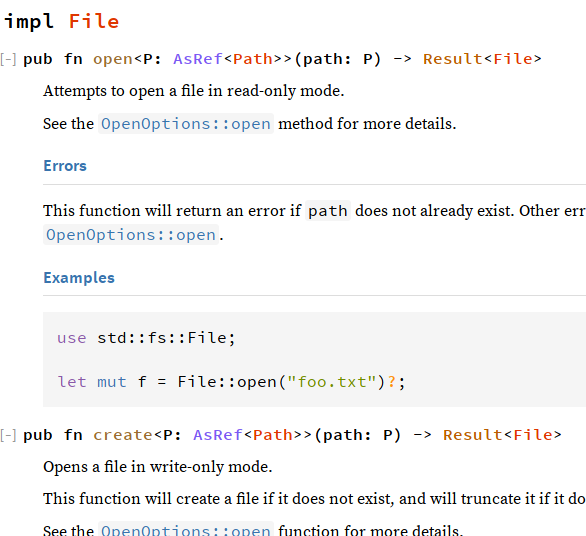
The lookup currently just looks at the top-level type, not looking inside things like Result or Option, which renders the spotlights on Read/Write a little less useful:
<details><summary>`File::{open, create}` don't have spotlight info (pic of old design)</summary>
</details>
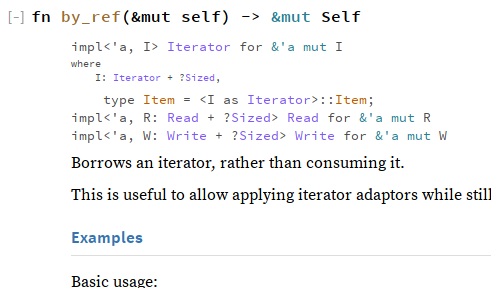
All three of the initially spotlighted traits are generically implemented on `&mut` references. Rustdoc currently treats a `&mut T` reference-to-a-generic as an impl on the reference primitive itself. `&mut Self` counts as a generic in the eyes of rustdoc. All this combines to create this lovely scene on `Iterator::by_ref`:
<details><summary>`Iterator::by_ref` spotlights Iterator, Read, and Write (pic of old design)</summary>
</details>
std: Add a new wasm32-unknown-unknown target

This commit adds a new target to the compiler: wasm32-unknown-unknown. This target is a reimagining of what it looks like to generate WebAssembly code from Rust. Instead of using Emscripten which can bring with it a weighty runtime this instead is a target which uses only the LLVM backend for WebAssembly and a "custom linker" for now which will hopefully one day be direct calls to lld.

Notable features of this target include:

* There is zero runtime footprint. The target assumes nothing exists other than the wasm32 instruction set.
* There is zero toolchain footprint beyond adding the target. No custom linker is needed, rustc contains everything.
* Very small wasm modules can be generated directly from Rust code using this target.
* Most of the standard library is stubbed out to return an error, but anything related to allocation works (aka `HashMap`, `Vec`, etc).
* Naturally, any `#[no_std]` crate should be 100% compatible with this new target.

This target is currently somewhat janky due to how linking works. The "linking" is currently unconditional whole program LTO (aka LLVM is being used as a linker). Naturally that means compiling programs is pretty slow! Eventually though this target should have a linker.

This target is also intended to be quite experimental. I'm hoping that this can act as a catalyst for further experimentation in Rust with WebAssembly. Breaking changes are very likely to land to this target, so it's not recommended to rely on it in any critical capacity yet. We'll let you know when it's "production ready".

### Building yourself

First you'll need to configure the build of LLVM and enable this target

```
$ ./configure --target=wasm32-unknown-unknown --set llvm.experimental-targets=WebAssembly
```

Next you'll want to remove any previously compiled LLVM as it needs to be rebuilt with WebAssembly support. You can do that with:

```
$ rm -rf build
```

And then you're good to go! A `./x.py build` should give you a rustc with the appropriate libstd target.

### Test support

Currently testing-wise this target is looking pretty good but isn't complete. I've got almost the entire `run-pass` test suite working with this target (lots of tests ignored, but many passing as well). The `core` test suite is [still getting LLVM bugs fixed](https://reviews.llvm.org/D39866) to get that working and will take some time. Relatively simple programs all seem to work though!

In general I've only tested this with a local fork that makes use of LLVM 5 rather than our current LLVM 4 on master. The LLVM 4 WebAssembly backend AFAIK isn't broken per se but is likely missing bug fixes available on LLVM 5. I'm hoping though that we can decouple the LLVM 5 upgrade and adding this wasm target!

### But the modules generated are huge!

It's worth nothing that you may not immediately see the "smallest possible wasm module" for the input you feed to rustc. For various reasons it's very difficult to get rid of the final "bloat" in vanilla rustc (again, a real linker should fix all this). For now what you'll have to do is:

    cargo install --git https://github.com/alexcrichton/wasm-gc
    wasm-gc foo.wasm bar.wasm

And then `bar.wasm` should be the smallest we can get it!

---

In any case for now I'd love feedback on this, particularly on the various integration points if you've got better ideas of how to approach them!
This commit adds a new target to the compiler: wasm32-unknown-unknown. This
target is a reimagining of what it looks like to generate WebAssembly code from
Rust. Instead of using Emscripten which can bring with it a weighty runtime this
instead is a target which uses only the LLVM backend for WebAssembly and a
"custom linker" for now which will hopefully one day be direct calls to lld.

Notable features of this target include:

* There is zero runtime footprint. The target assumes nothing exists other than
  the wasm32 instruction set.
* There is zero toolchain footprint beyond adding the target. No custom linker
  is needed, rustc contains everything.
* Very small wasm modules can be generated directly from Rust code using this
  target.
* Most of the standard library is stubbed out to return an error, but anything
  related to allocation works (aka `HashMap`, `Vec`, etc).
* Naturally, any `#[no_std]` crate should be 100% compatible with this new
  target.

This target is currently somewhat janky due to how linking works. The "linking"
is currently unconditional whole program LTO (aka LLVM is being used as a
linker). Naturally that means compiling programs is pretty slow! Eventually
though this target should have a linker.

This target is also intended to be quite experimental. I'm hoping that this can
act as a catalyst for further experimentation in Rust with WebAssembly. Breaking
changes are very likely to land to this target, so it's not recommended to rely
on it in any critical capacity yet. We'll let you know when it's "production
ready".

---

Currently testing-wise this target is looking pretty good but isn't complete.
I've got almost the entire `run-pass` test suite working with this target (lots
of tests ignored, but many passing as well). The `core` test suite is still
getting LLVM bugs fixed to get that working and will take some time. Relatively
simple programs all seem to work though!

---

It's worth nothing that you may not immediately see the "smallest possible wasm
module" for the input you feed to rustc. For various reasons it's very difficult
to get rid of the final "bloat" in vanilla rustc (again, a real linker should
fix all this). For now what you'll have to do is:

    cargo install --git https://github.com/alexcrichton/wasm-gc
    wasm-gc foo.wasm bar.wasm

And then `bar.wasm` should be the smallest we can get it!

---

In any case for now I'd love feedback on this, particularly on the various
integration points if you've got better ideas of how to approach them!



