Cleanup rustdoc pass descriptions a bit

Also changed a couple of comments from "intra-doc-links" to
"intra-doc links" (my understanding is that "intra-doc links" is the
standard way to refer to them).
Remove struct_type from union output

Also bumps the format number and adds a test

Rationale: It's illegal to have unions of the form `union Union(i32, f32);`, or `union Union;`. The struct_type field was recently removed from the rustdoc Union AST, at which time this field was changed to always just read "union". It makes sense to completely remove it, as it provides no information.
rustdoc: Move `display_fn` struct inside `display_fn`

This makes it clear that it's an implementation detail of `display_fn`
and shouldn't be used elsewhere, and it enforces in the compiler that no
one else can use it.

r? ````@GuillaumeGomez````
Make remote-test-server easier to use with new targets

While testing #81455 I encountered 2 issues with `remote-test-server`:
- It is built with the stage 0 toolchain, which does not support a newly added target.
- It overwrites `LD_LIBRARY_PATH` instead of appending to it, which prevents the use of a custom sysroot for target libraries.
rustdoc-json: Fix has_body

Previously, `has_body` was always true. Now propagate the type of the method to set it correctly. Relies on #81287, that will need to be merged first.
relax adt unsizing requirements

Changes unsizing of structs in case the last struct field shares generic params with other adt fields which do not change.
This change is currently insta stable and changes the language, so it at least requires a lang fcp. I feel like the current state is fairly unintuitive.

An example for what's now allowed would be https://play.rust-lang.org/?version=stable&mode=debug&edition=2018&gist=6dd331d23f5c9ffc8c978175aae2e967
```rust
struct A<T, U: ?Sized>(T, B<T, U>); // previously ERR
// struct A<T, U: ?Sized>(T, B<[u32; 1], U>); // ok
struct B<T, U: ?Sized>(T, U);

fn main() {
    let x = A([0; 1], B([0; 1], [0; 1]));
    let y: &A<[u32; 1], [u32]> = &x;
    assert_eq!(y.1.1.len(), 1);
}
```
Use `# min-llvm-version: 11.0` to force a minimum LLVM version

Use `# min-llvm-version: 11.0` to force a minimum LLVM version, rather than ad-hoc internal solution.

In particular: the specific code to define LLVM_VERSION_11_PLUS here was, for some reason, using `$(shell ...)` with bash-specific variable replacement code. On non-bash platforms like dash, that `shell` invocation would fail, and the
LLVM_VERSION_11_PLUS check would always fail, the test would always be ignored, and thus be treated as a "success" (in the sense that `--bless` would never do anything).

 * Note in particular that GNU Make treats the SHELL variable as a very special case: it does not inherit the value of SHELL from the user's environment. Except on Windows. See more explanation in the [GNU Make docs](https://www.gnu.org/software/make/manual/html_node/Choosing-the-Shell.html).
 * The effect of this is that these tests end up using `/bin/sh` (except on Windows) for their `$(shell ...)` invocations, and thus we see differing behaviors depending on whether your `/bin/sh` links to `/bin/dash` or to `/bin/bash`.

This was causing me a lot of pain.
Update cargo

5 commits in e099df243bb2495b9b197f79c19f124032b1e778..34170fcd6e0947808a1ac63ac85ffc0da7dace2f
2021-02-01 16:24:34 +0000 to 2021-02-04 15:52:52 +0000
- Fix permission issue with `cargo vendor`. (rust-lang/cargo#9131)
- Add split-debuginfo profile option (rust-lang/cargo#9112)
- Add RegistryBuilder for tests, and update crates-io error handling. (rust-lang/cargo#9126)
- Add some documentation for index and registry stuff. (rust-lang/cargo#9125)
- Fix env/cfg set for `cargo test` and `cargo run`. (rust-lang/cargo#9122)
Rollup of 9 pull requests

Successful merges:

 - #74304 (Stabilize the Wake trait)
 - #79805 (Rename Iterator::fold_first to reduce and stabilize it)
 - #81556 (introduce future-compatibility warning for forbidden lint groups)
 - #81645 (Add lint for `panic!(123)` which is not accepted in Rust 2021.)
 - #81710 (OsStr eq_ignore_ascii_case takes arg by value)
 - #81711 (add #[inline] to all the public IpAddr functions)
 - #81725 (Move test to be with the others)
 - #81727 (Revert stabilizing integer::BITS.)
 - #81745 (Stabilize poison API of Once, rename poisoned())

Failed merges:

r? `@ghost`
`@rustbot` modify labels: rollup
Also changed a couple of comments from "intra-doc-links" to
"intra-doc links" (my understanding is that "intra-doc links" is the
standard way to refer to them).
CI: only copy python.exe to python3.exe if the latter does not exist

We're copying the binary to make sure we can call `python3.exe` around, but it seems like the base image of GitHub Actions changed, copying the file before we do so. This PR changes the CI script to only copy the file if it doesn't already exist.

r? `@m-ou-se`
cc `@Mark-Simulacrum`
We're copying the binary to make sure we can call python3.exe around,
but it seems like the base image of GitHub Actions changed, copying the
file before we do so.

This commit changes the CI script to only copy the file if it doesn't
already exist.
Move test to be with the others

No functional changes. I just created this test in the wrong place in a past PR. All of the other or-pattern tests are in the `or-patterns` directory.
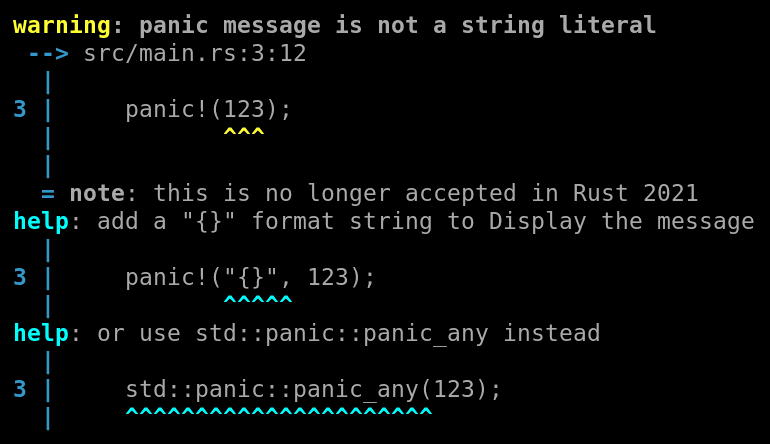
Add lint for `panic!(123)` which is not accepted in Rust 2021.
This extends the `panic_fmt` lint to warn for all cases where the first argument cannot be interpreted as a format string, as will happen in Rust 2021.
It suggests to add `"{}",` to format the message as a string. In the case of `std::panic!()`, it also suggests the recently stabilized
`std::panic::panic_any()` function as an alternative.
It renames the lint to `non_fmt_panic` to match the lint naming guidelines.
This is part of #80162.
r? ```@estebank```
introduce future-compatibility warning for forbidden lint groups

We used to ignore `forbid(group)` scenarios completely. This changed in #78864, but that led to a number of regressions (#80988, #81218).

This PR introduces a future compatibility warning for the case where a group is forbidden but then an individual lint within that group is allowed. We now issue a FCW when we see the "allow", but permit it to take effect.

r? ``@Mark-Simulacrum``
Stabilize the Wake trait

This PR proposes stabilizing the `wake_trait` feature, tracking issue https://github.com/rust-lang/rust/issues/69912.

## Motivation

The surface area this trait introduces is small, and it has been on nightly for 4 months without any reported issues. Given the surface area of this trait is small and only serves to provide a safe interface around the already stable [`std::task::RawWakerVTable`](https://doc.rust-lang.org/std/task/struct.RawWaker.html) it seems unlikely this trait will require any further changes. So I'm proposing we stabilize this.

Personally I would love to have this available on stable, since it would enable cleaning up some runtime internals by removing the tedious pointer required to construct a [`RawWakerVTable`](https://doc.rust-lang.org/std/task/struct.RawWakerVTable.html). I believe the intent was always to introduce a `Wake` counterpart to `RawWaker` in order to safely construct `Waker` instances. And the `Wake` trait feels like it does that job as intended.

## Implementation notes

This PR itself fixes a link in the docs, and introduces an example of how to use the trait: a minimal `block_on` example that runs a future to completion on the current thread. It doesn't include fancier features such as support for nesting, but is intended to serve as a teaching device for both `task::Wake` and futures alike.
This extends the `panic_fmt` lint to warn for all cases where the first
argument cannot be interpreted as a format string, as will happen in
Rust 2021.

It suggests to add `"{}", ` to format the message as a string. In the
case of `std::panic!()`, it also suggests the recently stabilized
`std::panic::panic_any()` function as an alternative.

It renames the lint to `non_fmt_panic` to match the lint naming
guidelines.
(Test was silently ignored on Linux CI prior to parent commit that switched to
using `# min-llvm-version`. But the switch made the ignoring stop, exposing
other brokenness in the form of bash-dependent syntax in the `$(shell ...)`
invocations.)
Fix panic when emitting diagnostic for closure mutable binding error
Fixes#81700
The upvar borrow kind may be `ty::BorrowKind::UniqueImmBorrow`, which is
still a mutable borrow for the purposes of this diagnostic code.
Fix non-existent-field ICE for generic fields.
I mentioned this ICE in a chat and it took about 3 milliseconds before `@eddyb` found the problem and said this change would fix it. :)
This also changes one the field types in the related test to one that triggered the ICE.
Fixes#81627.
Fixes#81672.
Fixes#81709.
Cc https://github.com/rust-lang/rust/pull/81480 `@b-naber` `@estebank.`
Remove incorrect `delay_span_bug`

The following code is supposed to compile

```rust
use std::ops::BitOr;

pub trait IntWrapper {
    type InternalStorage;
}

impl<T> BitOr for dyn IntWrapper<InternalStorage = T>
where
    Self: Sized,
    T: BitOr + BitOr<Output = T>,
{
    type Output = Self;
    fn bitor(self, _other: Self) -> Self {
        todo!()
    }
}
```

Before this change it would ICE. In #70998 the removed logic was added
to provide better suggestions, and the `delay_span_bug` guard was added
to  protect against a potential logic error when returning traits. As it
happens, there are cases, like the one above, where traits can indeed be
returned, so valid code was being rejected.

Fix (but not close) #80207.
make const_err a future incompat lint

This is the first step for https://github.com/rust-lang/rust/issues/71800: make const_err a future-incompat lint. I also rewrote the const_err lint description as the old one seemed wrong.

This has the unfortunate side-effect of making const-eval error even more verbose by making the const_err message longer without fixing the redundancy caused by additionally emitting an error on each use site of the constant. We cannot fix that redundancy until const_err is a *hard* error (at that point the error-on-use-site can be turned into a `delay_span_bug!` for uses of monomorphic consts, and into a nicely rendered error for [lazily / post-monomorhization evaluated] associated consts).

~~The one annoying effect of this PR is that `let _x = &(1/(1-1));` now also shows the future-incompat warning, even though of course we will *not* make this a hard error. We'll instead (hopefully) stop promoting it -- see https://github.com/rust-lang/rfcs/pull/3027. The only way I see to avoid the future-incompat warning is to use a different lint for "failure to evaluate promoted".~~

Cc `@rust-lang/wg-const-eval`
The following code is supposed to compile
```rust
use std::ops::BitOr;
pub trait IntWrapper {
type InternalStorage;
}
impl<T> BitOr for dyn IntWrapper<InternalStorage = T>
where
Self: Sized,
T: BitOr + BitOr<Output = T>,
{
type Output = Self;
fn bitor(self, _other: Self) -> Self {
todo!()
}
}
```
Before this change it would ICE. In #70998 the removed logic was added
to provide better suggestions, and the `delay_span_bug` guard was added
to protect against a potential logic error when returning traits. As it
happens, there are cases, like the one above, where traits can indeed be
returned, so valid code was being rejected.
Fix#80207.


