Add lint for panic!("{}")
This adds a lint that warns about `panic!("{}")`.
`panic!(msg)` invocations with a single argument use their argument as panic payload literally, without using it as a format string. The same holds for `assert!(expr, msg)`.
This lints checks if `msg` is a string literal (after expansion), and warns in case it contained braces. It suggests to insert `"{}", ` to use the message literally, or to add arguments to use it as a format string.
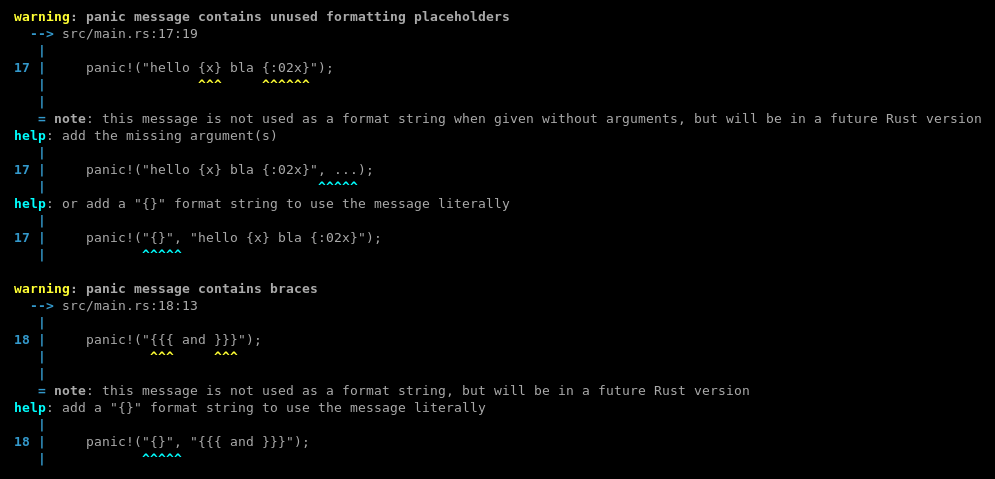
This lint is also a good starting point for adding warnings about `panic!(not_a_string)` later, once [`panic_any()`](https://github.com/rust-lang/rust/pull/74622) becomes a stable alternative.
Test drop order for (destructuring) assignments

Add a test that checks whether the drop order of `let` bindings is consistent with the drop order of the corresponding destructuring assignments.

Thanks to ```@RalfJung``` for the suggesting this test ([here](https://github.com/rust-lang/rust/pull/79016#issuecomment-727608732)) and an implementation!

r? ```@RalfJung```
add optimization fuel checks to some mir passes
Fixes#77402
Inserts a bunch of calls to `consider_optimizing`. Note that `consider_optimizing` is the method that actually decrements the fuel count, so the point at which it's called is when the optimization takes place, from a fuel perspective. This means that where we call it has some thought behind it:
1. We probably don't want to decrement the fuel count before other simple checks, otherwise we count an optimization as being performed even if nothing was mutated (ie. it returned early).
2. In cases like `InstCombine`, where we gather optimizations in a pass and then mutate values, we probably would rather skip the gathering pass for performance reasons rather than skip the mutations afterwards.
Improve the diagnostic for when an `fn` contains qualifiers inside an `extern` block.

This mitigates #78941. As suggested by ```@estebank,``` `span_suggestion` was replaced with `span_suggestion_verbose` for this specific diagnostic.
Make bad "rust-call" arguments no longer ICE
The simplest of bad rust-call definitions will no longer cause an ICE. There is a FIXME added for future work, as I wanted to get this easy fix in before trying to either add a hack or mess with the whole obligation system
fixes#22565
Handle empty matches cleanly in exhaustiveness checking

This removes the special-casing of empty matches that was done in `check_match`. This fixes most of https://github.com/rust-lang/rust/issues/55123.
Somewhat unrelatedly, I also made `_match.rs` more self-contained, because I think it's cleaner.

r? `@varkor`
`@rustbot` modify labels: +A-exhaustiveness-checking
type is too big -> values of the type are too big

strictly speaking, `[u8; usize::MAX]` or even `[[[u128; usize::MAX]; usize::MAX]; usize::MAX]` are absolutely fine types as long as you don't try to deal with any values of it.

This error message seems to cause some confusion imo, for example in https://github.com/rust-lang/rust/pull/79135#issuecomment-729361380 so I would prefer us to be more precise here.

See the added test case which uses one of these types without causing an error.

r? ``@oli-obk``
RFC-2229: Implement Precise Capture Analysis
### This PR introduces
- Feature gate for RFC-2229 (incomplete) `capture_disjoint_field`
- Rustc Attribute to print out the capture analysis `rustc_capture_analysis`
- Precise capture analysis
### Description of the analysis
1. If the feature gate is not set then all variables that are not local to the closure will be added to the list of captures. (This is for backcompat)
2. The rest of the analysis is based entirely on how the captured `Place`s are used within the closure. Precise information (i.e. projections) about the `Place` is maintained throughout.
3. To reduce the amount of information we need to keep track of, we do a minimization step. In this step, we determine a list such that no Place within this list represents an ancestor path to another entry in the list. Check rust-lang/project-rfc-2229#9 for more detailed examples.
4. To keep the compiler functional as before we implement a Bridge between the results of this new analysis to existing data structures used for closure captures. Note the new capture analysis results are only part of MaybeTypeckTables that is the information is only available during typeck-ing.
### Known issues
- Statements like `let _ = x` will make the compiler ICE when used within a closure with the feature enabled. More generally speaking the issue is caused by `let` statements that create no bindings and are init'ed using a Place expression.
### Testing
We removed the code that would handle the case where the feature gate is not set, to enable the feature as default and did a bors try and perf run. More information here: #78762
### Thanks
This has been slowly in the works for a while now.
I want to call out `@Azhng` `@ChrisPardy` `@null-sleep` `@jenniferwills` `@logmosier` `@roxelo` for working on this and the previous PRs that led up to this, `@nikomatsakis` for guiding us.
Closesrust-lang/project-rfc-2229#7Closesrust-lang/project-rfc-2229#9Closesrust-lang/project-rfc-2229#6Closesrust-lang/project-rfc-2229#19
r? `@nikomatsakis`
improve type const mismatch errors

Doesn't completely remove `check_generic_arg_count` as that would have required some more complex changes but
instead checks type and const params in only one step. Also moved the help added by `@JulianKnodt` in #75611 to `generic_arg_mismatch_err`.

r? `@varkor` cc `@petrochenkov`
Simplify output capturing

This is a sequence of incremental improvements to the unstable/internal `set_panic` and `set_print` mechanism used by the `test` crate:

1. Remove the `LocalOutput` trait and use `Arc<Mutex<dyn Write>>` instead of `Box<dyn LocalOutput>`. In practice, all implementations of `LocalOutput` were just `Arc<Mutex<..>>`. This simplifies some logic and removes all custom `Sink` implementations such as `library/test/src/helpers/sink.rs`. Also removes a layer of indirection, as the outermost `Box` is now gone. It also means that locking now happens per `write_fmt`, not per individual `write` within. (So `"{} {}\n"` now results in one `lock()`, not four or more.)

2. Since in all cases the `dyn Write`s were just `Vec<u8>`s, replace the type with `Arc<Mutex<Vec<u8>>>`. This simplifies things more, as error handling and flushing can be removed now. This also removes the hack needed in the default panic handler to make this work with `::realstd`, as (unlike `Write`) `Vec<u8>` is from `alloc`, not `std`.

3. Replace the `RefCell`s by regular `Cell`s. The `RefCell`s were mostly used as `mem::replace(&mut *cell.borrow_mut(), something)`, which is just `Cell::replace`. This removes an unecessary bookkeeping and makes the code a bit easier to read.

4. Merge `set_panic` and `set_print` into a single `set_output_capture`. Neither the test crate nor rustc (the only users of this feature) have a use for using these separately. Merging them simplifies things even more. This uses a new function name and feature name, to make it clearer this is internal and not supposed to be used by other crates.

Might be easier to review per commit.
Make `_` an expression, to discard values in destructuring assignments

This is the third and final step towards implementing destructuring assignment (RFC: rust-lang/rfcs#2909, tracking issue: #71126). This PR is the third and final part of #71156, which was split up to allow for easier review.

With this PR, an underscore `_` is parsed as an expression but is allowed *only* on the left-hand side of a destructuring assignment. There it simply discards a value, similarly to the wildcard `_` in patterns. For instance,
```rust
(a, _) = (1, 2)
```
will simply assign 1 to `a` and discard the 2. Note that for consistency,
```
_ = foo
```
is also allowed and equivalent to just `foo`.

Thanks to ````@varkor```` who helped with the implementation, particularly around pre-expansion gating.

r? ````@petrochenkov````
Normalize function type during validation
During inlining, the callee body is normalized and has types revealed,
but some of locals corresponding to the arguments might come from the
caller body which is not. As a result the caller body does not pass
validation without additional normalization.
Closes#78442.
refactor: removing alloc::collections::vec_deque ignore-tidy-filelength

This PR removes the need for ignore-tidy-filelength for alloc::collections::vec_deque which is part of the issue https://github.com/rust-lang/rust/issues/60302

It is probably easiest to review this PR by looking at it commit by commit rather than looking at the overall diff.
Lower intrinsics calls: forget, size_of, unreachable, wrapping_*
This allows constant propagation to evaluate `size_of` and `wrapping_*`,
and unreachable propagation to propagate a call to `unreachable`.
The lowering is performed as a MIR optimization, rather than during MIR
building to preserve the special status of intrinsics with respect to
unsafety checks and promotion.
Currently enabled by default to determine the performance impact (no
significant impact expected). In practice only useful when combined with
inlining since intrinsics are rarely used directly (with exception of
`unreachable` and `discriminant_value` used by built-in derive macros).
Closes#32716.


