refactor and cleanup region errors for NLL

This is a WIP commit. It simplifies some of the code from https://github.com/rust-lang/rust/pull/51536 and extends a few more steps towards the errors that @davidtwco and I were shooting for. These are intended as a replacement for the general "unable to infer lifetime" messages -- one that is actually actionable. We're certainly not there yet, but the overall shape hopefully gets a bit clearer.

I'm thinking about trying to open up an internals thread to sketch out the overall plan and perhaps discuss how to get the wording right, which special cases to handle, etc.

r? @estebank
cc @davidtwco
enable Atomic*.{load,store} for ARMv6-M / MSP430
closes#45085
as proposed in https://github.com/rust-lang/rust/issues/45085#issuecomment-384825434
this commit adds an `atomic_cas` target option and extends the `#[cfg(target_has_atomic)]`
attribute to enable a subset of the `Atomic*` API on architectures that don't support atomic CAS
natively, like MSP430 and ARMv6-M.
r? @alexcrichton
Rollup of 14 pull requests

Successful merges:

 - #51619 (rust: add initial changes to support powerpc64le musl)
 - #51793 (Fix variant background color on hover in search results)
 - #52005 (Update LLVM to bring in a wasm codegen fix)
 - #52016 (Deduplicate error reports for statics)
 - #52019 ([cross-lang-lto] Allow the linker to choose the LTO-plugin (which is useful when using LLD))
 - #52030 (Any docs preposition change)
 - #52031 (Strenghten synchronization in `Arc::is_unique`)
 - #52033 ([Gardening] Update outdated comments: ByVal -> Scalar)
 - #52055 (Include VS 2017 in error message.)
 - #52063 (Add a link to the rustc docs)
 - #52073 (Add a punch card to weird expressions test)
 - #52080 (Improve dependency deduplication diagnostics)
 - #52093 (rustc: Update tracking issue for wasm_import_module)
 - #52096 (Fix typo in cell.rs)

Failed merges:
Fix various issues with control-flow statements inside anonymous constants
Fixes#51761.
Fixes#51963 (and the host of other reported issues there).
(Might be easiest to review per commit, as they should be standalone.)
r? @estebank
in which we plug the crack where `?`-desugaring leaked into errors
Most of the time, it's not a problem that the types of the arm bodies in
a desugared-from-`?` match are different (that is, specifically: in `x?`
where x is a `Result<A, B>`, the `Ok` arm body is an `A`, whereas the
`Err` arm diverges to return a `Result<A, B>`), because they're being
assigned to different places. But in tail position, the types do need to
match, and our error message was explicitly referring to "match arms",
which is confusing when there's no `match` in the sweetly sugared
source.
It is not without some misgivings that we pollute the clarity-of-purpose
of `note_error_origin` with the suggestion to wrap with `Ok` (the other
branches are pointing out the odd-arm-out in the HIR that is the origin
of the error; the new branch that issues the `Ok` suggestion is serving
a different purpose), but it's the natural place to do it given that
we're already matching on `ObligationCauseCode::MatchExpressionArm {
arm_span, source }` there.
Resolves#51632.
[NLL] Fix various unused mut errors
Closes#51801Closes#50897Closes#51830Closes#51904
cc #51918 - keeping this one open in case there are any more issues
This PR contains multiple changes. List of changes with examples of what they fix:
* Change mir generation so that the parameter variable doesn't get a name when a `ref` pattern is used as an argument
```rust
fn f(ref y: i32) {} // doesn't trigger lint
```
* Change mir generation so that by-move closure captures don't get first moved into a temporary.
```rust
let mut x = 0; // doesn't trigger lint
move || {
x = 1;
};
```
* Treat generator upvars the same as closure upvars
```rust
let mut x = 0; // This mut is now necessary and is not linted against.
move || {
x = 1;
yield;
};
```
r? @nikomatsakis
rustdoc: import cross-crate macros alongside everything else

The thrilling conclusion of the cross-crate macro saga in rustdoc! After https://github.com/rust-lang/rust/pull/51425 made sure we saw all the namespaces of an import (and prevented us from losing the `vec!` macro in std's documentation), here is the PR to handle cross-crate macro re-exports at the same time as everything else. This way, attributes like `#[doc(hidden)]` and `#[doc(no_inline)]` can be used to control how the documentation for these macros is seen, rather than rustdoc inlining every macro every time.

Fixes https://github.com/rust-lang/rust/issues/50647
Move self trait predicate to items

This is a "reimagination" of @tmandry's PR #50183. The main effect is described in this comment from one of the commits:

---

Before we had the following results for `predicates_of`:

```rust
trait Foo { // predicates_of: Self: Foo
  fn bar(); // predicates_of: Self: Foo (inherited from trait)
}
```

Now we have removed the `Self: Foo` from the trait. However, we still
add it to the trait ITEM. This is because when people do things like
`<T as Foo>::bar()`, they still need to prove that `T: Foo`, and
having it in the `predicates_of` seems to be the cleanest way to
ensure that happens right now (otherwise, we'd need special case code
in various places):

```rust
trait Foo { // predicates_of: []
  fn bar(); // predicates_of: Self: Foo
}
```

However, we sometimes want to get the list of *just* the predicates
truly defined on a trait item (e.g., for chalk, but also for a few
other bits of code). For that, we define `predicates_defined_on`,
which does not contain the `Self: Foo` predicate yet, and we plumb
that through metadata and so forth.

---

I'm assigning @eddyb as the main reviewer, but I thought I might delegate to scalexm for this one in any case. I also want to post an alternative that I'll leave in the comments; it occurred to me as I was writing. =)

r? @eddyb
cc @scalexm @tmandry @leodasvacas
[NLL] Use better span for initializing a variable twice
Closes#51217
When assigning to a (projection from a) local immutable local which starts initialised (everything except `let PATTERN;`):
* Point to the declaration of that local
* Make the error message refer to the local, rather than the projection.
r? @nikomatsakis
Rollup of 13 pull requests

Successful merges:

 - #51548 (Initialize LLVM's AMDGPU target machine, if available.)
 - #51809 (Add read_exact_at and write_all_at methods to FileExt on unix)
 - #51914 (add outlives annotations to `BTreeMap`)
 - #51958 (Show known meta items in unknown meta items error)
 - #51973 (Make Stdio handle UnwindSafe)
 - #51977 (bootstrap: tests should use rustc from config.toml)
 - #51978 (Do not suggest changes to str literal if it isn't one)
 - #51979 (Get rid of `TyImplTraitExistential`)
 - #51980 (Emit column info in debuginfo for non msvc like targets)
 - #51982 (incr.comp.: Take names of children into account when computing the ICH of a module's HIR.)
 - #51997 (add entry for cargo-metadata feature to RELEASES)
 - #52004 (toolstate: Fixed detection of changed submodule, and other fixes.)
 - #52006 ( Change --keep-stage to apply more often)

Failed merges:

r? @ghost
Show known meta items in unknown meta items error
This PR adds a label to E0541. It also factors built-in attribute parsing into a submodule of `attr` for ease of future refactoring.
Fixes#51469.
Make custom trait object for `Future` generic

- `TaskObj` -> `FutureObj<'static, ()>`
- The `impl From<...> for FutureObj<'a, T>` impls are impossible because of the type parameter `T`. The impl has to live in libstd, but `FutureObj<'a, T>` is from libcore. Therefore `Into<FutureObj<'a, T>>` was implemented instead. Edit: This didn‘t compile without warnings. I am now using non-generic Form impls.

See https://github.com/rust-lang-nursery/futures-rs/issues/1058

r? @cramertj

Edit: Added lifetime
introduce dirty list to liveness, eliminate `ins` vector

At least in my measurements, this seems to knock much of the liveness computation off the profile.

r? @Zoxc
cc @nnethercote
This new query returns only the predicates *directly defined* on an
item (in contrast to the more common `predicates_of`, which returns
the predicates that must be proven to reference an item). These two
sets are almost always identical except for traits, where
`predicates_of` includes an artificial `Self: Trait<...>` predicate
(basically saying that you cannot use a trait item without proving
that the trait is implemented for the type parameters).

This new query is only used in chalk lowering, where this artificial
`Self: Trait` predicate is problematic. We encode it in metadata but
only where needed since it is kind of repetitive with existing
information.

Co-authored-by: Tyler Mandry <tmandry@gmail.com>
If we have

```rust
struct Foo<T: Copy = String> { .. }
```

the old code would have proven that `String: Copy` was WF -- this,
incidentally, also proved that `String: Copy`. The new code just
proves `String: Copy` directly.

Co-authored-by: Tyler Mandry <tmandry@gmail.com>
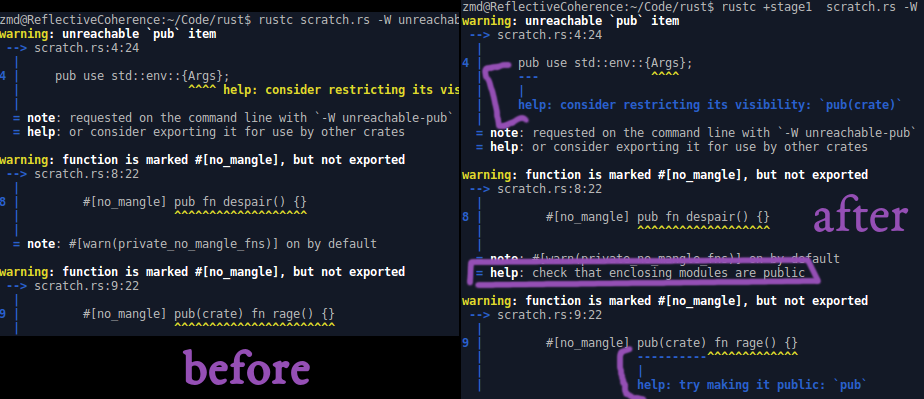
add modifier keyword spans to hir::Visibility; improve unreachable-pub, private-no-mangle lint suggestions
#50455 pointed out that the unreachable-pub suggestion for brace-grouped `use`s was bogus; #50476 partially ameliorated this by marking the suggestion as `Applicability::MaybeIncorrect`, but this is the actual fix.
Meanwhile, another application of having spans available in `hir::Visibility` is found in the private-no-mangle lints, where we can now issue a suggestion to use `pub` if the item has a more restricted visibility marker (this seems much less likely to come up in practice than not having any visibility keyword at all, but thoroughness is a virtue). While we're there, we can also add a helpful note if the item does have a `pub` (but triggered the lint presumably because enclosing modules were private).
r? @nrc
cc @Manishearth
Loosened rules involving statics mentioning other statics

Before this PR, trying to mention a static in any way other than taking a reference to it caused a compile-time error. So, while

```rust
static A: u32 = 42;
static B: &u32 = &A;
```

compiles successfully,

```rust
static A: u32 = 42;
static B: u32 = A; // error
```

and

```rust
static A: u32 = 42;
static B: u32 = *&A; // error
```

are not possible to express in Rust. On the other hand, introducing an intermediate `const fn` can presently allow one to do just that:

```rust
static A: u32 = 42;
static B: u32 = foo(&A); // success!

const fn foo(a: &u32) -> u32 {
    *a
}
```

Preventing `const fn` from allowing to work around the ban on reading from statics would cripple `const fn` almost into uselessness.
Additionally, the limitation for reading from statics comes from the old const evaluator(s) and is not shared by `miri`.

This PR loosens the rules around use of statics to allow statics to evaluate other statics by value, allowing all of the above examples to compile and run successfully.
Reads from extern (foreign) statics are however still disallowed by miri, because there is no compile-time value to be read.

```rust
extern static A: u32;

static B: u32 = A; // error
```

This opens up a new avenue of potential issues, as a static can now not just refer to other statics or read from other statics, but even contain references that point into itself.
While it might seem like this could cause subtle bugs like allowing a static to be initialized by its own value, this is inherently impossible in miri.
Reading from a static causes the `const_eval` query for that static to be invoked. Calling the `const_eval` query for a static while already inside the `const_eval` query of said static will cause cycle errors.
It is not possible to accidentally create a bug in miri that would enable initializing a static with itself, because the memory of the static *does not exist* while being initialized.
The memory is not uninitialized, it is not there. Thus any change that would accidentally allow reading from a not yet initialized static would cause ICEs.

Tests have been modified according to the new rules, and new tests have been added for writing to `static mut`s within definitions of statics (which needs to fail), and incremental compilation with complex/interlinking static definitions.
Note that incremental compilation did not need to be adjusted, because all of this was already possible before with workarounds (like intermediate `const fn`s) and the encoding/decoding already supports all the possible cases.

r? @eddyb


