Properly parse impls for the never type `!`
Recover from missing `for` in `impl Trait for Type`
Prohibit inherent default impls and default impls of auto traits
Change wording in more diagnostics to use "auto traits"
Some minor code cleanups in the parser
Use correct line offsets for doctests
Not yet tested.
This doesn't handle char positions. It could if I collected a map of char offsets and lines, but this is a bit more work and requires hooking into the parser much more (unsure if it's possible).
r? @QuietMisdreavus
(fixes#45868)
rustc: Tweak `#[target_feature]` syntax

This is an implementation of the `#[target_feature]` syntax-related changes of
[RFC 2045][rfc]. Notably two changes have been implemented:

* The new syntax is `#[target_feature(enable = "..")]` instead of
  `#[target_feature = "+.."]`. The `enable` key is necessary instead of the `+`
  to indicate that a feature is being enabled, and a sub-list is used for
  possible expansion in the future. Additionally within this syntax the feature
  names being enabled are now whitelisted against a known set of target feature
  names that we know about.

* The `#[target_feature]` attribute can only be applied to unsafe functions. It
  was decided in the RFC that invoking an instruction possibly not defined for
  the current processor is undefined behavior, so to enable this feature for now
  it requires an `unsafe` intervention.

[rfc]: https://github.com/rust-lang/rfcs/blob/master/text/2045-target-feature.md
This is an implementation of the `#[target_feature]` syntax-related changes of
[RFC 2045][rfc]. Notably two changes have been implemented:

* The new syntax is `#[target_feature(enable = "..")]` instead of
  `#[target_feature = "+.."]`. The `enable` key is necessary instead of the `+`
  to indicate that a feature is being enabled, and a sub-list is used for
  possible expansion in the future. Additionally within this syntax the feature
  names being enabled are now whitelisted against a known set of target feature
  names that we know about.

* The `#[target_feature]` attribute can only be applied to unsafe functions. It
  was decided in the RFC that invoking an instruction possibly not defined for
  the current processor is undefined behavior, so to enable this feature for now
  it requires an `unsafe` intervention.

[rfc]: https://github.com/rust-lang/rfcs/blob/master/text/2045-target-feature.md
No longer parse it.
Remove AutoTrait variant from AST and HIR.
Remove backwards compatibility lint.
Remove coherence checks, they make no sense for the new syntax.
Remove from rustdoc.
Remove deprecated unstable attribute #[simd]

The `#[simd]` attribute has been deprecated since c8b6d5b23c back in 2015. Any nightly crates using it have had ample time to switch to `#[repr(simd)]`, and if they didn't they're likely broken by now anyway.

r? @eddyb
`struct` pattern parsing and diagnostic tweaks
- Recover from struct parse error on match and point out missing match
body.
- Point at struct when finding non-identifier while parsing its fields.
- Add label to "expected identifier, found {}" error.
Fix#15980.
type error method suggestions use whitelisted identity-like conversions
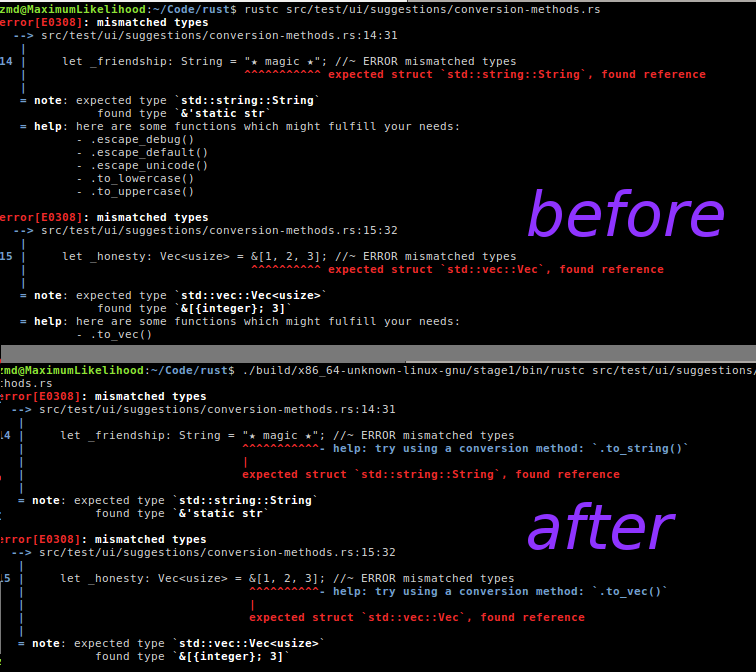
Previously, on a type mismatch (and if this wasn't preëmpted by a
higher-priority suggestion), we would look for argumentless methods
returning the expected type, and list them in a `help` note. This had two
major shortcomings: firstly, a lot of the suggestions didn't really make
sense (if you used a &str where a String was expected,
`.to_ascii_uppercase()` is probably not the solution you were hoping
for). Secondly, we weren't generating suggestions from the most useful
traits! We address the first problem with an internal
`#[rustc_conversion_suggestion]` attribute meant to mark methods that keep
the "same value" in the relevant sense, just converting the type. We
address the second problem by making `FnCtxt.probe_for_return_type` pass
the `ProbeScope::AllTraits` to `probe_op`: this would seem to be safe
because grep reveals no other callers of `probe_for_return_type`.
Also, structured suggestions are pretty and good for RLS and friends.
Unfortunately, the trait probing is still not all one would hope for: at a
minimum, we don't know how to rule out `into()` in cases where it wouldn't
actually work, and we don't know how to rule in `.to_owned()` where it
would. Issues #46459 and #46460 have been filed and are ref'd in a FIXME.
This is hoped to resolve#42929, #44672, and #45777.
Treat #[path] files as mod.rs files

Fixes https://github.com/rust-lang/rust/issues/46936, cc @briansmith, @SergioBenitez, @nikomatsakis.

This (insta-stable) change treats files included via `#[path = "bla.rs"] mod foo;` as though they were `mod.rs` files. Namely, it allows them to include `mod` statements and looks for the child modules in sibling directories, rather than in relative `modname/childmodule.rs` files as happens for non-`mod.rs` files.

This change makes the `non_modrs_mods` feature backwards compatible with the existing usage in https://github.com/briansmith/ring, several versions of which are currently broken in beta. If we decide to merge, this change should be backported to beta.

cc https://github.com/rust-lang/rust/issues/37872

r? @jseyfried
Skip linker-output-non-utf8 test on Apple

This test fails on APFS filesystems with the following error:

```shell
mkdir: /Users/ryan/Code/rust/build/x86_64-apple-darwin/test/run-make/linker-output-non-utf8.stage2-x86_64-apple-darwin/zzz�: Illegal byte sequence
```

The mkdir does succeed on an HFS+ volume mounted on the same system:
```shell
$ mkdir zzz$$'\xff'
$ ls
zzz47432\xff
```

This is due to APFS now requiring that all paths are valid UTF-8. As APFS will be the default filesystem for all new Darwin-based systems the most straightforward fix is to skip this test on Darwin as well as Windows.
macros: improve 1.0/2.0 interaction

This PR supports using unhygienic macros from hygienic macros without breaking the latter's hygiene.
```rust
// crate A:
#[macro_export]
macro_rules! m1 { () => {
    f(); // unhygienic: this macro needs `f` in its environment
    fn g() {} // (1) unhygienic: `g` is usable outside the macro definition
} }

// crate B:
#![feature(decl_macro)]
extern crate A;
use A::m1;

macro m2() {
    fn f() {} // (2)
    m1!(); // After this PR, `f()` in the expansion resolves to (2), not (3)
    g(); // After this PR, this resolves to `fn g() {}` from the above expansion.
         // Today, it is a resolution error.
}

fn test() {
    fn f() {} // (3)
    m2!(); // Today, `m2!()` can see (3) even though it should be hygienic.
    fn g() {} // Today, this conflicts with `fn g() {}` from the expansion, even though it should be hygienic.
}
```

Once this PR lands, you can make an existing unhygienic macro hygienic by wrapping it in a hygienic macro. There is an [example](https://github.com/rust-lang/rust/pull/46551/commits/b766fa887dc0e4b923a38751fe4d570e35a75710) of this in the tests.

r? @nrc
Fix built-in indexing not being used where index type wasn't "obviously" usize
Fixes#33903Fixes#46095
This PR was made possible thanks to the generous help of @eddyb
Following the example of binary operators, builtin checking for indexing has been moved from the typecheck stage to a writeback stage, after type constraints have been resolved.
This test fails on APFS filesystems with the following error:

mkdir: /Users/ryan/Code/rust/build/x86_64-apple-darwin/test/run-make/linker-output-non-utf8.stage2-x86_64-apple-darwin/zzz�: Illegal byte sequence

This is due to APFS now requiring that all paths are valid UTF-8. As
APFS will be the default filesystem for all new Darwin-based systems the
most straightforward fix is to skip this test on Darwin as well as
Windows.
fix the doc-comment-decoration-trimming edge-case rustdoc ICE
This `horizontal_trim` function strips the leading whitespace from
doc-comments that have a left-asterisk-margin:
```
/**
* You know what I mean—
*
* comments like this!
*/
```
The index of the column of asterisks is `i`, and if trimming is deemed
possible, we slice each line from `i+1` to the end of the line. But if, in
particular, `i` was 0 _and_ there was an empty line (as in the example
given in the reporting issue), we ended up panicking trying to slice an
empty string from 0+1 (== 1).
Let's tighten our check to say that we can't trim when `i` is even the same
as the length of the line, not just when it's greater. (Any such cases
would panic trying to slice `line` from `line.len()+1`.)
Resolves#47197.
Add help message for incorrect pattern syntax

When I was getting started with rust I often made the mistake of using `||` instead of `|` to match multiple patterns and spent a long time staring at my code wondering what was wrong.

for example:

```
fn main() {
    let x = 1;

    match x {
        1 || 2 => println!("1 or 2"),
        _ => println!("Something else"),
    }
}

```

If you compile this with current rustc you will see

```
error: expected one of `...`, `..=`, `..`, `=>`, `if`, or `|`, found `||`
 --> test.rs:5:11
  |
5 |         1 || 2 => println!("1 or 2"),
  |          -^^ unexpected token
  |          |
  |          expected one of `...`, `..=`, `..`, `=>`, `if`, or `|` here

error: aborting due to previous error
```

With my proposed change it will show:
```
error: unexpected token `||` after pattern
 --> test.rs:5:11
  |
5 |         1 || 2 => println!("1 or 2"),
  |           ^^
  |
  = help: did you mean to use `|` to specify multiple patterns instead?

error: aborting due to previous error
```
- Recover from struct parse error on match and point out missing match
   body.
 - Point at struct when finding non-identifier while parsing its fields.
 - Add label to "expected identifier, found {}" error.
Provide suggestion when trying to use method on numeric literal
New output:
```
error[E0688]: can't call method `powi` on ambiguous numeric type `{float}`
--> $DIR/method-on-ambiguous-numeric-type.rs:12:17
|
12 | let x = 2.0.powi(2);
| ^^^^
help: you must specify a concrete type for this numeric value, like `f32`
|
12 | let x = 2.0_f32.powi(2);
| ^^^^^^^
```
Previous output:
```
error[E0599]: no method named `powi` found for type `{float}` in the current scope
--> src/main.rs:12:17
|
12 | let x = 2.0.powi(2);
| ^^^^
|
= help: items from traits can only be used if the trait is in scope
help: the following trait is implemented but not in scope, perhaps add a `use` for it:
|
11 | use core::num::Float;
|
```
Fix#40985.
The `#[simd]` attribute has been deprecated since c8b6d5b23c back in 2015. Any nightly crates using it have had ample time to switch to `#[repr(simd)]`, and if they didn't they're likely broken by now anyway.


