Rollup of 5 pull requests

Successful merges:

 - #115773 (tvOS simulator support on Apple Silicon for rustc)
 - #117162 (Remove `cfg_match` from the prelude)
 - #117311 (-Zunpretty help: add missing possible values)
 - #117316 (Mark constructor of `BinaryHeap` as const fn)
 - #117319 (explain why we don't inline when target features differ)

r? `@ghost`
`@rustbot` modify labels: rollup
change default output mode of `BootstrapCommand`
`SuppressOnSuccess` on `BootstrapCommand` is a problematic default mode as it affects the logs during the bootstrapping (as shown in the screenshot below). The default behavior should be to print everything unless we explicitly modify the behavior within build steps.
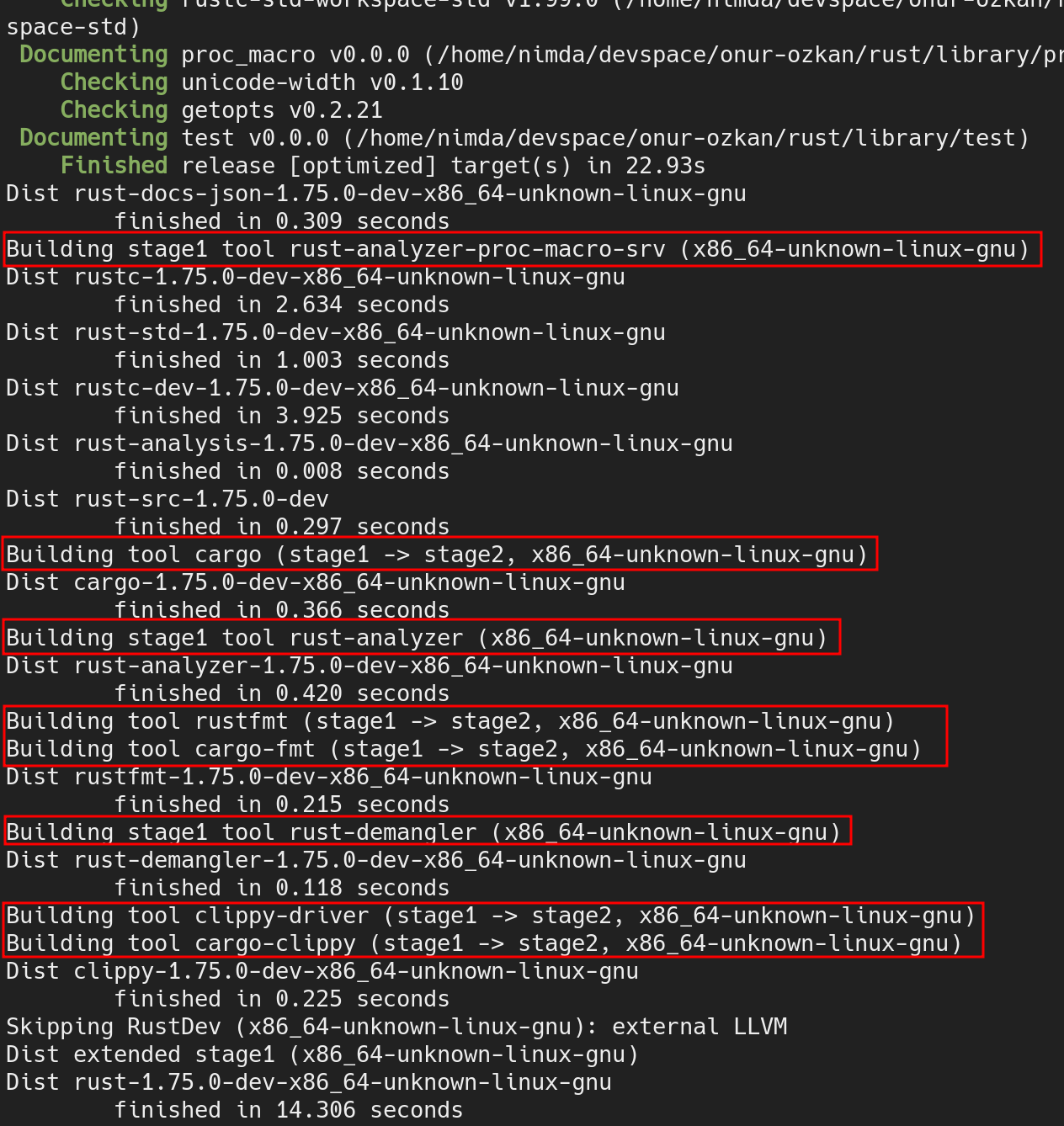
Fixes#117315
cc `@Kobzol`
Add support for i586-unknown-netbsd as target.

This restricts instructions to those offered by Pentium, to support e.g. AMD Geode.

There is already an entry for this target in the NetBSD platform support page at

  src/doc/rustc/src/platform-support/netbsd.md

...so this should forestall its removal.

Additional fixes are needed for some vendored modules, this is the changes in the rust compiler core itself.
tvOS simulator support on Apple Silicon for rustc

Closes or is a subtask of #115692.

# Tier 3 Target Policy

At this tier, the Rust project provides no official support for a target, so we place minimal requirements on the introduction of targets.

> * A tier 3 target must have a designated developer or developers (the "target maintainers") on record to be CCed when issues arise regarding the target. (The mechanism to track and CC such developers may evolve over time.)

See [`src/doc/rustc/src/platform-support/apple-tvos.md`](4ab4d48ee5/src/doc/rustc/src/platform-support/apple-tvos.md)

> * Targets must use naming consistent with any existing targets; for instance, a target for the same CPU or OS as an existing Rust target should use the same name for that CPU or OS. Targets should normally use the same names and naming conventions as used elsewhere in the broader ecosystem beyond Rust (such as in other toolchains), unless they have a very good reason to diverge. Changing the name of a target can be highly disruptive, especially once the target reaches a higher tier, so getting the name right is important even for a tier 3 target.
>     * Target names should not introduce undue confusion or ambiguity unless absolutely necessary to maintain ecosystem compatibility. For example, if the name of the target makes people extremely likely to form incorrect beliefs about what it targets, the name should be changed or augmented to disambiguate it.
>     * If possible, use only letters, numbers, dashes and underscores for the name. Periods (.) are known to cause issues in Cargo.

This naming scheme matches `$ARCH-$VENDOR-$OS-$ABI` (I think `sim` is the ABI here) which is matches the iOS apple silicon simulator (`aarch64-apple-ios-sim`). [There is some discussion about renaming some apple simulator targets](https://github.com/rust-lang/rust/issues/115692#issuecomment-1712931910) to match the `-sim` suffix but that is outside the scope of this PR.

> * Tier 3 targets may have unusual requirements to build or use, but must not create legal issues or impose onerous legal terms for the Rust project or for Rust developers or users.
>
>    * The target must not introduce license incompatibilities.
>    * Anything added to the Rust repository must be under the standard Rust license (MIT OR Apache-2.0).
>    * The target must not cause the Rust tools or libraries built for any other host (even when supporting cross-compilation to the target) to depend on any new dependency less permissive than the Rust licensing policy. This applies whether the dependency is a Rust crate that would require adding new license exceptions (as specified by the tidy tool in the rust-lang/rust repository), or whether the dependency is a native library or binary. In other words, the introduction of the target must not cause a user installing or running a version of Rust or the Rust tools to be subject to any new license requirements.
>    * Compiling, linking, and emitting functional binaries, libraries, or other code for the target (whether hosted on the target itself or cross-compiling from another target) must not depend on proprietary (non-FOSS) libraries. Host tools built for the target itself may depend on the ordinary runtime libraries supplied by the platform and commonly used by other applications built for the target, but those libraries must not be required for code generation for the target; cross-compilation to the target must not require such libraries at all. For instance, rustc built for the target may depend on a common proprietary C runtime library or console output library, but must not depend on a proprietary code generation library or code optimization library. Rust's license permits such combinations, but the Rust project has no interest in maintaining such combinations within the scope of Rust itself, even at tier 3.
>    * "onerous" here is an intentionally subjective term. At a minimum, "onerous" legal/licensing terms include but are not limited to: non-disclosure requirements, non-compete requirements, contributor license agreements (CLAs) or equivalent, "non-commercial"/"research-only"/etc terms, requirements conditional on the employer or employment of any particular Rust developers, revocable terms, any requirements that create liability for the Rust project or its developers or users, or any requirements that adversely affect the livelihood or prospects of the Rust project or its developers or users.

This contribution is fully available under the standard Rust license with no additional legal restrictions whatsoever. This PR does not introduce any new dependency less permissive than the Rust license policy.

The new targets do not depend on proprietary libraries.

> * Tier 3 targets should attempt to implement as much of the standard libraries as possible and appropriate (core for most targets, alloc for targets that can support dynamic memory allocation, std for targets with an operating system or equivalent layer of system-provided functionality), but may leave some code unimplemented (either unavailable or stubbed out as appropriate), whether because the target makes it impossible to implement or challenging to implement. The authors of pull requests are not obligated to avoid calling any portions of the standard library on the basis of a tier 3 target not implementing those portions.

This new target implements as much of the standard library as the other tvOS targets do.

> * The target must provide documentation for the Rust community explaining how to build for the target, using cross-compilation if possible. If the target supports running binaries, or running tests (even if they do not pass), the documentation must explain how to run such binaries or tests for the target, using emulation if possible or dedicated hardware if necessary.

I have added the target to the other tvOS targets in [`src/doc/rustc/src/platform-support/apple-tvos.md`](4ab4d48ee5/src/doc/rustc/src/platform-support/apple-tvos.md)

> * Neither this policy nor any decisions made regarding targets shall create any binding agreement or estoppel by any party. If any member of an approving Rust team serves as one of the maintainers of a target, or has any legal or employment requirement (explicit or implicit) that might affect their decisions regarding a target, they must recuse themselves from any approval decisions regarding the target's tier status, though they may otherwise participate in discussions.
>    * This requirement does not prevent part or all of this policy from being cited in an explicit contract or work agreement (e.g. to implement or maintain support for a target). This requirement exists to ensure that a developer or team responsible for reviewing and approving a target does not face any legal threats or obligations that would prevent them from freely exercising their judgment in such approval, even if such judgment involves subjective matters or goes beyond the letter of these requirements.
> * Tier 3 targets must not impose burden on the authors of pull requests, or other developers in the community, to maintain the target. In particular, do not post comments (automated or manual) on a PR that derail or suggest a block on the PR based on a tier 3 target. Do not send automated messages or notifications (via any medium, including via ``@)`` to a PR author or others involved with a PR regarding a tier 3 target, unless they have opted into such messages.
>    * Backlinks such as those generated by the issue/PR tracker when linking to an issue or PR are not considered a violation of this policy, within reason. However, such messages (even on a separate repository) must not generate notifications to anyone involved with a PR who has not requested such notifications.
> * Patches adding or updating tier 3 targets must not break any existing tier 2 or tier 1 target, and must not knowingly break another tier 3 target without approval of either the compiler team or the maintainers of the other tier 3 target.
>    * In particular, this may come up when working on closely related targets, such as variations of the same architecture with different features. Avoid introducing unconditional uses of features that another variation of the target may not have; use conditional compilation or runtime detection, as appropriate, to let each target run code supported by that target.

I acknowledge these requirements and intend to ensure that they are met.

This target does not touch any existing tier 2 or tier 1 targets and should not break any other targets.
Implement `gen` blocks in the 2024 edition

Coroutines tracking issue https://github.com/rust-lang/rust/issues/43122
`gen` block tracking issue https://github.com/rust-lang/rust/issues/117078

This PR implements `gen` blocks that implement `Iterator`. Most of the logic with `async` blocks is shared, and thus I renamed various types that were referring to `async` specifically.

An example usage of `gen` blocks is

```rust
fn foo() -> impl Iterator<Item = i32> {
    gen {
        yield 42;
        for i in 5..18 {
            if i.is_even() { continue }
            yield i * 2;
        }
    }
}
```

The limitations (to be resolved) of the implementation are listed in the tracking issue
Distribute cg_clif as rustup component on the nightly channel

This makes it possible to use cg_clif using:

```bash
$ rustup component add rustc-codegen-cranelift-preview --toolchain nightly
$ RUSTFLAGS="-Zcodegen-backend=cranelift" cargo +nightly build
```

cc https://github.com/rust-lang/compiler-team/issues/405.
r? `@Mark-Simulacrum`
Bump stdarch submodule and remove special handling for LLVM intrinsics that are no longer needed

Bumps stdarch to pull https://github.com/rust-lang/stdarch/pull/1477, which reimplemented some functions with portable SIMD intrinsics instead of arch specific LLVM intrinsics.

Handling of those LLVM intrinsics is removed from cranelift codegen and miri.

cc `@RalfJung` `@bjorn3`
Cleanup and improve `--check-cfg` implementation

This PR removes some indentation in the code, as well as preventing some bugs/misusages and fix a nit in the doc.

r? ```@petrochenkov``` (maybe)
Update cargo

8 commits in df3509237935f9418351b77803df7bc05c009b3d..708383d620e183a9ece69b8fe930c411d83dee27
2023-10-24 23:09:01 +0000 to 2023-10-27 21:09:26 +0000
- feat(doc): Print the generated docs links (rust-lang/cargo#12859)
- feat(toml): Allow version-less manifests (rust-lang/cargo#12786)
- Remove outdated option to `-Zcheck-cfg` warnings (rust-lang/cargo#12884)
- Remove duplicate binaries during install (rust-lang/cargo#12868)
- refactor(shell): Write at once rather than in fragments (rust-lang/cargo#12880)
- docs(ref): Link to docs.rs metadata table (rust-lang/cargo#12879)
- docs(contrib): Describe how to add a new package (rust-lang/cargo#12878)
- move up looking at index summary enum (rust-lang/cargo#12749)

r? ghost
Avoid unnecessary builds/rebuilds of `rust-demangler`

This is a combination of two loosely-related changes:

- Don't build `rust-demangler` as a dependency of `tests/run-make`, because after #112300 none of the remaining run-make tests actually use it. (If future run-make tests ever do need the demangler, it'll be easy to add it back.)
- For `tests/run-coverage`, build the demangler with the stage 0 compiler instead of the current-stage compiler. This avoids having to uselessly rebuild the demangler after modifying and rebuilding the compiler itself.
rustdoc: use JS to inline target type impl docs into alias
Preview docs:
- https://notriddle.com/rustdoc-html-demo-5/js-trait-alias/std/io/type.Result.html
- https://notriddle.com/rustdoc-html-demo-5/js-trait-alias-compiler/rustc_middle/ty/type.PolyTraitRef.html
This pull request also includes a bug fix for trait alias inlining across crates. This means more documentation is generated, and is why ripgrep runs slower (it's a thin wrapper on top of the `grep` crate, so 5% of its docs are now the Result type).
- Before, built with rustdoc 1.75.0-nightly (aa1a71e9e 2023-10-26), Result type alias method docs are missing: http://notriddle.com/rustdoc-html-demo-5/ripgrep-js-nightly/rg/type.Result.html
- After, built with this branch, all the methods on Result are shown: http://notriddle.com/rustdoc-html-demo-5/ripgrep-js-trait-alias/rg/type.Result.html
*Review note: This is mostly just reverting https://github.com/rust-lang/rust/pull/115201. The last commit has the new work in it.*
Fixes#115718
This is an attempt to balance three problems, each of which would
be violated by a simpler implementation:
- A type alias should show all the `impl` blocks for the target
type, and vice versa, if they're applicable. If nothing was
done, and rustdoc continues to match them up in HIR, this
would not work.
- Copying the target type's docs into its aliases' HTML pages
directly causes far too much redundant HTML text to be generated
when a crate has large numbers of methods and large numbers
of type aliases.
- Using JavaScript exclusively for type alias impl docs would
be a functional regression, and could make some docs very hard
to find for non-JS readers.
- Making sure that only applicable docs are show in the
resulting page requires a type checkers. Do not reimplement
the type checker in JavaScript.
So, to make it work, rustdoc stashes these type-alias-inlined docs
in a JSONP "database-lite". The file is generated in `write_shared.rs`,
included in a `<script>` tag added in `print_item.rs`, and `main.js`
takes care of patching the additional docs into the DOM.
The format of `trait.impl` and `type.impl` JS files are superficially
similar. Each line, except the JSONP wrapper itself, belongs to a crate,
and they are otherwise separate (rustdoc should be idempotent). The
"meat" of the file is HTML strings, so the frontend code is very simple.
Links are relative to the doc root, though, so the frontend needs to fix
that up, and inlined docs can reuse these files.
However, there are a few differences, caused by the sophisticated
features that type aliases have. Consider this crate graph:
```text
---------------------------------
| crate A: struct Foo<T> |
| type Bar = Foo<i32> |
| impl X for Foo<i8> |
| impl Y for Foo<i32> |
---------------------------------
|
----------------------------------
| crate B: type Baz = A::Foo<i8> |
| type Xyy = A::Foo<i8> |
| impl Z for Xyy |
----------------------------------
```
The type.impl/A/struct.Foo.js JS file has a structure kinda like this:
```js
JSONP({
"A": [["impl Y for Foo<i32>", "Y", "A::Bar"]],
"B": [["impl X for Foo<i8>", "X", "B::Baz", "B::Xyy"], ["impl Z for Xyy", "Z", "B::Baz"]],
});
```
When the type.impl file is loaded, only the current crate's docs are
actually used. The main reason to bundle them together is that there's
enough duplication in them for DEFLATE to remove the redundancy.
The contents of a crate are a list of impl blocks, themselves
represented as lists. The first item in the sublist is the HTML block,
the second item is the name of the trait (which goes in the sidebar),
and all others are the names of type aliases that successfully match.
This way:
- There's no need to generate these files for types that have no aliases
in the current crate. If a dependent crate makes a type alias, it'll
take care of generating its own docs.
- There's no need to reimplement parts of the type checker in
JavaScript. The Rust backend does the checking, and includes its
results in the file.
- Docs defined directly on the type alias are dropped directly in the
HTML by `render_assoc_items`, and are accessible without JavaScript.
The JSONP file will not list impl items that are known to be part
of the main HTML file already.
[JSONP]: https://en.wikipedia.org/wiki/JSONP
`parse_cfgspecs` and `parse_check_cfg` run very early, before the main
interner is running. They each use a short-lived interner and convert
all interned symbols to strings in their output data structures. Once
the main interner starts up, these data structures get converted into
new data structures that are identical except with the strings converted
to symbols.

All is not obvious from the current code, which is a mess, particularly
with inconsistent naming that obscures the parallel string/symbol data
structures. This commit clean things up a lot.

- The existing `CheckCfg` type is generic, allowing both
  `CheckCfg<String>` and `CheckCfg<Symbol>` forms. This is really
  useful, but it defaults to `String`. The commit removes the default so
  we have to use `CheckCfg<String>` and `CheckCfg<Symbol>` explicitly,
  which makes things clearer.

- Introduces `Cfg`, which is generic over `String` and `Symbol`, similar
  to `CheckCfg`.

- Renames some things.
  - `parse_cfgspecs` -> `parse_cfg`
  - `CfgSpecs` -> `Cfg<String>`, plus it's used in more places, rather
    than the underlying `FxHashSet` type.
  - `CrateConfig` -> `Cfg<Symbol>`.
  - `CrateCheckConfig` -> `CheckCfg<Symbol>`

- Adds some comments explaining the string-to-symbol conversions.

- `to_crate_check_config`, which converts `CheckCfg<String>` to
  `CheckCfg<Symbol>`, is inlined and removed and combined with the
  overly-general `CheckCfg::map_data` to produce
  `CheckCfg::<String>::intern`.

- `build_configuration` now does the `Cfg<String>`-to-`Cfg<Symbol>`
  conversion, so callers don't need to, which removes the need for
  `to_crate_config`.

The diff for two of the fields in `Config` is a good example of the
improved clarity:
```
-    pub crate_cfg: FxHashSet<(String, Option<String>)>,
-    pub crate_check_cfg: CheckCfg,
+    pub crate_cfg: Cfg<String>,
+    pub crate_check_cfg: CheckCfg<String>,
```
Compare that with the diff for the corresponding fields in `ParseSess`,
and the relationship to `Config` is much clearer than before:
```
-    pub config: CrateConfig,
-    pub check_config: CrateCheckConfig,
+    pub config: Cfg<Symbol>,
+    pub check_config: CheckCfg<Symbol>,
```
This avoids needlessly building cg_clif for other targets and makes it
easier for the dist code to determine if it should distribute cg_clif as
component.
Allow partially moved values in match
This PR attempts to unify the behaviour between `let _ = PLACE`, `let _: TY = PLACE;` and `match PLACE { _ => {} }`.
The logical conclusion is that the `match` version should not check for uninitialised places nor check that borrows are still live.
The `match PLACE {}` case is handled by keeping a `FakeRead` in the unreachable fallback case to verify that `PLACE` has a legal value.
Schematically, `match PLACE { arms }` in surface rust becomes in MIR:
```rust
PlaceMention(PLACE)
match PLACE {
// Decision tree for the explicit arms
arms,
// An extra fallback arm
_ => {
FakeRead(ForMatchedPlace, PLACE);
unreachable
}
}
```
`match *borrow { _ => {} }` continues to check that `*borrow` is live, but does not read the value.
`match *borrow {}` both checks that `*borrow` is live, and fake-reads the value.
Continuation of ~https://github.com/rust-lang/rust/pull/102256~ ~https://github.com/rust-lang/rust/pull/104844~
Fixes https://github.com/rust-lang/rust/issues/99180https://github.com/rust-lang/rust/issues/53114
Rollup of 6 pull requests

Successful merges:

 - #114998 (feat(docs): add cargo-pgo to PGO documentation 📝)
 - #116868 (Tweak suggestion span for outer attr and point at item following invalid inner attr)
 - #117240 (Fix documentation typo in std::iter::Iterator::collect_into)
 - #117241 (Stash and cancel cycle errors for auto trait leakage in opaques)
 - #117262 (Create a new ConstantKind variant (ZeroSized) for StableMIR)
 - #117266 (replace transmute by raw pointer cast)

r? `@ghost`
`@rustbot` modify labels: rollup
The demangler was only needed by coverage tests, but those tests were migrated
into their own custom test mode in #112300.

This avoids having to build the demangler just for run-make tests. It will
still be built as needed by run-coverage tests or for other purposes.
Centralize command running in boostrap (part one)

This PR tries to consolidate the various `run, try_run, run_quiet, run_quiet_delaying_failure, run_delaying_failure` etc. methods on `Builder`. This PR only touches command execution which doesn't produce output that would be later read by bootstrap, and it also only refactors spawning of commands that happens after a builder is created (commands executed during download & git submodule checkout are left as-is, for now).

The `run_cmd` method is quite meaty, but I expect that it will be changing rapidly soon, so I considered it easy to kept everything in a single method, and only after things settle down a bit, then maybe again split it up a bit.

I still kept the original shortcut methods like `run_quiet_delaying_failure`, but they now only delegate to `run_cmd`. I tried to keep the original behavior (or as close to it as possible) for all the various commands, but it is a giant mess, so there may be some deviations. Notably, `cmd.output()` is now always called, instead of just `status()`, which was called previously in some situations.

Apart from the refactored methods, there is also `Config::try_run`, `check_run`, methods that run commands that produce output, oh my… that's left for follow-up PRs :)

The driving goal of this (and following) refactors is to centralize command execution in bootstrap on a single place, to make command mocking feasible.

r? `@onur-ozkan`
Prepare the `bootstrap` tool for the new check-cfg syntax

This PR prepare the `bootstrap` tool for the [new check-cfg syntax](https://github.com/rust-lang/rust/pull/111072) as well as the according [changes to Cargo](https://github.com/rust-lang/cargo/pull/12845).

~~Note that while the new syntax can technically available on stage > 2, we actually cannot use it since we need a cargo version that supports the new syntax which won't happen until the next beta bump (if I understand everything correctly).~~

r? bootstrap
Store #[stable] attribute's `since` value in structured form

Followup to https://github.com/rust-lang/rust/pull/116773#pullrequestreview-1680913901.

Prior to this PR, if you wrote an improper `since` version in a `stable` attribute, such as `#[stable(feature = "foo", since = "wat.0")]`, rustc would emit a diagnostic saying **_'since' must be a Rust version number, such as "1.31.0"_** and then throw out the whole `stable` attribute as if it weren't there. This strategy had 2 problems, both fixed in this PR:

1. If there was also a `#[deprecated]` attribute on the same item, rustc would want to enforce that the stabilization version is older than the deprecation version. This involved reparsing the `stable` attribute's `since` version, with a diagnostic **_invalid stability version found_** if it failed to parse. Of course this diagnostic was unreachable because an invalid `since` version would have already caused the `stable` attribute to be thrown out. This PR deletes that unreachable diagnostic.

2. By throwing out the `stable` attribute when `since` is invalid, you'd end up with a second diagnostic saying **_function has missing stability attribute_** even though your function is not missing a stability attribute. This PR preserves the `stable` attribute even when `since` cannot be parsed, avoiding the misleading second diagnostic.

Followups I plan to try next:

- Do the same for the `since` value of `#[deprecated]`.

- See whether it makes sense to also preserve `stable` and/or `unstable` attributes when they contain an invalid `feature`. What redundant/misleading diagnostics can this eliminate? What problems arise from not having a usable feature name for some API, in the situation that we're already failing compilation, so not concerned about anything that happens in downstream code?
Stop telling people to submit bugs for internal feature ICEs
This keeps track of usage of internal features, and changes the message to instead tell them that using internal features is not supported.
I thought about several ways to do this but now used the explicit threading of an `Arc<AtomicBool>` through `Session`. This is not exactly incremental-safe, but this is fine, as this is set during macro expansion, which is pre-incremental, and also only affects the output of ICEs, at which point incremental correctness doesn't matter much anyways.
See [MCP 620.](https://github.com/rust-lang/compiler-team/issues/596)
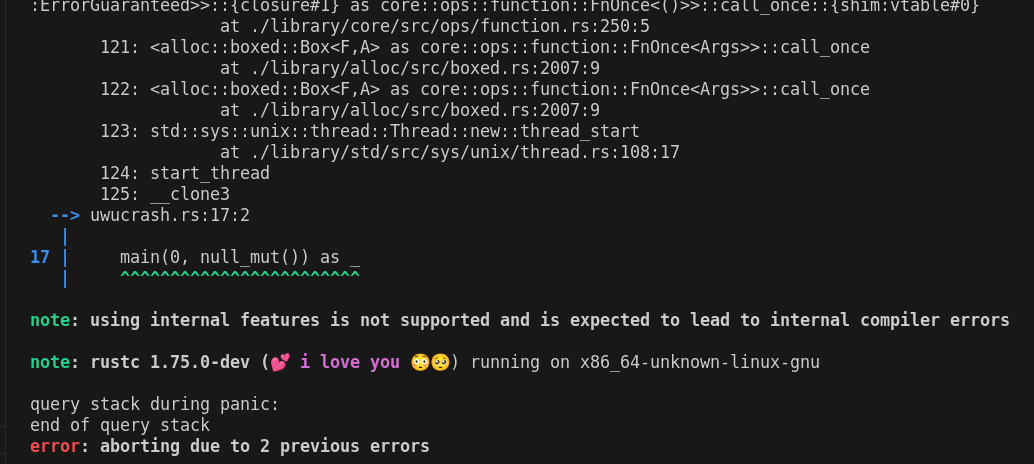
Remap Cargo dependencies to /rust/deps

⚠️ **This doesn't affect user-compiled programs, it only affects building the Rust compiler itself.** ⚠️

Right now, `rust.remap-debuginfo = true` doesn't completely remap all paths: while LLVM and rustc sources are properly remapped (respectively to `/rust/llvm` and `/rust/$commit`), Cargo dependencies still use absolute paths from the Cargo home.

This never affected builds from CI much, because `CARGO_HOME=/cargo` in CI, so users see paths like this included in the precompiled binaries and libraries:

```
/cargo/registry/src/index.crates.io-6f17d22bba15001f/gimli-0.26.2/src/read/line.rs
```

Builds outside CI don't have remapping though, and it's confusing that the config flag doesn't fully do what it advertises.

This PR fixes it by adding remapping for dependencies too. *All registries's* source directory are remapped to `/rust/deps`, to account for multiple registries being able to contain crates.io crates (sparse index vs git, and source replacement mirrors). This results in paths like this being included:

```
/rust/deps/gimli-0.26.2/src/read/line.rs
```
Rename AsyncCoroutineKind to CoroutineSource

pulled out of https://github.com/rust-lang/rust/pull/116447

Also refactors the printing infra of `CoroutineSource` to be ready for easily extending it with a `Gen` variant for `gen` blocks
This keeps track of usage of internal features, and changes the message
to instead tell them that using internal features is not supported.

See MCP 620.
Rollup of 7 pull requests

Successful merges:

 - #117111 (Remove support for alias `-Z instrument-coverage`)
 - #117141 (Require target features to match exactly during inlining)
 - #117152 (Fix unwrap suggestion for async fn)
 - #117154 (implement C ABI lowering for CSKY)
 - #117159 (Work around the fact that `check_mod_type_wf` may spuriously return `ErrorGuaranteed`)
 - #117163 (compiletest: Display compilation errors in mir-opt tests)
 - #117173 (Make `Iterator` a lang item)

r? `@ghost`
`@rustbot` modify labels: rollup
compiletest: Display compilation errors in mir-opt tests

Previously when compilation failed the `check_mir_dump` would panic first, so we would never display the compiler output.
Work around the fact that `check_mod_type_wf` may spuriously return `ErrorGuaranteed`

Even if that error is only emitted by `check_mod_item_types`.

fixes https://github.com/rust-lang/rust/issues/117153

A cleaner refactoring would merge/chain these queries in ways that ensure we only actually get an `ErrorGuaranteed` if there was an error emitted.


