Update RLS and Rustfmt
Fixes#79406Fixes#79407
This does pull 1.4.28 version of Rustfmt. Do you want me to pull the 1.4.29 while we're at it?
r? `@calebcartwright`
Update cargo

12 commits in bfca1cd22bf514d5f2b6c1089b0ded0ba7dfaa6e..63d0fe43449adcb316d34d98a982b597faca4178
2020-11-24 16:33:21 +0000 to 2020-12-02 01:44:30 +0000
- Add "--workspace" to update command (rust-lang/cargo#8725)
- Add an FAQ for "Why is my crate rebuilt?" (rust-lang/cargo#8927)
- Set docs.rs as the default extern-map for crates.io (rust-lang/cargo#8877)
- remove extra whitespace when running cargo -Z help (rust-lang/cargo#8924)
- Remove version from dev-dependencies to make it easier to publish. (rust-lang/cargo#8920)
- update dependency queue to consider cost for each node (rust-lang/cargo#8908)
- Fix some rustdoc warnings. (rust-lang/cargo#8911)
- Bump miow dependency to not invalidly assume memory layout (rust-lang/cargo#8909)
- Remove unnecessary trailing semicolons (rust-lang/cargo#8906)
- Fix custom_target_dependency test. (rust-lang/cargo#8907)
- fix: we don't ignore `version` for `git`/`path` deps now (rust-lang/cargo#8900)
- doc (book): add "Getting Started" subsection: "Essential Terminology" (rust-lang/cargo#8855)
Tested and validate results for panic unwind, panic abort, assert!()
macro, TerminatorKind::Assert (for example, numeric overflow), and
async/await.

Implemented a previous documented idea to change Assert handling to be
the same as FalseUnwind and Goto, so it doesn't get its own
BasicCoverageBlock anymore. This changed a couple of coverage regions,
but I validated those changes are not any worse than the prior results,
and probably help assure some consistency (even if some people might
disagree with how the code region is consistently computed).

Fixed issue with async/await. AggregateKind::Generator needs to be
handled like AggregateKind::Closure; coverage span for the outer async
function should not "cover" the async body, which is actually executed
in a separate "closure" MIR.
Validate lint docs separately.

This addresses some concerns raised in https://github.com/rust-lang/rust/pull/76549#issuecomment-727638552 about errors with the lint docs being confusing and cumbersome. Errors from validating the lint documentation were being generated during `x.py doc` (and `x.py dist`), since extraction and validation are being done in a single step. This changes it so that extraction and validation are separated, so that `x.py doc` will not error if there is a validation problem, and tests are moved to `x.py test src/tools/lint-docs`.

This includes the following changes:

* Separate validation to `x.py test`.
* Added some more documentation on how to more easily modify and test the docs.
* Added more help to the error messages to hopefully provide more information on how to fix things.

The first commit just moves the code around, so you may consider looking at the other commits for a smaller diff.
Update error to reflect that integer literals can have float suffixes

For example, `1` is parsed as an integer literal, but it can be turned
into a float with the suffix `f32`. Now the error calls them "numeric
literals" and notes that you can add a float suffix since they can be
either integers or floats.
Update tests to remove old numeric constants

Part of #68490.

Care has been taken to leave the old consts where appropriate, for testing backcompat regressions, module shadowing, etc. The intrinsics docs were accidentally referring to some methods on f64 as std::f64, which I changed due to being contrary with how we normally disambiguate the shadow module from the primitive. In one other place I changed std::u8 to std::ops since it was just testing path handling in macros.

For places which have legitimate uses of the old consts, deprecated attributes have been optimistically inserted. Although currently unnecessary, they exist to emphasize to any future deprecation effort the necessity of these specific symbols and prevent them from being accidentally removed.
Part of #68490.

Care has been taken to leave the old consts where appropriate, for testing backcompat regressions, module shadowing, etc. The intrinsics docs were accidentally referring to some methods on f64 as std::f64, which I changed due to being contrary with how we normally disambiguate the shadow module from the primitive. In one other place I changed std::u8 to std::ops since it was just testing path handling in macros.

For places which have legitimate uses of the old consts, deprecated attributes have been optimistically inserted. Although currently unnecessary, they exist to emphasize to any future deprecation effort the necessity of these specific symbols and prevent them from being accidentally removed.
Improve rustdoc JS tests error output

It's pretty common when starting to add new tests for rustdoc-js to have issues to understand the errors. With this, it should make things a bit simpler. So now, in case of an error, it displays:

```
---- [js-doc-test] rustdoc-js/basic.rs stdout ----

error: rustdoc-js test failed!
failed to decode compiler output as json: line: {
output: Checking "basic" ... FAILED
==> Result not found in 'others': '{"path":"basic","name":"Fo"}'
Diff of first error:
{
    "path": "basic",
    - "name": "Fo",
    + "name": "Foo",
}
thread '[js-doc-test] rustdoc-js/basic.rs' panicked at 'explicit panic', src/tools/compiletest/src/json.rs:126:21
```

I think it was ``@camelid`` who asked about it a few days ago?

r? ``@jyn514``
For example, `1` is parsed as an integer literal, but it can be turned
into a float with the suffix `f32`. Now the error calls them "numeric
literals" and notes that you can add a float suffix since they can be
either integers or floats.
Always print lints from plugins, if they're available
Currently you can get a list of lints and lint groups by running `rustc
-Whelp`. This prints an additional line at the end:
```
Compiler plugins can provide additional lints and lint groups. To see a listing of these, re-run `rustc -W help` with a crate filename.
```
Clippy is such a "compiler plugin", that provides additional lints.
Running `clippy-driver -Whelp` (`rustc` wrapper) still only prints the
rustc lints with the above message at the end. But when running
`clippy-driver -Whelp main.rs`, where `main.rs` is any rust file, it
also prints Clippy lints. I don't think this is a good approach from a
UX perspective: Why is a random file necessary to print a help message?
This PR changes this behavior: Whenever a compiler callback
registers lints, it is assumed that these lints come from a plugin and
are printed without having to specify a Rust source file.
Fixesrust-lang/rust-clippy#6122
cc `@Manishearth` `@ebroto` for the Clippy changes.
rustc_ast currently has a few dependencies on rustc_lexer. Ideally, an AST
would not have any dependency its lexer, for minimizing unnecessarily
design-time dependencies. Breaking this dependency would also have practical
benefits, since modifying rustc_lexer would not trigger a rebuild of rustc_ast.

This commit does not remove the rustc_ast --> rustc_lexer dependency,
but it does remove one of the sources of this dependency, which is the
code that handles fuzzy matching between symbol names for making suggestions
in diagnostics. Since that code depends only on Symbol, it is easy to move
it to rustc_span. It might even be best to move it to a separate crate,
since other tools such as Cargo use the same algorithm, and have simply
contain a duplicate of the code.

This changes the signature of find_best_match_for_name so that it is no
longer generic over its input. I checked the optimized binaries, and this
function was duplicated at nearly every call site, because most call sites
used short-lived iterator chains, generic over Map and such. But there's
no good reason for a function like this to be generic, since all it does
is immediately convert the generic input (the Iterator impl) to a concrete
Vec<Symbol>. This has all of the costs of generics (duplicated method bodies)
with no benefit.

Changing find_best_match_for_name to be non-generic removed about 10KB of
code from the optimized binary. I know it's a drop in the bucket, but we have
to start reducing binary size, and beginning to tame over-use of generics
is part of that.
Qualify `panic!` as `core::panic!` in non-built-in `core` macros
Fixes#78333.
-----
Otherwise code like this

    #![no_implicit_prelude]

    fn main() {
        ::std::todo!();
        ::std::unimplemented!();
    }

will fail to compile, which is unfortunate and presumably unintended.

This changes many invocations of `panic!` in a `macro_rules!` definition
to invocations of `$crate::panic!`, which makes the invocations hygienic.

Note that this does not make the built-in macro `assert!` hygienic.
Otherwise code like this
#![no_implicit_prelude]
fn main() {
::std::todo!();
::std::unimplemented!();
}
will fail to compile, which is unfortunate and presumably unintended.
This changes many invocations of `panic!` in a `macro_rules!` definition
to invocations of `$crate::panic!`, which makes the invocations hygienic.
Note that this does not make the built-in macro `assert!` hygienic.
Drop support for all cloudabi targets

`cloudabi` is a tier-3 target, and [it is no longer being maintained upstream][no].

This PR drops supports for cloudabi targets. Those targets are:
* aarch64-unknown-cloudabi
* armv7-unknown-cloudabi
* i686-unknown-cloudabi
* x86_64-unknown-cloudabi

Since this drops supports for a target, I'd like somebody to tag `relnotes` label to this PR.

Some other issues:
* The tidy exception for `cloudabi` crate is still remained because
  * `parking_lot v0.9.0` and `parking_lot v0.10.2` depends on `cloudabi v0.0.3`.
  * `parking_lot v0.11.0` depends on `cloudabi v0.1.0`.

[no]: https://github.com/NuxiNL/cloudabi#note-this-project-is-unmaintained
Allow using generic trait methods in `const fn`

Next step for https://github.com/rust-lang/rust/issues/67792, this now also allows code like the following:

```rust
struct S;

impl const PartialEq for S {
    fn eq(&self, _: &S) -> bool {
        true
    }
}

const fn equals_self<T: PartialEq>(t: &T) -> bool {
    *t == *t
}

pub const EQ: bool = equals_self(&S);
```

This works by threading const-ness of trait predicates through trait selection, in particular through `ParamCandidate`, and exposing it in the resulting `ImplSource`.

Since this change makes two bounds `T: Trait` and `T: ?const Trait` that only differ in their const-ness be treated like different bounds, candidate winnowing has been changed to drop the `?const` candidate in favor of the const candidate, to avoid ambiguities when both a const and a non-const bound is present.
Give a better error when rustdoc tests fail

- Run the default rustdoc against the current rustdoc
- Diff output recursively
- Colorize diff output

Closes https://github.com/rust-lang/rust/issues/78750.

## Resolved questions

- Should this be opt-in instead of on by default?
  + No
- Should this call through to `delta`? That's not a very common program to have installed, but I'm not sure how to do diffs after the fact. Maybe `compiletest` can take a `--syntax-highlighter` parameter or something?
  + I decided to use `delta` if available and `diff --color` otherwise. It prints a warning if delta isn't installed so you know you can get nicer diffs

## Open questions.

- What version of rustdoc would this compare against? Ideally it would compare against `$(git merge-base HEAD origin/master)` - maybe that's feasible if we install those artifacts from CI?
- Does it always make sense to compare the tests? Especially for new tests, I'm not sure how useful it would be ... but then again, one of the questions I want to know most as a reviewer is 'did it break before?'.

r? `@GuillaumeGomez`
cc `@Mark-Simulacrum`
Add lint for panic!("{}")
This adds a lint that warns about `panic!("{}")`.
`panic!(msg)` invocations with a single argument use their argument as panic payload literally, without using it as a format string. The same holds for `assert!(expr, msg)`.
This lints checks if `msg` is a string literal (after expansion), and warns in case it contained braces. It suggests to insert `"{}", ` to use the message literally, or to add arguments to use it as a format string.
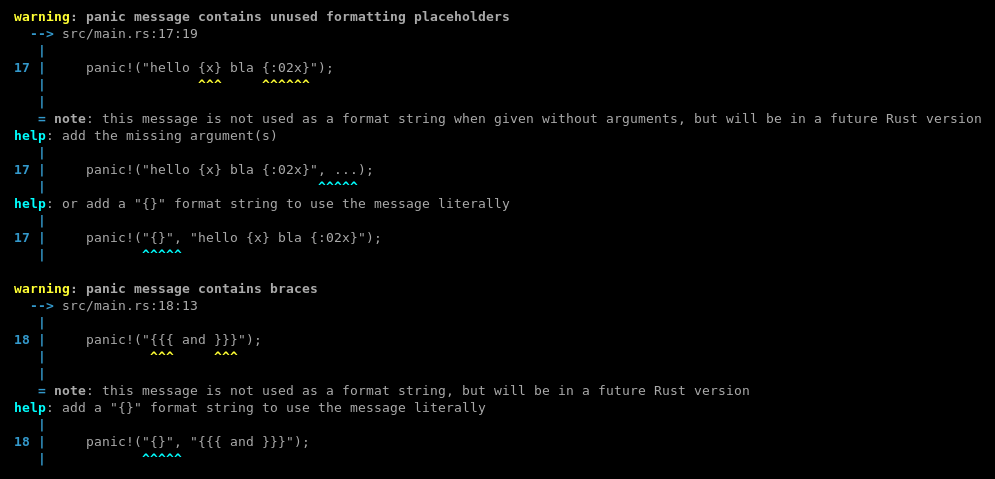
This lint is also a good starting point for adding warnings about `panic!(not_a_string)` later, once [`panic_any()`](https://github.com/rust-lang/rust/pull/74622) becomes a stable alternative.


