drop glue takes in mutable references, it should reflect that in its type

When drop glue begins, it should retag, like all functions taking references do. But to do that, it needs to take the reference at a proper type: `&mut T`, not `*mut T`.

Failing to retag can mean that the memory the reference points to remains frozen, and `EscapeToRaw` on a frozen location is a NOP, meaning later mutations cause a Stacked Borrows violation.

Cc @nikomatsakis @Gankro because Stacked Borrows
Cc @eddyb for the changes to miri argument passing (the intention is to allow passing `*mut [u8]` when `&mut [u8]` is expected and vice versa)
Add libstd Cargo feature "panic_immediate_abort"
It stop asserts and panics from libstd to automatically
include string output and formatting code.
Use case: developing static executables smaller than 50 kilobytes,
where usual formatting code is excessive while keeping debuggability
in debug mode.
May resolve#54981.
Add TryFrom<&[T]> for [T; $N] where T: Copy

`TryFrom<&[T]> for &[T; $N]` (note *reference* to an array) already exists, but not needing to dereference makes type inference easier for example when using `u32::from_be_bytes`.

Also add doc examples doing just that.
It stop asserts and panics from libstd to automatically
include string output and formatting code.
Use case: developing static executables smaller than 50 kilobytes,
where usual formatting code is excessive while keeping debuggability
in debug mode.
May resolve#54981.
libcore: Add VaList and variadic arg handling intrinsics

## Summary

 - Add intrinsics for `va_start`, `va_end`, `va_copy`, and `va_arg`.
 - Add `core::va_list::VaList` to `libcore`.

Part 1 of (at least) 3 for #44930

Comments and critiques are very much welcomed 😄
Remove unsafe `unsafe` inner function.

Within this `Iterator` implementation, a function `unsafe_get` is
defined which unsafely allows _unchecked_ indexing of any element in a
slice. This should be marked as _unsafe_, but it is not.

To address this issue, I removed that inner function.
atomic::Ordering: Get rid of misleading parts of intro
Remove the parts of atomic::Ordering's intro that wrongly claimed that
SeqCst prevents all reorderings around it.
Closes#55196
This is a (minimal) alternative to #55233.
I also wonder if it would be worth adding at least some warnings that atomics are often a footgun/hard to use correctly, similarly like `mem::transmute` or other functions have.
Within this `Iterator` implementation, a function `unsafe_get` is
defined which unsafely allows _unchecked_ indexing of any element in a
slice. This should be marked as _unsafe_, but it is not.

To address this issue, I removed that inner function.
Make `ParseIntError` and `IntErrorKind` fully public

Why would you write nice error types if I can't read them?

# Why

It can be useful to use `match` with errors produced when parsing strings to int. This would be useful for the `.err_match()` function in my [new crate](https://crates.io/crates/read_input).

---
I could also do this for `ParseFloatError` if people think it is a good idea.
I am new around hear so please tell me if I am getting anything wrong.
`TryFrom<&[T]> for &[T; $N]` (note *reference* to an array) already exists,
but not needing to dereference makes type inference easier
for example when using `u32::from_be_bytes`.

Also add doc examples doing just that.
Add std::iter::unfold

This adds an **unstable** ~`std::iter::iterate`~ `std::iter::unfold` function and ~`std::iter::Iterate`~ `std::iter::Unfold` type that trivially wrap a ~`FnMut() -> Option<T>`~ `FnMut(&mut State) -> Option<T>` closure to create an iterator. ~Iterator state can be kept in the closure’s environment or captures.~

This is intended to help reduce amount of boilerplate needed when defining an iterator that is only created in one place. Compare the existing example of the `std::iter` module: (explanatory comments elided)

```rust
struct Counter {
    count: usize,
}

impl Counter {
    fn new() -> Counter {
        Counter { count: 0 }
    }
}

impl Iterator for Counter {
    type Item = usize;

    fn next(&mut self) -> Option<usize> {
        self.count += 1;
        if self.count < 6 {
            Some(self.count)
        } else {
            None
        }
    }
}
```

… with the same algorithm rewritten to use this new API:

```rust
fn counter() -> impl Iterator<Item=usize> {
    std::iter::unfold(0, |count| {
        *count += 1;
        if *count < 6 {
            Some(*count)
        } else {
            None
        }
    })
}
```

-----

This also add unstable `std::iter::successors` which takes an (optional) initial item and a closure that takes an item and computes the next one (its successor).

```rust
let powers_of_10 = successors(Some(1_u16), |n| n.checked_mul(10));
assert_eq!(powers_of_10.collect::<Vec<_>>(), &[1, 10, 100, 1_000, 10_000]);
```
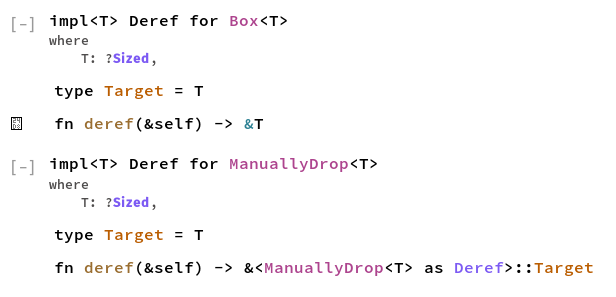
Return &T / &mut T in ManuallyDrop Deref(Mut) impl
Without this change the generated documentation looks like this:
fn deref(&self) -> &<ManuallyDrop<T> as Deref>::Target
Returning the actual type directly makes the generated docs more clear:
fn deref(&self) -> &T
Basically, compare how the impl for `Box<T>` and `ManuallyDrop<T>` looks in this screenshot:
Doc total order requirement of sort(_unstable)_by

I took the definition of what a total order is from the Ord trait
docs. I specifically put "elements of the slice" because if you
have a slice of f64s, but know none are NaN, then sorting by
partial ord is total in this case. I'm not sure if I should give
such an example in the docs or not.

r? @GuillaumeGomez


