Point at unused arguments for format string

Avoid overlapping spans by only pointing at the arguments that are not
being used in the argument string. Enable libsyntax to have diagnostics
with multiple primary spans by accepting `Into<MultiSpan>` instead of
`Span`.

Partially addresses #41850.
private no-mangle lints: only suggest `pub` if it doesn't already exist
Fixes#47383 (function or static can be `pub` but unreachable because it's in a private module; adding another `pub` is nonsensical).
r? @estebank
Don't include bang in macro replacement suggestion
When we suggest the replacement for a macro we include the "!" in the suggested replacement but the span only contains the name of the macro itself. Using that replacement would cause a duplicate "!" in the resulting code.
I originally tried to extend the span to be replaced by 1 byte in rust-lang/rust#47424. However, @zackmdavis pointed out that there can be whitespace between the macro name and the bang.
Instead, just remove the bang from the suggested replacement.
Fixes#47418
r? @estebank
fix mispositioned span
This fixes#47377
The output now looks like this
```
error[E0369]: binary operation `+` cannot be applied to type `&str`
--> h.rs:3:11
|
3 | let _a = b + ", World!";
| ^^^^^^^^^^^^^^ `+` can't be used to concatenate two `&str` strings
help: `to_owned()` can be used to create an owned `String` from a string reference. String concatenation appends the string on the right to the string on the left and may require reallocation. This requires ownership of the string on the left
|
3 | let _a = b.to_owned() + ", World!";
| ^^^^^^^^^
error: aborting due to previous error
```
For the case when emojis are involved, it gives the new output for proper indentation.
But for an indentation as follows,
```
fn main() {
let b = "hello";
let _a = b + ", World!";
}
```
it still mispositions the span
```
3 | println!("🦀🦀🦀🦀🦀"); let _a = b + ", World!";
| ^^^^^^^^^^^^^^ `+` can't be used to concatenate two `&str` strings
|
3 | println!("🦀🦀🦀🦀🦀"); let _a = b.to_owned() + ", World!";
| ^^^^^^^
error: aborting due to previous erro
```
cc @estebank @est31
The incompetent fool who added these suggestions in 38e5a964f2 apparently
thought it was safe to assume that, because the offending function or
static was unreachable, it would therefore have not have any existing
visibility modifiers, making it safe for us to unconditionally suggest
inserting `pub`. This isn't true.
This resolves#47383.
Avoid overlapping spans by only pointing at the arguments that are not
being used in the argument string. Enable libsyntax to have diagnostics
with multiple primary spans by accepting `Into<MultiSpan>` instead of
`Span`.
When given the following code:

```rust
fn give_any<F: for<'r> FnOnce(&'r ())>(f: F) {
    f(&());
}

fn main() {
    let mut x = None;
    give_any(|y| x = Some(y));
}
```

provide a custom error:

```
error: borrowed data cannot be moved outside of its closure
 --> file.rs:7:27
  |
6 |     let mut x = None;
  |         ----- binding declared outside of closure
7 |     give_any(|y| x = Some(y));
  |              ---          ^ cannot be assigned to binding outside of its closure
  |              |
  |              closure you can't escape
```

instead of the generic lifetime error:

```
error[E0495]: cannot infer an appropriate lifetime due to conflicting requirements
 --> file.rs:7:27
  |
7 |     give_any(|y| x = Some(y));
  |                           ^
  |
note: first, the lifetime cannot outlive the anonymous lifetime #2 defined on the body at 7:14...
 --> file.rs:7:14
  |
7 |     give_any(|y| x = Some(y));
  |              ^^^^^^^^^^^^^^^
note: ...so that expression is assignable (expected &(), found &())
 --> file.rs:7:27
  |
7 |     give_any(|y| x = Some(y));
  |                           ^
note: but, the lifetime must be valid for the block suffix following statement 0 at 6:5...
 --> file.rs:6:5
  |
6 | /     let mut x = None;
7 | |     give_any(|y| x = Some(y));
8 | | }
  | |_^
note: ...so that variable is valid at time of its declaration
 --> file.rs:6:9
  |
6 |     let mut x = None;
  |         ^^^^^
```
When we suggest the replacement for a macro we include the "!" in the
suggested replacement but the span only contains the name of the macro
itself. Using that replacement would cause a duplicate "!" in the
resulting code.
I originally tried to extend the span to be replaced by 1 byte in
rust-lang/rust#47424. However, @zackmdavis pointed out that there can be
whitespace between the macro name and the bang.
Instead, just remove the bang from the suggested replacement.
Fixes#47418
- Use `syntax::util::parser::expr_precedence` to determine wether
   parenthesis are needed around the casting target.
 - Update message to not incorrectly mention rounding on `.into()`
   suggestions, as those types that do have that implemented will never
   round.
Properly parse impls for the never type `!`
Recover from missing `for` in `impl Trait for Type`
Prohibit inherent default impls and default impls of auto traits
Change wording in more diagnostics to use "auto traits"
Some minor code cleanups in the parser
rustc: Tweak `#[target_feature]` syntax

This is an implementation of the `#[target_feature]` syntax-related changes of
[RFC 2045][rfc]. Notably two changes have been implemented:

* The new syntax is `#[target_feature(enable = "..")]` instead of
  `#[target_feature = "+.."]`. The `enable` key is necessary instead of the `+`
  to indicate that a feature is being enabled, and a sub-list is used for
  possible expansion in the future. Additionally within this syntax the feature
  names being enabled are now whitelisted against a known set of target feature
  names that we know about.

* The `#[target_feature]` attribute can only be applied to unsafe functions. It
  was decided in the RFC that invoking an instruction possibly not defined for
  the current processor is undefined behavior, so to enable this feature for now
  it requires an `unsafe` intervention.

[rfc]: https://github.com/rust-lang/rfcs/blob/master/text/2045-target-feature.md
This is an implementation of the `#[target_feature]` syntax-related changes of
[RFC 2045][rfc]. Notably two changes have been implemented:

* The new syntax is `#[target_feature(enable = "..")]` instead of
  `#[target_feature = "+.."]`. The `enable` key is necessary instead of the `+`
  to indicate that a feature is being enabled, and a sub-list is used for
  possible expansion in the future. Additionally within this syntax the feature
  names being enabled are now whitelisted against a known set of target feature
  names that we know about.

* The `#[target_feature]` attribute can only be applied to unsafe functions. It
  was decided in the RFC that invoking an instruction possibly not defined for
  the current processor is undefined behavior, so to enable this feature for now
  it requires an `unsafe` intervention.

[rfc]: https://github.com/rust-lang/rfcs/blob/master/text/2045-target-feature.md
Remove deprecated unstable attribute #[simd]

The `#[simd]` attribute has been deprecated since c8b6d5b23c back in 2015. Any nightly crates using it have had ample time to switch to `#[repr(simd)]`, and if they didn't they're likely broken by now anyway.

r? @eddyb
`struct` pattern parsing and diagnostic tweaks
- Recover from struct parse error on match and point out missing match
body.
- Point at struct when finding non-identifier while parsing its fields.
- Add label to "expected identifier, found {}" error.
Fix#15980.
type error method suggestions use whitelisted identity-like conversions
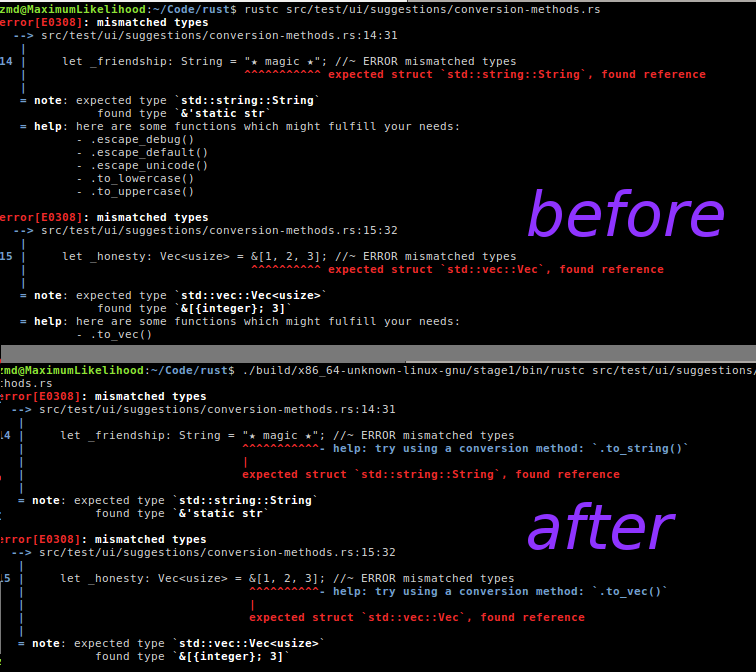
Previously, on a type mismatch (and if this wasn't preëmpted by a
higher-priority suggestion), we would look for argumentless methods
returning the expected type, and list them in a `help` note. This had two
major shortcomings: firstly, a lot of the suggestions didn't really make
sense (if you used a &str where a String was expected,
`.to_ascii_uppercase()` is probably not the solution you were hoping
for). Secondly, we weren't generating suggestions from the most useful
traits! We address the first problem with an internal
`#[rustc_conversion_suggestion]` attribute meant to mark methods that keep
the "same value" in the relevant sense, just converting the type. We
address the second problem by making `FnCtxt.probe_for_return_type` pass
the `ProbeScope::AllTraits` to `probe_op`: this would seem to be safe
because grep reveals no other callers of `probe_for_return_type`.
Also, structured suggestions are pretty and good for RLS and friends.
Unfortunately, the trait probing is still not all one would hope for: at a
minimum, we don't know how to rule out `into()` in cases where it wouldn't
actually work, and we don't know how to rule in `.to_owned()` where it
would. Issues #46459 and #46460 have been filed and are ref'd in a FIXME.
This is hoped to resolve#42929, #44672, and #45777.


