We carry around a list of stylesheets that can carry two different types
of thing:

 1. Internal stylesheets specific to a page type (only for settings)
 2. Themes

In this change I move the link generation for settings.css into
settings(), so Context.style_files is reserved just for themes.

We had two places where we extracted a base theme name from a list of
StylePaths. I consolidated that code to be a method on StylePath.

I moved generation of link tags for stylesheets into the page.html
template. With that change, I made the template responsible for special
handling of light.css (making it the default theme) and of the other
themes (marking them disabled). That allowed getting rid of the
`disabled` field on StylePath.
- Remove border.
 - Reduce size of emoji slightly.
 - Remove details disclosure for unstable reason. This was inconsistent
   with our other details disclosures, and the detail revealed was
   usually better explained by clicking on the issue link.
This change has two advantages:

1. It makes the possible states clearer, and it makes it impossible to
   construct invalid states, such as a blanket impl that is also an auto
   trait impl.

2. It shrinks the size of `Impl` a bit, since now there is only one
   field, rather than two.
Show all Deref implementations recursively
Fixes#87783.
This is a re-implementation of #80653, so taking the original PR comment:
This changes `rustdoc` to recursively follow `Deref` targets so that methods from all levels are added to the rendered output. This implementation displays the methods from all levels in the expanded state with separate sections for each level.
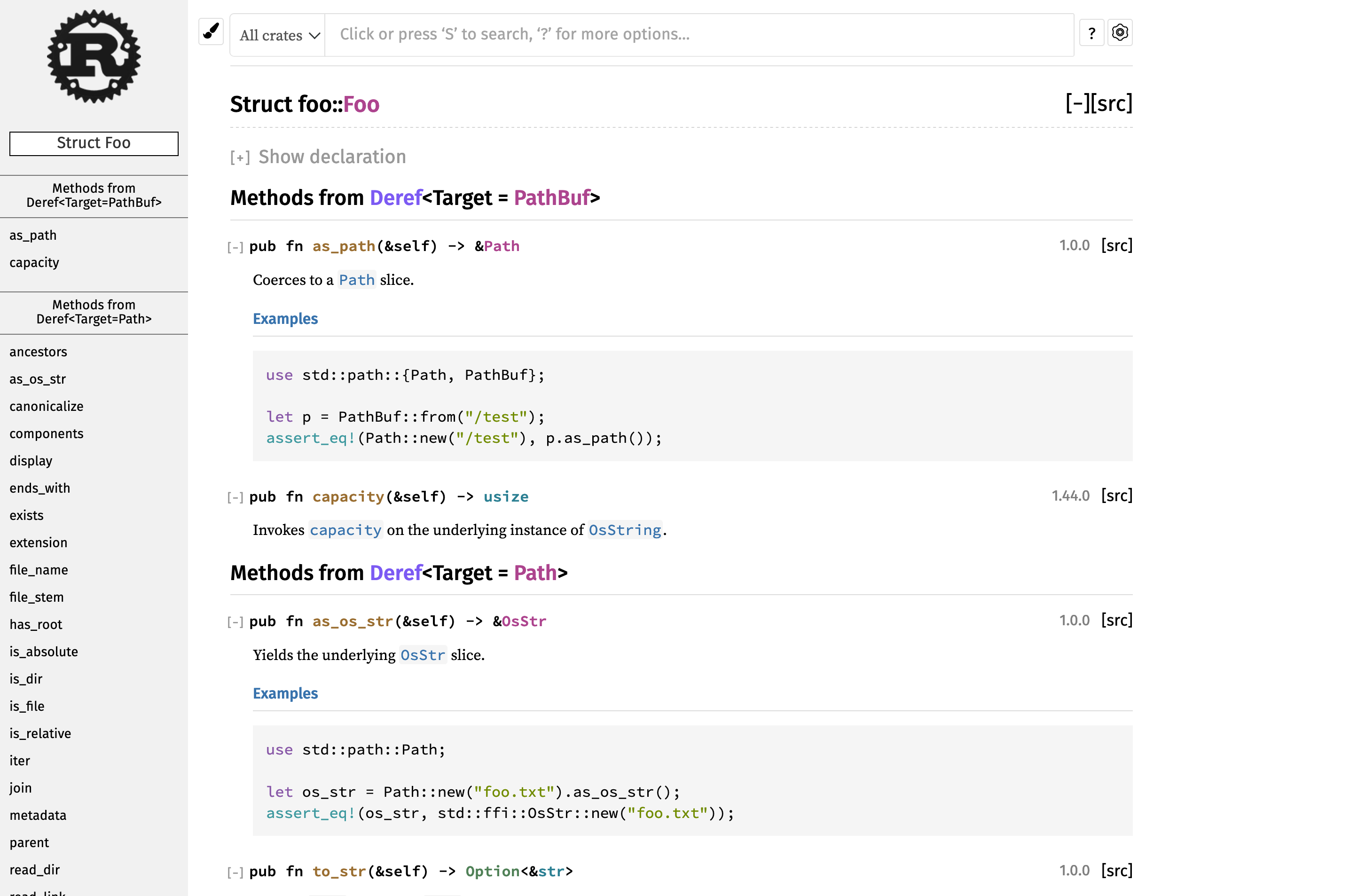
cc `@camelid`
r? `@jyn514`
It should be preferred over `def_id_no_primitives()`, so it should have
a shorter name. I also put it before `def_id_no_primitives()` so that it
shows up first in the docs.
Now that it's only implemented for `Type`, using inherent methods
instead means that imports are no longer necessary. Also, `GetDefId` is
only meant to be used with `Type`, so it shouldn't be a trait.
Move top part of print_item to Tera templates

Part of #84419.

This moves the first line of each item page (E.g. `Struct foo::Bar .... 1.0.0 [-][src]` into a Tera template.

I also moved template initialization into its own module and added a small macro to reduce duplication and opportunity for errors.
* Move call location logic from function constructor to rendering
* Fix issue with macro spans in scraping examples
* Clean up example loading logic

Documentation / newtype for DecorationInfo

Fix line number display

Serialize edition of call site, other small cleanup
Move rendering of examples into

Finalize design

Cleanup, rename found -> scraped

Softer yellow

Clean up dead code

Document scrape_examples

More simplification and documentation

Remove extra css

Test


