Revert libbacktrace -> gimli
This reverts 4cbd265c11028f8d7b8513db3cc1e8d7a36d8964 (and technically 79673d3009 but it's made empty by previous reverts).
The current plan is to land this PR as a temporary change, so that we can get a better handle on the regressions introduced by it. Trying to fix/examine them in master is difficult, and we want to be better able to evaluate them without impact to other PRs being landed in the mean time.
That said, it is currently *my* belief that gimli, in one form or another, will need to land sometime soon. I think it's quite likely that it may slip a week or two, but I would personally push for re-landing it then "regardless" of the regressions. We should try to focus efforts on understanding and removing as much of the performance impact as possible, as everyone pretty much agrees that it should be quite minimal (and entirely in the linker, basically).
r? @nnethercote
Stabilize control-flow-guard codegen option

This is the stabilization PR discussed in #68793. It converts the `-Z control-flow-guard` debugging option into a codegen option (`-C control-flow-guard`), and changes the associated tests.
Teach bootstrap install and dist commands about TargetSelection

With this, we can now use a target JSON file to build a
cross-compiler:

```
x.py install --host ../aarch64-apple-darwin.json --target aarch64-apple-darwin
```

r? @Mark-Simulacrum
With this, we can now use a target JSON file to build a
cross-compiler:

```
x.py install --host ../aarch64-apple-darwin.json --target aarch64-apple-darwin
```
Generating the coverage map
@tmandry @wesleywiser
rustc now generates the coverage map and can support (limited)
coverage report generation, at the function level.
Example commands to generate a coverage report:
```shell
$ BUILD=$HOME/rust/build/x86_64-unknown-linux-gnu
$ $BUILD/stage1/bin/rustc -Zinstrument-coverage \
$HOME/rust/src/test/run-make-fulldeps/instrument-coverage/main.rs
$ LLVM_PROFILE_FILE="main.profraw" ./main
called
$ $BUILD/llvm/bin/llvm-profdata merge -sparse main.profraw -o main.profdata
$ $BUILD/llvm/bin/llvm-cov show --instr-profile=main.profdata main
```
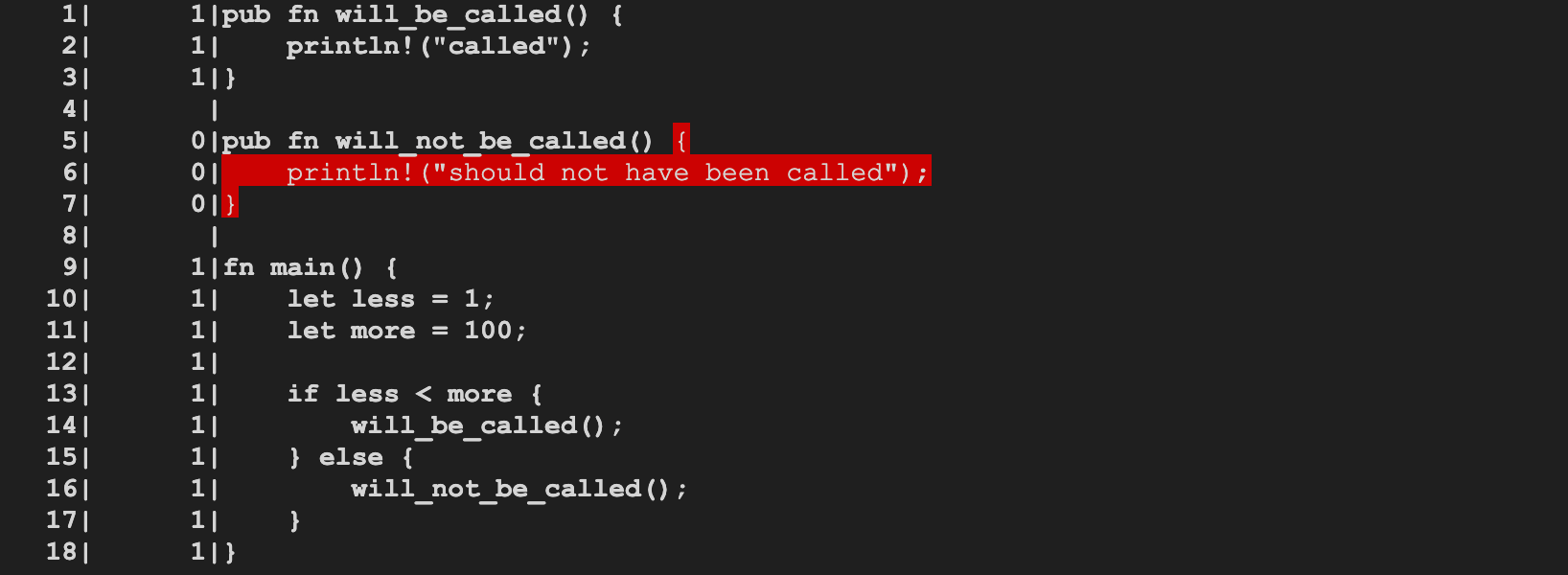
r? @wesleywiser
Rust compiler MCP rust-lang/compiler-team#278
Relevant issue: #34701 - Implement support for LLVMs code coverage instrumentation
bootstrap.py: patch RPATH on NixOS to handle the new zlib dependency.

This is a stop-gap until #74420 is resolved (assuming we'll patch beta to statically link zlib).

However, I've been meaning to rewrite the NixOS support we have in `bootstrap.py` for a while now, and had to in order to cleanly add zlib as a dependency (the second commit is a relatively small delta in functionality, compared to the first).

Previously, we would extract the `ld-linux.so` path from the output of `ldd /run/current-system/sw/bin/sh`, which assumes a lot. On top of that we didn't use any symlinks, which meant if the user ran  GC (`nix-collect-garbage`), e.g. after updating their system, their `stage0` binaries would suddenly be broken (i.e. referring to files that no longer exist).
We were also using `patchelf` directly, assuming it can be found in `$PATH` (which is not necessarily true).

My new approach relies on using `nix-build` to get the following "derivations" (packages, more or less):
* `stdenv.cc.bintools`, which has a `nix-support/dynamic-linker` file containing the path to `ld-linux.so`
  * reading this file is [the canonical way to run `patchelf --set-interpreter`](https://github.com/NixOS/nixpkgs/search?l=Nix&q=%22--set-interpreter+%24%28cat+%24NIX_CC%2Fnix-support%2Fdynamic-linker%29%22)
* `patchelf` (so that the user doesn't need to have it installed)
* `zlib`, for the `libz.so` dependency of `libLLVM-*.so` (until #74420 is resolved, presumably)

This is closer to how software is built on Nix, but I've tried to keep it as simple as possible (and not add e.g. a `stage0.nix` file).
Symlinks to each of those dependencies are kept in `stage0/.nix-deps`, which prevents GC from invalidating `stage0` binaries.

r? @nagisa cc @Mark-Simulacrum @oli-obk @davidtwco
Teach bootstrap about target files vs target triples

`rustc` allows passing in predefined target triples as well as JSON
target specification files. This change allows bootstrap to have the
first inkling about those differences. This allows building a
cross-compiler for an out-of-tree architecture (even though that
compiler won't work for other reasons).

Even if no one ever uses this functionality, I think the newtype
around the `Interned<String>` improves the readability of the code.
Enforce even more the code blocks attributes check through rustdoc

`rustdoc` now has a lint which allows it to warn if a code block attribute is malformated (which can end up in bad situations, even more in case of testing examples!). Now it'll fail if such a situation is encountered when testing markdown code blocks examples.

r? @Mark-Simulacrum
`rustc` allows passing in predefined target triples as well as JSON
target specification files. This change allows bootstrap to have the
first inkling about those differences. This allows building a
cross-compiler for an out-of-tree architecture (even though that
compiler won't work for other reasons).

Even if no one ever uses this functionality, I think the newtype
around the `Interned<String>` improves the readability of the code.
Use local links in the alloc docs.

Links to other crates (like core) from the alloc crate were incorrectly using the `https://doc.rust-lang.org/nightly/` absolute (remote) links, instead of relative (local) links.  For example, the link to `Result` at https://doc.rust-lang.org/1.44.1/alloc/vec/struct.Vec.html#method.try_reserve goes to /nightly/.

This is because alloc was being documented before core, and rustdoc relies on the existence of the local directory to know if it should use a local or remote link.

There was code that tried to compensate for this (`create_dir_all`), but in #54543 it was broken because instead of running `cargo doc` once for all the crates, it was changed to run `cargo rustdoc` for each crate individually. This means that `create_dir_all` was no longer doing what it was supposed to be doing (creating all the directories before starting).

The solution here is to just build in the correct order (from the dependency leaves towards the root).  An alternate solution would be to switch back to running `cargo doc` once (and use RUSTDOCFLAGS for passing in flags).  Another alternate solution would be to iterate over the list twice, creating the directories during the first pass.

I also did a little cleanup to remove the "crate-docs" directory. This was added in the past because different crates were built in different directories. Over time, things have been unified (and rustc docs no longer include std), so it is no longer necessary.
RISC-V GNU/Linux as host platform

This PR add a new builder named `dist-riscv64-linux` that builds the compiler toolchain for RISC-V 64-bit GNU/Linux.

r? @alexcrichton
Don't allow `DESTDIR` to influence LLVM builds

When running a command like `DESTDIR=foo x.py install` in a completely
clean build directory, this will cause LLVM to be installed into
`DESTDIR`, which then causes the build to fail later when it attempts
to *use* those LLVM files.
Fix caching issue when building tools.
This fixes a problem with tool builds not being cached properly.
#73297 changed it so that Clippy will participate in the "deny warnings" setting. Unfortunately this causes a problem because Clippy shares the build directory with other tools which do not participate in "deny warnings". Because Cargo does not independently cache artifacts based on different RUSTFLAGS settings, it causes all the shared dependencies to get rebuilt if Clippy ever gets built.
The solution here is to stop using RUSTFLAGS, and just sneak the settings in through the rustc wrapper. Cargo won't know about the different settings, so it will not bust the cache. This should be safe since lint settings on dependencies are ignored. This is how things used to work in the past before #64316.
Alternate solutions:
* Treat Clippy as a "submodule" and don't enforce warnings on it. This was the behavior before #73297. The consequence is that if a warning sneaks into clippy, that the clippy maintainers will need to fix it when they sync clippy back to the clippy repo.
* Just deny warnings on all tools (removing the in-tree/submodule distinction). This is tempting, but with some issues (cc #52336):
* Adding or changing warnings in rustc can be difficult to land because tools have to be updated if they trip the warning. In practice, this isn't too bad. Cargo (and rustfmt) already runs with `deny(warnings)`, so this has been the de-facto standard already (although they do not use the extra lints like `unused_lifetimes`).
* Teach Cargo to add flags to the workspace members, but not dependencies.
* Teach Cargo to add flags without fingerprinting them?
* Teach Cargo to independently cache different RUSTFLAGS artifacts (this was [reverted](https://github.com/rust-lang/cargo/pull/7417) due to complications). This would also unnecessarily rebuild dependencies, but would avoid cache thrashing.
* Teach Cargo about lint settings.
Closes#74016
When running a command like `DESTDIR=foo x.py install` in a completely
clean build directory, this will cause LLVM to be installed into
`DESTDIR`, which then causes the build to fail later when it attempts
to *use* those LLVM files.
Fix cross compilation of LLVM to aarch64 Windows targets

When cross-compiling, the LLVM build system recurses to build tools that need to run on the host system. However, since we pass cmake defines to set the compiler and target, LLVM still compiles these tools for the target system, rather than the host. The tools then fail to execute during the LLVM build.

This change sets defines for the tools that need to run on the host (llvm-nm, llvm-tablegen, and llvm-config), so that the LLVM build does not attempt to build them, and instead relies on the tools already built.

If compiling with clang-cl, adds the `--target` option to specify the target triple. MSVC compilers do not require this, since there is a separate compiler binary for each cross-compilation target.

Related issue: #72881
Requires LLVM change: rust-lang/llvm-project#67
When cross-compiling, the LLVM build system recurses to build tools
that need to run on the host system. However, since we pass cmake defines
to set the compiler and target, LLVM still compiles these tools for the
target system, rather than the host. The tools then fail to execute
during the LLVM build.

This change sets defines for the tools that need to run on the
host (llvm-nm, llvm-tablegen, and llvm-config), so that the LLVM build
does not attempt to build them, and instead relies on the tools already built.

If compiling with clang-cl, this change also adds the `--target` option
to specify the target triple. MSVC compilers do not require this, since there
is a separate compiler binary for cross-compilation.
Remove unused RUSTC_DEBUG_ASSERTIONS

Since #73374 the rustc wrapper no longer configures debug assertions
based on RUSTC_DEBUG_ASSERTIONS environment variable.

r? @RalfJung
The current plan is that submodule tracks the `release` branch of
rust-analyzer, which is updated once a week.

rust-analyzer is a workspace (with a virtual manifest), the actual
binary is provide by `crates/rust-analyzer` package.

Note that we intentionally don't add rust-analyzer to `Kind::Test`,
for two reasons.

*First*, at the moment rust-analyzer's test suite does a couple of
things which might not work in the context of rust repository. For
example, it shells out directly to `rustup` and `rustfmt`. So, making
this work requires non-trivial efforts.

*Second*, it seems unlikely that running tests in rust-lang/rust repo
would provide any additional guarantees. rust-analyzer builds with
stable and does not depend on the specifics of the compiler, so
changes to compiler can't break ra, unless they break stability
guarantee. Additionally, rust-analyzer itself is gated on bors, so we
are pretty confident that test suite passes.
Rollup of 10 pull requests

Successful merges:

 - #73414 (Implement `slice_strip` feature)
 - #73564 (linker: Create GNU_EH_FRAME header by default when producing ELFs)
 - #73622 (Deny unsafe ops in unsafe fns in libcore)
 - #73684 (add spans to injected coverage counters, extract with CoverageData query)
 - #73812 (ast_pretty: Pass some token streams and trees by reference)
 - #73853 (Add newline to rustc MultiSpan docs)
 - #73883 (Compile rustdoc less often.)
 - #73885 (Fix wasm32 being broken due to a NodeJS version bump)
 - #73903 (Changes required for rustc/cargo to build for iOS targets)
 - #73938 (Optimise fast path of checked_ops with `unlikely`)

Failed merges:

r? @ghost
Compile rustdoc less often.
Previously rustdoc was built 3 times with `x.py test`:
1. stage2 (using stage1 compiler) for compiletest tests (stage1-tools copied to stage2).
2. stage1 (using stage0 compiler) for std crate tests (stage0-tools copied to stage1).
3. stage2 test (using stage2 compiler) for rustdoc crate tests and error_index_generator (stage2-tools).
This PR removes the majority of number 3, where it will instead use the stage1 compiler, which will share the artifacts from number 1.
This matches the behavior of the libstd crate tests. I don't think it is entirely necessary to run the tests using stage2.
At `-j2`, the last build step goes from about 300s to 70s on my machine. It's not a huge win, but shaving 4 minutes isn't bad.
The other two builds would be pretty difficult (or undesired or impossible) to unify. It looks like std tests use stage1 very intentionally (see `force_use_stage1` and its history), and compiletests use the top stage very intentionally.
Unfortunately the linkchecker builds all docs at stage2 (stage2-tools), which means a few build script artifacts are not shared. It's not really clear to me how to fix that (because it uses `default_doc`, there doesn't seem to be any control over the stages).
---
For `x.py doc`, rustdoc was previously built three times (with compiler-docs):
1. stage2 (using stage1 compiler) for normal documentation output (stage1-tools copied to stage2).
2. stage1 (using stage0 compiler) for compiler-docs
3. stage2 (using stage2 compiler) for error_index_generator (stage2-tools)
This PR combines these so that they consistently use the "top stage" rustdoc. I don't know why the compiler-docs was written to use stage minus one, but it seems better to be consistent across the doc steps.
---
I've tried to test this with a variety of commands (`x.py doc`, `x.py test`, different `--stage` flags, `full-bootstrap`, setting `--target`, etc.) to try to make sure there aren't significant regressions here. It's tricky since there are so many variables, and this stuff is difficult for me to fully understand.
Closes#70799 (I think)




