Reenable generator drop tracking tests and fix mutation handling

The previous PR, #94068, was overly zealous in counting mutations as borrows, which effectively nullified drop tracking. We would have caught this except the drop tracking tests were still ignored, despite having the option of using the `-Zdrop-tracking` flag now.

This PR fixes the issue introduced by #94068 by only counting mutations as borrows the mutated place has a project. This is sufficient to distinguish `x.y = 42` (which should count as a borrow of `x`) from `x = 42` (which is not a borrow of `x` because the whole variable is overwritten).

This PR also re-enables the drop tracking regression tests using the `-Zdrop-tracking` flag so we will avoid introducing these sorts of issues in the future.

Thanks to ``@tmiasko`` for noticing this problem and pointing it out!

r? ``@tmiasko``
Delay bug in expr adjustment when check_expr is called multiple times
Instead of including slightly more complicated logic in `check_argument_types` to fix the bug (#94516) I introduced in #94438, and inevitably have this bug appear once again when some other diagnostic is written that causes `check_expr` to be called an expression during a (bad) code path, just delay the bug in adjustment logic.
I am open to other implementations that don't delay the bug here.
Fixes#94516
Add well known values to `--check-cfg` implementation

This pull-request adds well known values for the well known names via `--check-cfg=values()`.

[RFC 3013: Checking conditional compilation at compile time](https://rust-lang.github.io/rfcs/3013-conditional-compilation-checking.html#checking-conditional-compilation-at-compile-time) doesn't define this at all, but this seems a nice improvement.
The activation is done by a empty `values()` (new syntax) similar to `names()` except that `names(foo)` also activate well known names while `values(aa, "aa", "kk")` would not.

As stated this use a different activation logic because well known values for the well known names are not always sufficient.
In fact this is problematic for every `target_*` cfg because of non builtin targets, as the current implementation use those built-ins targets to create the list the well known values.

The implementation is straight forward, first we gather (if necessary) all the values (lazily or not) and then we apply them.

r? ```@petrochenkov```
Add #[track_caller] to track callers when initializing poisoned Once

This PR is for this Issue.
https://github.com/rust-lang/rust/issues/87707

With this fix, we expect to be able to track the caller when poisoned Once is initialized.
Add !align metadata on loads of &/&mut/Box

Note that this refers to the alignment of what the loaded value points
to, _not_ the alignment of the loaded value itself.

r? `@ghost` (blocked on #94158)
Ensure stability directives are checked in all cases

Split off  #93017

Stability and deprecation were not checked in all cases, for instance if a type error happened.
This PR moves the check earlier in the pipeline to ensure the errors are emitted in all cases.

r? `@lcnr`
Rollup of 10 pull requests

Successful merges:

 - #88805 (Clarification of default socket flags)
 - #93418 (rustdoc & doc: no `shortcut` for `rel="icon"`)
 - #93913 (Remove the everybody loops pass)
 - #93965 (Make regular stdio lock() return 'static handles)
 - #94339 (ARM: Only allow using d16-d31 with asm! when supported by the target)
 - #94404 (Make Ord and PartialOrd opt-out in `newtype_index`)
 - #94466 (bootstrap: correct reading of flags for llvm)
 - #94572 (Use `HandleOrNull` and `HandleOrInvalid` in the Windows FFI bindings.)
 - #94575 (CTFE SwitchInt: update comment)
 - #94582 (Fix a bug in `x.py fmt` that prevents some files being formatted.)

Failed merges:

r? `@ghost`
`@rustbot` modify labels: rollup
Support GATs in Rustdoc
Implements:
1. Rendering GATs in trait definitions and impl blocks
2. Rendering GATs in types (e.g. in the return type of a function)
Fixes#92341
This is my first rustdoc PR, so I have absolutely no idea how to produce tests for this. Advice from the rustdoc team would be wonderful!
I tested locally and things looked correct:
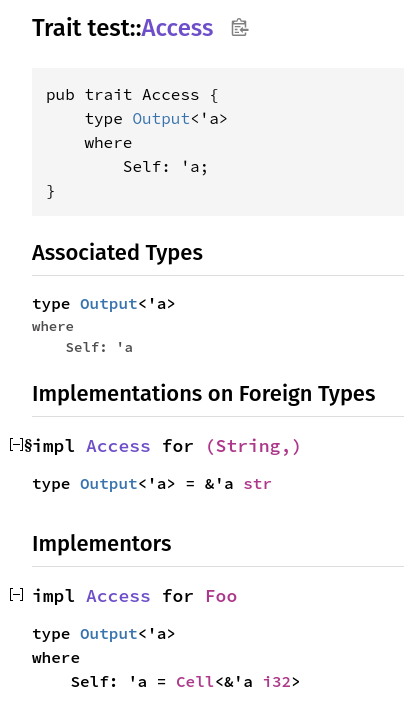
Fix invalid lint_node_id being put on a removed stmt

This pull-request remove a invalid `assign_id!` being put on an stmt node.

The problem is that this node is being removed away by a cfg making it unreachable when triggering a buffered lint.
The comment in the other match arm already tell to not assign a id because it could have a `#[cfg()]` so this is just respecting the comment.

Fixes https://github.com/rust-lang/rust/issues/94523
r? ```````@petrochenkov```````
rustdoc: Add test for higher kinded functions generated by macros
Fixes#75564.
The problem has been solved apparently so adding a test to prevent a regression.
r? ```@notriddle```
Implementation of the `expect` attribute (RFC 2383)

This is an implementation of the `expect` attribute as described in [RFC-2383](https://rust-lang.github.io/rfcs/2383-lint-reasons.html). The attribute allows the suppression of lint message by expecting them. Unfulfilled lint expectations (meaning no expected lint was caught) will emit the `unfulfilled_lint_expectations` lint at the `expect` attribute.

### Example
#### input
```rs
// required feature flag
#![feature(lint_reasons)]

#[expect(unused_mut)] // Will warn about an unfulfilled expectation
#[expect(unused_variables)] // Will be fulfilled by x
fn main() {
    let x = 0;
}
```

#### output

```txt
warning: this lint expectation is unfulfilled
  --> $DIR/trigger_lint.rs:3:1
   |
LL | #[expect(unused_mut)] // Will warn about an unfulfilled expectation
   |          ^^^^^^^^^^
   |
   = note: `#[warn(unfulfilled_lint_expectations)]` on by default
```

### Implementation

This implementation introduces `Expect` as a new lint level for diagnostics, which have been expected. All lint expectations marked via the `expect` attribute are collected in the [`LintLevelsBuilder`] and assigned an ID that is stored in the new lint level. The `LintLevelsBuilder` stores all found expectations and the data needed to emit the `unfulfilled_lint_expectations` in the [`LintLevelsMap`] which is the result of the [`lint_levels()`] query.

The [`rustc_errors::HandlerInner`] is the central error handler in rustc and handles the emission of all diagnostics. Lint message with the level `Expect` are suppressed during this emission, while the expectation ID is stored in a set which marks them as fulfilled. The last step is then so simply check if all expectations collected by the [`LintLevelsBuilder`] in the [`LintLevelsMap`] have been marked as fulfilled in the [`rustc_errors::HandlerInner`]. Otherwise, a new lint message will be emitted.

The implementation of the `LintExpectationId` required some special handling to make it stable between sessions. Lints can be emitted during [`EarlyLintPass`]es. At this stage, it's not possible to create a stable identifier. The level instead stores an unstable identifier, which is later converted to a stable `LintExpectationId`.

### Followup TO-DOs
All open TO-DOs have been marked with `FIXME` comments in the code. This is the combined list of them:

* [ ] The current implementation doesn't cover cases where the `unfulfilled_lint_expectations` lint is actually expected by another `expect` attribute.
   * This should be easily possible, but I wanted to get some feedback before putting more work into this.
   * This could also be done in a new PR to not add to much more code to this one
* [ ] Update unstable documentation to reflect this change.
* [ ] Update unstable expectation ids in [`HandlerInner::stashed_diagnostics`](https://doc.rust-lang.org/nightly/nightly-rustc/rustc_errors/struct.HandlerInner.html#structfield.stashed_diagnostics)

### Open questions
I also have a few open questions where I would like to get feedback on:
1. The RFC discussion included a suggestion to change the `expect` attribute to something else. (Initiated by `@Ixrec` [here](https://github.com/rust-lang/rfcs/pull/2383#issuecomment-378424091), suggestion from `@scottmcm` to use `#[should_lint(...)]` [here](https://github.com/rust-lang/rfcs/pull/2383#issuecomment-378648877)). No real conclusion was drawn on that point from my understanding. Is this still open for discussion, or was this discarded with the merge of the RFC?
2. How should the expect attribute deal with the new `force-warn` lint level?

---

This approach was inspired by a discussion with `@LeSeulArtichaut.`

RFC tracking issue: #54503

Mentoring/Implementation issue: #85549

[`LintLevelsBuilder`]: https://doc.rust-lang.org/nightly/nightly-rustc/rustc_lint/levels/struct.LintLevelsBuilder.html
[`LintLevelsMap`]: https://doc.rust-lang.org/nightly/nightly-rustc/rustc_middle/lint/struct.LintLevelMap.html
[`lint_levels()`]: https://doc.rust-lang.org/nightly/nightly-rustc/rustc_middle/ty/context/struct.TyCtxt.html#method.lint_levels
[`rustc_errors::HandlerInner`]: https://doc.rust-lang.org/nightly/nightly-rustc/rustc_errors/struct.HandlerInner.html
[`EarlyLintPass`]: https://doc.rust-lang.org/nightly/nightly-rustc/rustc_lint/trait.EarlyLintPass.html
Miri/CTFE: properly treat overflow in (signed) division/rem as UB

To my surprise, it looks like LLVM treats overflow of signed div/rem as UB. From what I can tell, MIR `Div`/`Rem` directly lowers to the corresponding LLVM operation, so to make that correct we also have to consider these overflows UB in the CTFE/Miri interpreter engine.

r? `@oli-obk`
Restore the local filter on mono item sorting

In `CodegenUnit::items_in_deterministic_order`, there's a comment that
only local HirIds should be taken into account, but #90408 removed the
`as_local` call that sets others to None. Restoring that check fixes the
s390x hangs seen in [RHBZ 2058803].

[RHBZ 2058803]: https://bugzilla.redhat.com/show_bug.cgi?id=2058803
Improve allowness of the unexpected_cfgs lint

This pull-request improve the allowness (`#[allow(...)]`) of the `unexpected_cfgs` lint.

Before this PR only crate level `#![allow(unexpected_cfgs)]` worked, now with this PR it also work when put around `cfg!` or if it is in a upper level. Making it work ~for the attributes `cfg`, `cfg_attr`, ...~ for the same level is awkward as the current code is design to give "Some parent node that is close to this macro call" (cf. https://doc.rust-lang.org/nightly/nightly-rustc/rustc_expand/base/struct.ExpansionData.html) meaning that allow on the same line as an attribute won't work. I'm note even sure if this would be possible.

Found while working on https://github.com/rust-lang/rust/pull/94298.
r? ````````@petrochenkov````````
Adt copy suggestions
Previously we've only suggested adding `Copy` bounds when the type being moved/copied is a type parameter (generic). With this PR we also suggest adding bounds when a type
- Can be copy
- All predicates that need to be satisfied for that are based on type params
i.e. we will suggest `T: Copy` for `Option<T>`, but won't suggest anything for `Option<String>`.
An example:
```rust
fn duplicate<T>(t: Option<T>) -> (Option<T>, Option<T>) {
(t, t)
}
```
New error (current compiler doesn't provide `help`:):
```text
error[E0382]: use of moved value: `t`
--> t.rs:2:9
|
1 | fn duplicate<T>(t: Option<T>) -> (Option<T>, Option<T>) {
| - move occurs because `t` has type `Option<T>`, which does not implement the `Copy` trait
2 | (t, t)
| - ^ value used here after move
| |
| value moved here
|
help: consider restricting type parameter `T`
|
1 | fn duplicate<T: Copy>(t: Option<T>) -> (Option<T>, Option<T>) {
| ++++++
```
Fixes#93623
r? ``````````@estebank``````````
``````````@rustbot`````````` label +A-diagnostics +A-suggestion-diagnostics +C-enhancement
----
I'm not at all sure if this is the right implementation for this kind of suggestion, but it seems to work :')


