Distribute cg_clif as rustup component on the nightly channel

This makes it possible to use cg_clif using:

```bash
$ rustup component add rustc-codegen-cranelift-preview --toolchain nightly
$ RUSTFLAGS="-Zcodegen-backend=cranelift" cargo +nightly build
```

cc https://github.com/rust-lang/compiler-team/issues/405.
r? `@Mark-Simulacrum`
Bump stdarch submodule and remove special handling for LLVM intrinsics that are no longer needed

Bumps stdarch to pull https://github.com/rust-lang/stdarch/pull/1477, which reimplemented some functions with portable SIMD intrinsics instead of arch specific LLVM intrinsics.

Handling of those LLVM intrinsics is removed from cranelift codegen and miri.

cc `@RalfJung` `@bjorn3`
Update cargo

8 commits in df3509237935f9418351b77803df7bc05c009b3d..708383d620e183a9ece69b8fe930c411d83dee27
2023-10-24 23:09:01 +0000 to 2023-10-27 21:09:26 +0000
- feat(doc): Print the generated docs links (rust-lang/cargo#12859)
- feat(toml): Allow version-less manifests (rust-lang/cargo#12786)
- Remove outdated option to `-Zcheck-cfg` warnings (rust-lang/cargo#12884)
- Remove duplicate binaries during install (rust-lang/cargo#12868)
- refactor(shell): Write at once rather than in fragments (rust-lang/cargo#12880)
- docs(ref): Link to docs.rs metadata table (rust-lang/cargo#12879)
- docs(contrib): Describe how to add a new package (rust-lang/cargo#12878)
- move up looking at index summary enum (rust-lang/cargo#12749)

r? ghost
Avoid unnecessary builds/rebuilds of `rust-demangler`

This is a combination of two loosely-related changes:

- Don't build `rust-demangler` as a dependency of `tests/run-make`, because after #112300 none of the remaining run-make tests actually use it. (If future run-make tests ever do need the demangler, it'll be easy to add it back.)
- For `tests/run-coverage`, build the demangler with the stage 0 compiler instead of the current-stage compiler. This avoids having to uselessly rebuild the demangler after modifying and rebuilding the compiler itself.
Allow partially moved values in match
This PR attempts to unify the behaviour between `let _ = PLACE`, `let _: TY = PLACE;` and `match PLACE { _ => {} }`.
The logical conclusion is that the `match` version should not check for uninitialised places nor check that borrows are still live.
The `match PLACE {}` case is handled by keeping a `FakeRead` in the unreachable fallback case to verify that `PLACE` has a legal value.
Schematically, `match PLACE { arms }` in surface rust becomes in MIR:
```rust
PlaceMention(PLACE)
match PLACE {
// Decision tree for the explicit arms
arms,
// An extra fallback arm
_ => {
FakeRead(ForMatchedPlace, PLACE);
unreachable
}
}
```
`match *borrow { _ => {} }` continues to check that `*borrow` is live, but does not read the value.
`match *borrow {}` both checks that `*borrow` is live, and fake-reads the value.
Continuation of ~https://github.com/rust-lang/rust/pull/102256~ ~https://github.com/rust-lang/rust/pull/104844~
Fixes https://github.com/rust-lang/rust/issues/99180https://github.com/rust-lang/rust/issues/53114
The demangler was only needed by coverage tests, but those tests were migrated
into their own custom test mode in #112300.

This avoids having to build the demangler just for run-make tests. It will
still be built as needed by run-coverage tests or for other purposes.
Prepare the `bootstrap` tool for the new check-cfg syntax

This PR prepare the `bootstrap` tool for the [new check-cfg syntax](https://github.com/rust-lang/rust/pull/111072) as well as the according [changes to Cargo](https://github.com/rust-lang/cargo/pull/12845).

~~Note that while the new syntax can technically available on stage > 2, we actually cannot use it since we need a cargo version that supports the new syntax which won't happen until the next beta bump (if I understand everything correctly).~~

r? bootstrap
Store #[stable] attribute's `since` value in structured form

Followup to https://github.com/rust-lang/rust/pull/116773#pullrequestreview-1680913901.

Prior to this PR, if you wrote an improper `since` version in a `stable` attribute, such as `#[stable(feature = "foo", since = "wat.0")]`, rustc would emit a diagnostic saying **_'since' must be a Rust version number, such as "1.31.0"_** and then throw out the whole `stable` attribute as if it weren't there. This strategy had 2 problems, both fixed in this PR:

1. If there was also a `#[deprecated]` attribute on the same item, rustc would want to enforce that the stabilization version is older than the deprecation version. This involved reparsing the `stable` attribute's `since` version, with a diagnostic **_invalid stability version found_** if it failed to parse. Of course this diagnostic was unreachable because an invalid `since` version would have already caused the `stable` attribute to be thrown out. This PR deletes that unreachable diagnostic.

2. By throwing out the `stable` attribute when `since` is invalid, you'd end up with a second diagnostic saying **_function has missing stability attribute_** even though your function is not missing a stability attribute. This PR preserves the `stable` attribute even when `since` cannot be parsed, avoiding the misleading second diagnostic.

Followups I plan to try next:

- Do the same for the `since` value of `#[deprecated]`.

- See whether it makes sense to also preserve `stable` and/or `unstable` attributes when they contain an invalid `feature`. What redundant/misleading diagnostics can this eliminate? What problems arise from not having a usable feature name for some API, in the situation that we're already failing compilation, so not concerned about anything that happens in downstream code?
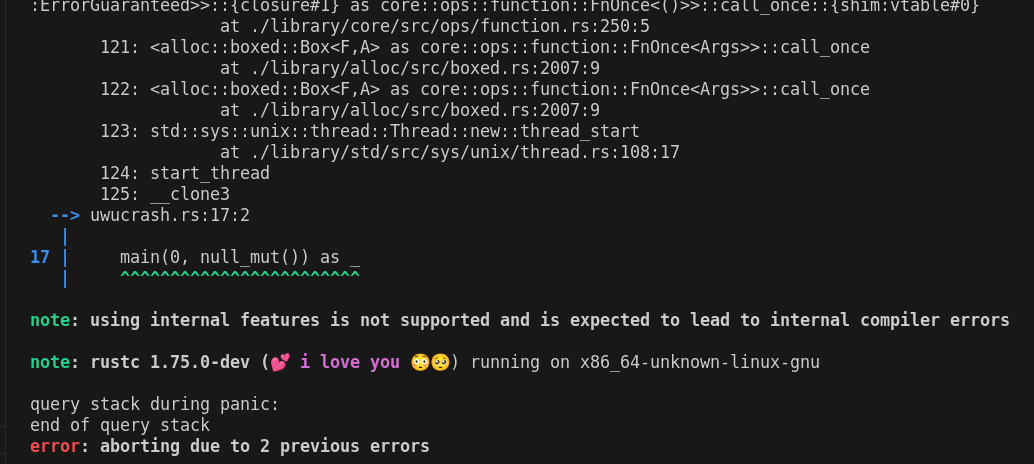
Stop telling people to submit bugs for internal feature ICEs
This keeps track of usage of internal features, and changes the message to instead tell them that using internal features is not supported.
I thought about several ways to do this but now used the explicit threading of an `Arc<AtomicBool>` through `Session`. This is not exactly incremental-safe, but this is fine, as this is set during macro expansion, which is pre-incremental, and also only affects the output of ICEs, at which point incremental correctness doesn't matter much anyways.
See [MCP 620.](https://github.com/rust-lang/compiler-team/issues/596)
Rename AsyncCoroutineKind to CoroutineSource

pulled out of https://github.com/rust-lang/rust/pull/116447

Also refactors the printing infra of `CoroutineSource` to be ready for easily extending it with a `Gen` variant for `gen` blocks
This keeps track of usage of internal features, and changes the message
to instead tell them that using internal features is not supported.

See MCP 620.
Rollup of 7 pull requests

Successful merges:

 - #117111 (Remove support for alias `-Z instrument-coverage`)
 - #117141 (Require target features to match exactly during inlining)
 - #117152 (Fix unwrap suggestion for async fn)
 - #117154 (implement C ABI lowering for CSKY)
 - #117159 (Work around the fact that `check_mod_type_wf` may spuriously return `ErrorGuaranteed`)
 - #117163 (compiletest: Display compilation errors in mir-opt tests)
 - #117173 (Make `Iterator` a lang item)

r? `@ghost`
`@rustbot` modify labels: rollup
compiletest: Display compilation errors in mir-opt tests

Previously when compilation failed the `check_mir_dump` would panic first, so we would never display the compiler output.
Work around the fact that `check_mod_type_wf` may spuriously return `ErrorGuaranteed`

Even if that error is only emitted by `check_mod_item_types`.

fixes https://github.com/rust-lang/rust/issues/117153

A cleaner refactoring would merge/chain these queries in ways that ensure we only actually get an `ErrorGuaranteed` if there was an error emitted.
This requires introducing `tidy_error_ext!` as an alternative to
`tidy_error!`. It is passed a closure that is called for an error. This
lets tests capture tidy error messages in a buffer instead of printing
them to stderr.

It also requires pulling part of `check` out into a new function
`check_lines`, so that tests can pass in an iterator over some strings
instead of a file.
- Tweak some comments.
- No need to do the `concat!` trick on `START_MARKER` because it's
  immediately followed by `END_MARKER`.
- Fix an off-by-one error in the line number for an error message.
- When a second start marker is found without an intervening end marker,
  after giving an error, treat it as though it ends the section. It's
  hard to know exactly what to do in this case, but it makes unit
  testing this case a little simpler (in the next commit).
- If an end marker occurs without a preceding start marker, issue an
  error.
These are comment lines in `Cargo.toml` files.

But exclude lines starting with `#!` from the skipping, because we want
to check them. (Rust `#![feature(...)]` lines.)

Also allow empty lines, which are occasionally useful.
Currently, if a `tidy-alphabetical-end` marker appears on the last line
of a file, tidy will erroneously issue a "reach end of file expecting
`tidy-alphabetical-end`" error. This is because it uses `take_while`
within `check_section`, which consumes the line with the end marker, and
then after `check_section` returns `check` peeks for at least one more
line, which won't be there is the marker was on the last line.

This commit fixes the problem, by removing the use of `take_while`, and
doing the "reached end of file" test within `check_section` without
using `peek`.

It also renames `{START,END}_COMMENT` as `{START,END}_MARKER`, which is
a more appropriate name.
Validate `feature` and `since` values inside `#[stable(…)]`

Previously the string passed to `#[unstable(feature = "...")]` would be validated as an identifier, but not `#[stable(feature = "...")]`. In the standard library there were `stable` attributes containing the empty string, and kebab-case string, neither of which should be allowed.

Pre-existing validation of `unstable`:

```rust
// src/lib.rs

#![allow(internal_features)]
#![feature(staged_api)]
#![unstable(feature = "kebab-case", issue = "none")]

#[unstable(feature = "kebab-case", issue = "none")]
pub struct Struct;
```

```console
error[E0546]: 'feature' is not an identifier
 --> src/lib.rs:5:1
  |
5 | #![unstable(feature = "kebab-case", issue = "none")]
  | ^^^^^^^^^^^^^^^^^^^^^^^^^^^^^^^^^^^^^^^^^^^^^^^^^^^^
```

For an `unstable` attribute, the need for an identifier is obvious because the downstream code needs to write a `#![feature(...)]` attribute containing that identifier. `#![feature(kebab-case)]` is not valid syntax and `#![feature(kebab_case)]` would not work if that is not the name of the feature.

Having a valid identifier even in `stable` is less essential but still useful because it allows for informative diagnostic about the stabilization of a feature. Compare:

```rust
// src/lib.rs

#![allow(internal_features)]
#![feature(staged_api)]
#![stable(feature = "kebab-case", since = "1.0.0")]

#[stable(feature = "kebab-case", since = "1.0.0")]
pub struct Struct;
```

```rust
// src/main.rs

#![feature(kebab_case)]

use repro::Struct;

fn main() {}
```

```console
error[E0635]: unknown feature `kebab_case`
 --> src/main.rs:3:12
  |
3 | #![feature(kebab_case)]
  |            ^^^^^^^^^^
```

vs the situation if we correctly use `feature = "snake_case"` and `#![feature(snake_case)]`, as enforced by this PR:

```console
warning: the feature `snake_case` has been stable since 1.0.0 and no longer requires an attribute to enable
 --> src/main.rs:3:12
  |
3 | #![feature(snake_case)]
  |            ^^^^^^^^^^
  |
  = note: `#[warn(stable_features)]` on by default
```
Windows: Support sub-millisecond sleep
Use `CreateWaitableTimerExW` with `CREATE_WAITABLE_TIMER_HIGH_RESOLUTION`. Does not work before Windows 10, version 1803 so in that case we fallback to using `Sleep`.
I've created a `WaitableTimer` type so it can one day be adapted to also support waiting to an absolute time (which has been talked about). Note though that it currently returns `Err(())` because we can't do anything with the errors other than fallback to the old `Sleep`. Feel free to tell me to do errors properly. It just didn't seem worth constructing an `io::Error` if we're never going to surface it to the user. And it *should* all be infallible anyway unless the OS is too old to support it.
Closes#43376
report `unused_import` for empty reexports even it is pub
Fixes#116032
An easy fix. r? `@petrochenkov`
(Discovered this issue while reviewing #115993.)


