Rollup of 6 pull requests

Successful merges:

 - #105567 (KCFI test: Also support LLVM 16 output)
 - #105847 (Ensure param-env is const before calling `eval_to_valtree`)
 - #105983 (Add a missing early return in drop tracking `handle_uninhabited_return`)
 - #106027 (rustdoc: simplify CSS and DOM for more-scraped-examples)
 - #106035 (Migrate search tab title color to CSS variable)
 - #106037 (Add regression test for #94293)

Failed merges:

r? `@ghost`
`@rustbot` modify labels: rollup
Prevents runs like the following:
```
$ x setup
Welcome to the Rust project! What do you want to do with x.py?
a) library: Contribute to the standard library
b) compiler: Contribute to the compiler itself
c) codegen: Contribute to the compiler, and also modify LLVM or codegen
d) tools: Contribute to tools which depend on the compiler, but do not modify it directly (e.g. rustdoc, clippy, miri)
e) user: Install Rust from source
Please choose one (a/b/c/d/e): b

To get started, try one of the following commands:
- `x.py check`
- `x.py build`
- `x.py test`
For more suggestions, see https://rustc-dev-guide.rust-lang.org/building/suggested.html
`x.py` will now use the configuration at /home/nilsh/projects/rustfast/src/bootstrap/defaults/config.compiler.toml
Welcome to the Rust project! What do you want to do with x.py?
...
```
rustdoc: simplify CSS and DOM for more-scraped-examples

This gets rid of the more-scraped-examples-inner wrapper, instead nesting the children directly and using absolute positioning for the toggle line.
Add a missing early return in drop tracking `handle_uninhabited_return`
This return is needed so we don't call `Ty::is_inhabited_from` from a type with ty/ct vars in it.
Fixes#105981
Ensure param-env is const before calling `eval_to_valtree`
Other queries call `ParamEnv::with_const` *inside* of the query itself (e.g. `const_eval_global_id_for_typeck`), so this could alternatively be moved into the provider of `eval_to_valtree` instead. I don't have a particularly strong opinion, though *theoretically* caching is better if we make the query keys more constrained.
I'm not exactly sure how this is an effect of the `-Zmir-opt-level=3` flag. Maybe something about the inliner causes us to inline an unevaluated const into a body where it can be evaluated, but where it has not yet been normalized.
This seems likely, since we're inlining `from_fn_1::<{ N / 2 }, _>` in `from_fn_2`, which means that we will need to evaluate that constant during the const prop pass after inlining.
Fixes#104396
This would have avoided a bug in https://github.com/rust-lang/rust/pull/104860.

In practice this shouldn't matter since nothing uses the query other than the `dead_code` lint,
but this isn't documented as an internal-only query so it seems nice for it to be accurate.
I think for `dead_code` it doesn't matter because the relevant code is generated by `rustc_builtin_macros` and isn't linted.
This duplicates mingw-check into two jobs where one job
runs `tidy` only while the other job does not. The tidy
job will not cancel other jobs on failure.
Retag as FnEntry on `drop_in_place`

This commit changes the mir drop shim to always retag its argument as if it were a `&mut`.

cc rust-lang/unsafe-code-guidelines#373
Improve `possible_borrower`

This PR makes several improvements to `clippy_uitls::mir::possible_borrower`. These changes benefit both `needless_borrow` and `redundant clone`.

1. **Use the compiler's `MaybeStorageLive` analysis**

I could spot not functional differences between the one in the compiler and the one in Clippy's repository. So, I removed the latter in favor of the the former.

2. **Make `PossibleBorrower` a dataflow analysis instead of a visitor**

The main benefit of this change is that allows `possible_borrower` to take advantage of statements' relative locations, which is easier to do in an analysis than in a visitor.

This is easier to illustrate with an example, so consider this one:
```rust
    fn foo(cx: &LateContext<'_>, lint: &'static Lint) {
        cx.struct_span_lint(lint, rustc_span::Span::default(), "", |diag| diag.note(&String::new()));
        //                                                                          ^
    }
```
We would like to flag the `&` pointed to by the `^` for removal. `foo`'s MIR begins like this:
```rust
fn span_lint::foo::{closure#0}(_1: [closure@$DIR/needless_borrow.rs:396:68: 396:74], _2: &mut rustc_errors::diagnostic_builder::DiagnosticBuilder<'_, ()>) -> &mut rustc_errors::diagnostic_builder::DiagnosticBuilder<'_, ()> {
    debug diag => _2;                    // in scope 0 at $DIR/needless_borrow.rs:396:69: 396:73
    let mut _0: &mut rustc_errors::diagnostic_builder::DiagnosticBuilder<'_, ()>; // return place in scope 0 at $DIR/needless_borrow.rs:396:75: 396:75
    let mut _3: &mut rustc_errors::diagnostic_builder::DiagnosticBuilder<'_, ()>; // in scope 0 at $DIR/needless_borrow.rs:396:75: 396:100
    let mut _4: &mut rustc_errors::diagnostic_builder::DiagnosticBuilder<'_, ()>; // in scope 0 at $DIR/needless_borrow.rs:396:75: 396:100
    let mut _5: &std::string::String;    // in scope 0 at $DIR/needless_borrow.rs:396:85: 396:99
    let _6: std::string::String;         // in scope 0 at $DIR/needless_borrow.rs:396:86: 396:99

    bb0: {
        StorageLive(_3);                 // scope 0 at $DIR/needless_borrow.rs:396:75: 396:100
        StorageLive(_4);                 // scope 0 at $DIR/needless_borrow.rs:396:75: 396:100
        _4 = &mut (*_2);                 // scope 0 at $DIR/needless_borrow.rs:396:75: 396:100
        StorageLive(_5);                 // scope 0 at $DIR/needless_borrow.rs:396:85: 396:99
        StorageLive(_6);                 // scope 0 at $DIR/needless_borrow.rs:396:86: 396:99
        _6 = std::string::String::new() -> bb1; // scope 0 at $DIR/needless_borrow.rs:396:86: 396:99
                                         // mir::Constant
                                         // + span: $DIR/needless_borrow.rs:396:86: 396:97
                                         // + literal: Const { ty: fn() -> std::string::String {std::string::String::new}, val: Value(<ZST>) }
    }

    bb1: {
        _5 = &_6;                        // scope 0 at $DIR/needless_borrow.rs:396:85: 396:99
        _3 = rustc_errors::diagnostic_builder::DiagnosticBuilder::<'_, ()>::note::<&std::string::String>(move _4, move _5) -> [return: bb2, unwind: bb4]; // scope 0 at $DIR/needless_borrow.rs:396:75: 396:100
                                         // mir::Constant
                                         // + span: $DIR/needless_borrow.rs:396:80: 396:84
                                         // + literal: Const { ty: for<'a> fn(&'a mut rustc_errors::diagnostic_builder::DiagnosticBuilder<'_, ()>, &std::string::String) -> &'a mut rustc_errors::diagnostic_builder::DiagnosticBuilder<'_, ()> {rustc_errors::diagnostic_builder::DiagnosticBuilder::<'_, ()>::note::<&std::string::String>}, val: Value(<ZST>) }
    }
```
The call to `diag.note` appears in `bb1` on the line beginning with `_3 =`. The `String` is owned by `_6`. So, in the call to `diag.note`, we would like to know whether there are any references to `_6` besides `_5`.

The old, visitor approach did not consider the relative locations of statements. So all borrows were treated the same, *even if they occurred after the location of interest*.

For example, before the `_3 = ...` call, the possible borrowers of `_6` would be just `_5`. But after the call, the possible borrowers would include `_2`, `_3`, and `_4`.

So, in a sense, the call from which we are try to remove the needless borrow is trying to prevent us from removing the needless borrow(!).

With an analysis, things do not get so muddled. We can determine the set of possible borrowers at any specific location, e.g., using a `ResultsCursor`.

3. **Change `only_borrowers` to `at_most_borrowers`**

`possible_borrowers` exposed a function `only_borrowers` that determined whether the borrowers of some local were *exactly* some set `S`. But, from what I can tell, this was overkill. For the lints that currently use `possible_borrower` (`needless_borrow` and `redundant_clone`), all we really want to know is whether there are borrowers *other than* those in `S`. (Put another way, we only care about the subset relation in one direction.) The new function `at_most_borrowers` takes this more tailored approach.

4. **Compute relations "on the fly" rather than using `transitive_relation`**

The visitor would compute and store the transitive closure of the possible borrower relation for an entire MIR body.

But with an analysis, there is effectively a different possible borrower relation at each location in the body. Computing and storing a transitive closure at each location would not be practical.

So the new approach is to compute the transitive closure on the fly, as needed. But the new approach might actually be more efficient, as I now explain.

In all current uses of `at_most_borrowers` (previously `only_borrowers`), the size of the set of borrowers `S` is at most 2. So you need only check at most three borrowers to determine whether the subset relation holds. That is, once you have found a third borrower, you can stop, since you know the relation cannot hold.

Note that `transitive_relation` is still used by `clippy_uitls::mir::possible_origin` (a kind of "subroutine" of `possible_borrower`).

cc: `@Jarcho`

---

changelog: [`needless_borrow`], [`redundant_clone`]: Now track references better and detect more cases
[#9701](https://github.com/rust-lang/rust-clippy/pull/9701)
<!-- changelog_checked -->
Avoid `match_wildcard_for_single_variants` on guarded wild matches
fix#9993
changelog: FP: [`match_wildcard_for_single_variants`]: No longer lints on wildcards with a guard
[#10056](https://github.com/rust-lang/rust-clippy/pull/10056)
<!-- changelog_checked -->
r? `@Jarcho`
Make LLD build forward-compatible with LLVM 16

Switch to using the cmake module instead of llvm-config. I believe this also removes the need for llvm-config-wrapper.
LLVM_CONFIG_PATH is no longer supported as of LLVM 16, switch to
using the cmake module instead.

We separately return the llvm-config and cmake directory paths,
because llvm-config always refers to the host binary, while
the cmake directory is for the target triple.
Rollup of 8 pull requests

Successful merges:

 - #104741 (Switch `#[track_caller]` back to a no-op unless feature gate is enabled)
 - #105769 (add function to tell the identical errors for ambiguity_errors)
 - #105843 (Suggest associated const on possible capitalization mistake)
 - #105966 (Re-enable `Fn` trait call notation error for non-tuple argument)
 - #106002 (codegen tests: adapt patterns to also work with v0 symbol mangling)
 - #106010 (Give opaque types a better coherence error)
 - #106016 (rustdoc: simplify link anchor to section expand JS)
 - #106024 (Fix ICE due to `todo!()` in `rustdoc` for `Term`s)

Failed merges:

r? `@ghost`
`@rustbot` modify labels: rollup
Fix ICE due to `todo!()` in `rustdoc` for `Term`s
Left a todo awhile ago (I think), so fill it in to print a const for `Term`s.
Fixes#105952.
Should I add some annotations to the rustdoc test?
Re-enable `Fn` trait call notation error for non-tuple argument
I have no idea why I delayed this bug... but also there doesn't seem to be a UI test that actually shows a change, so maybe that's why.
Fixes#105936
add function to tell the identical errors for ambiguity_errors
if 2 errors of the kind and ident and span of the ident, b1, b2 and misc1 misc2 are the same we call these 2 ambiguity errors identical
prevent identical ambiguity error from pushing into vector of ambiguity_errors this will fix#105177
Switch `#[track_caller]` back to a no-op unless feature gate is enabled
This patch fixes a regression, in which `#[track_caller]`, which was previously a no-op, was changed to actually turn on the behavior. This should instead only happen behind the `closure_track_caller` feature gate.
Also, add a warning for the user to understand how their code will compile depending on the feature gate being turned on or not.
Fixes#104588
feat: Add an option to hide adjustment hints outside of `unsafe` blocks and functions
As the title suggests: this PR adds an option (namely `rust-analyzer.inlayHints.expressionAdjustmentHints.hideOutsideUnsafe`) that allows to hide adjustment hints outside of `unsafe` blocks and functions:
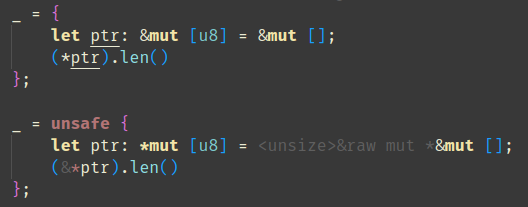
Requested by `@BoxyUwU` <3
Fix impl block in const expr
Fixes#83026.
The problem was that we didn't visit block expressions. Considering how big the [walk_expr](https://doc.rust-lang.org/nightly/nightly-rustc/src/rustc_hir/intravisit.rs.html#678) function is, I decided to instead implement the `hir` visitor on the struct. It also answers the question which was in a comment for `RustdocVisitor`: we should have used a visitor instead of our ad-hoc implementation.
Adding this visitor also added some extra checks that weren't present before (check changes in `rustdoc-ui` tests).
r? `@notriddle`


