Sync LLVM submodule if it has been initialized

Since having enabled the download-ci-llvm option,
and having rebased on top of #76864,
I've noticed that I had to update the llvm-project
submodule manually if it was checked out.
Orignally, the submodule update logic was
introduced to reduce the friction for contributors
to manage the submodules, or in other words, to prevent
getting PRs that have unwanted submodule rollbacks
because the contributors didn't run git submodule update.

This commit adds logic to ensure there is no inadvertent
LLVM submodule rollback in a PR if download-ci-llvm
(or llvm-config) is enabled. It will detect whether the
llvm-project submodule is initialized, and if so, update
it in any case. If it is not initialized, behaviour is
kept to not do any update/initialization.

An alternative to the chosen implementation would
be to not pass the --init command line arg to
`git submodule update` for the src/llvm-project
submodule. This would show a confusing error message
however on all builds with an uninitialized repo.
We could pass the --silent param, but we still want
it to print something if it is initialized and has
to update something.
So we just do a manual check for whether the
submodule is initialized.
Clean up and improve some docs

* compiler docs
  * Don't format list as part of a code block
  * Clean up some other formatting
* rustdoc book
  * Update CommonMark spec version to latest (0.28 -> 0.29)
  * Clean up some various wording and formatting
Avoid extraneous space between visibility kw and ident for statics

Today, given a static like `static mut FOO: usize = 1`, rustdoc would
emit `static mut  FOO: usize = 1`, as it emits both the mutability kw
with a space and reserves a space after the mutability kw. This patch
fixes that misformatting.

This patch also adds some tests for emit of other statics, as I could
not find an existing test devoted to statics.
Fix trait solving ICEs
- Selection candidates that are known to be applicable are preferred
over candidates that are not.
- Don't ICE if a projection/object candidate is no longer applicable
(this can happen due to cycles in normalization)
- Normalize supertraits when finding trait object candidates
Closes#77653Closes#77656
r? `@nikomatsakis`
Rollup of 10 pull requests

Successful merges:

 - #77420 (Unify const-checking structured errors for `&mut` and `&raw mut`)
 - #77554 (Support signed integers and `char` in v0 mangling)
 - #77976 (Mark inout asm! operands as used in liveness pass)
 - #78009 (Haiku: explicitly set CMAKE_SYSTEM_NAME when cross-compiling)
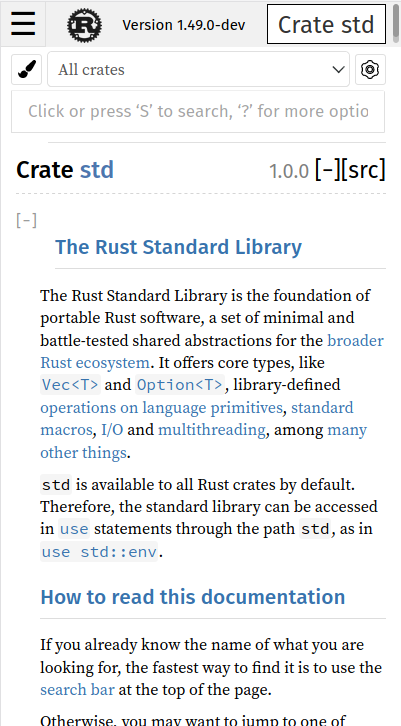
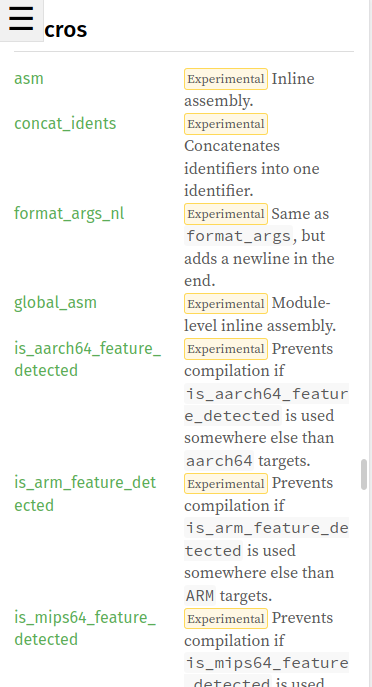
 - #78084 (Greatly improve display for small mobile devices screens)
 - #78155 (Fix two small issues in compiler/rustc_lint/src/types.rs)
 - #78156 (Fixed build failure of `rustfmt`)
 - #78172 (Add test case for #77062)
 - #78188 (Add tracking issue number for pin_static_ref)
 - #78200 (Add `ControlFlow::is_{break,continue}` methods)

Failed merges:

r? `@ghost`
* compiler docs
  * Don't format list as part of a code block
  * Clean up some other formatting
* rustdoc book
  * Update CommonMark spec version to latest (0.28 -> 0.29)
  * Clean up some various wording and formatting
Haiku: explicitly set CMAKE_SYSTEM_NAME when cross-compiling

This resolves issues where the cross-build of LLVM fails because it tries to
link to the host's system libraries instead of the target's system libraries.
Mark inout asm! operands as used in liveness pass
Variables used in `inout` operands in inline assembly (that is, they're used as both input and output to some arbitrary assembly instruction) are being marked as read and written, but are not marked as being used in the RWU table during the liveness pass. This can result in such expressions triggering an unused variable lint warning. This is incorrect behavior- reads without uses are currently only used for compound assignments. We conservatively assume that an `inout` operand is being read and used in the context of the assembly instruction.
Closes#77915
Support signed integers and `char` in v0 mangling

Likely we want more tests, to check the output is correct too: however, I wasn't sure what kind of test we needed, so I just added one similar to that added in https://github.com/rust-lang/rust/pull/77452 for now.

r? @eddyb
Calculate visibilities once in resolve

Then use them through a query based on resolver outputs.

Item visibilities were previously calculated in three places - initially in `rustc_resolve`, then in `rustc_privacy` during type privacy checkin, and then in `rustc_metadata` during metadata encoding.
The visibility logic is not entirely trivial, especially for things like constructors or enum variants, and all of it was duplicated.

This PR deduplicates all the visibility calculations, visibilities are determined once during early name resolution and then stored in `ResolverOutputs` and are later available through `tcx` as a query `tcx.visibility(def_id)`.
(This query existed previously, but only worked for other crates.)

Some special cases (e.g. visibilities for closure types, which are needed for type privacy checking) are not processed in resolve, but deferred and performed directly in the query instead.
Cycles in normalization can cause evaluations to change from Unknown to
Err. This means that some selection that were applicable no longer are.

To avoid this:
* Selection candidates that are known to be applicable are prefered
  over candidates that are not.
* We don't ICE if a candidate is no longer applicable.
rustdoc: Show the correct source filename in page titles, without `.html`

Previously the title would be

    lib.rs.html -- source

if `lib.rs` was the actual source filename. Now the title is

    lib.rs - source