To buy time on issue 83139, revert effect of PR 77885: We will not conditionally
enable probe-stack=inline-asm on LLVM 11+ anymore on any of our targets that
opted into doing so on PR #77885 (and were subsequently configured to do so in a
fine grained manner on PR #80838).

After we resolve 83139 (potentially by backporting a fix to LLVM, or potentially
by deciding that one cannot rely on the quality of our DWARF output in the
manner described in issue 83139), we can change this back.

(Update: fixed formatting issue.)
The panic happens when in recovery parsing a full `impl`
(`parse_item_impl`) fails and we drop the `DiagnosticBuilder` for the
recovery suggestion and return the `parse_item_impl` error.
We now raise the original error "expected identifier found `impl`" when
parsing the `impl` fails.
Note that the regression test is slightly simplified version of the
original repro in #81806, to make the error output smaller and more
resilient to unrelated changes in parser error messages.
Fixes#81806
Rollup of 7 pull requests

Successful merges:

 - #80011 (Stabilize `peekable_next_if`)
 - #81580 (Document how `MaybeUninit<Struct>` can be initialized.)
 - #81610 (BTreeMap: make Ord bound explicit, compile-test its absence)
 - #81664 (Avoid a hir access inside get_static)
 - #81675 (Make rustdoc respect `--error-format short` in doctests)
 - #81753 (Never MIR inline functions with a different instruction set)
 - #81795 (Small refactor with Iterator::reduce)

Failed merges:

r? `@ghost`
`@rustbot` modify labels: rollup
Avoid a hir access inside get_static

Together with #81056 this ensures that the codegen unit DepNode doesn't have a direct dependency on any part of the hir.
Fix rustc sysroot in systems using CAS

Change filesearch::get_or_default_sysroot() to check if sysroot is found using env::args().next() if rustc in argv[0] is a symlink; otherwise, or if it is not found, use env::current_exe() to imply sysroot. This makes the rustc binary able to locate Rust libraries in systems using content-addressable storage (CAS).
Encode MIR metadata by iterating on DefId instead of traversing the HIR tree

Split out of https://github.com/rust-lang/rust/pull/80347.

This part only traverses `mir_keys` and encodes MIR according to the def kind.

r? `@oli-obk`
Revert 78373 ("dont leak return value after panic in drop")
Short term resolution for issue #80949.
Reopen#47949 after this lands.
(We plan to fine-tune PR #78373 to not run into this problem.)
Rollup of 15 pull requests

Successful merges:

 - #79554 (Generic associated types in trait paths)
 - #80726 (relax adt unsizing requirements)
 - #81307 (Handle `Span`s for byte and raw strings and add more detail )
 - #81318 (rustdoc-json: Fix has_body)
 - #81456 (Make remote-test-server easier to use with new targets)
 - #81497 (rustdoc: Move `display_fn` struct inside `display_fn`)
 - #81500 (Remove struct_type from union output)
 - #81542 (Expose correct symlink API on WASI)
 - #81676 (Add more information to the error code for 'crate not found')
 - #81682 (Add additional bitset benchmarks)
 - #81730 (Make `Allocator` object-safe)
 - #81763 (Cleanup rustdoc pass descriptions a bit)
 - #81767 (Update LayoutError/LayoutErr stability attributes)
 - #81771 (Indicate change in RSS from start to end of pass in time-passes output)
 - #81781 (Fix `install-awscli.sh` error in CI)

Failed merges:

r? `@ghost`
`@rustbot` modify labels: rollup
Indicate change in RSS from start to end of pass in time-passes output

Previously, this was omitted because it could be misleading, but the
functionality seems too useful not to include.

r? ``@oli-obk``
Add additional bitset benchmarks

Add additional benchmarks for operations in bitset, I realize that it was a bit lacking when I intended to optimize it earlier, so I was hoping to put some in so I can verify my work later.
relax adt unsizing requirements

Changes unsizing of structs in case the last struct field shares generic params with other adt fields which do not change.
This change is currently insta stable and changes the language, so it at least requires a lang fcp. I feel like the current state is fairly unintuitive.

An example for what's now allowed would be https://play.rust-lang.org/?version=stable&mode=debug&edition=2018&gist=6dd331d23f5c9ffc8c978175aae2e967
```rust
struct A<T, U: ?Sized>(T, B<T, U>); // previously ERR
// struct A<T, U: ?Sized>(T, B<[u32; 1], U>); // ok
struct B<T, U: ?Sized>(T, U);

fn main() {
    let x = A([0; 1], B([0; 1], [0; 1]));
    let y: &A<[u32; 1], [u32]> = &x;
    assert_eq!(y.1.1.len(), 1);
}
```
rustc_codegen_ssa: tune codegen scheduling to reduce memory usage

For better throughput during parallel processing by LLVM, we used to sort
CGUs largest to smallest. This would lead to better thread utilization
by, for example, preventing a large CGU from being processed last and
having only one LLVM thread working while the rest remained idle.

However, this strategy would lead to high memory usage, as it meant the
LLVM-IR for all of the largest CGUs would be resident in memory at once.

Instead, we can compromise by ordering CGUs such that the largest and
smallest are first, second largest and smallest are next, etc. If there
are large size variations, this can reduce memory usage significantly.
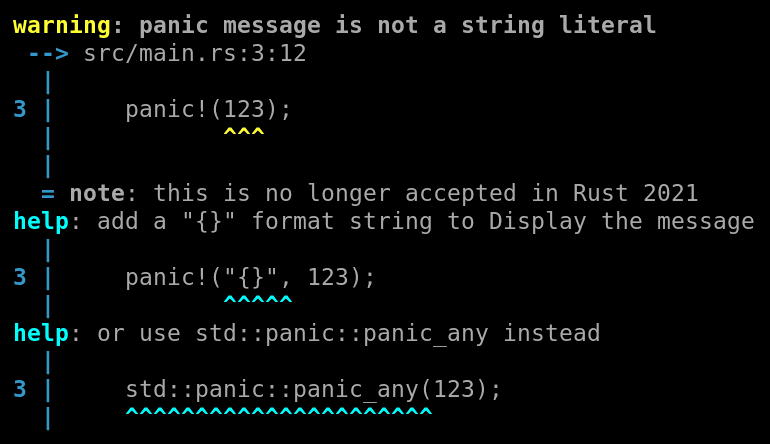
Add lint for `panic!(123)` which is not accepted in Rust 2021.
This extends the `panic_fmt` lint to warn for all cases where the first argument cannot be interpreted as a format string, as will happen in Rust 2021.
It suggests to add `"{}",` to format the message as a string. In the case of `std::panic!()`, it also suggests the recently stabilized
`std::panic::panic_any()` function as an alternative.
It renames the lint to `non_fmt_panic` to match the lint naming guidelines.
This is part of #80162.
r? ```@estebank```
introduce future-compatibility warning for forbidden lint groups

We used to ignore `forbid(group)` scenarios completely. This changed in #78864, but that led to a number of regressions (#80988, #81218).

This PR introduces a future compatibility warning for the case where a group is forbidden but then an individual lint within that group is allowed. We now issue a FCW when we see the "allow", but permit it to take effect.

r? ``@Mark-Simulacrum``
For better throughput during parallel processing by LLVM, we used to sort
CGUs largest to smallest. This would lead to better thread utilization
by, for example, preventing a large CGU from being processed last and
having only one LLVM thread working while the rest remained idle.

However, this strategy would lead to high memory usage, as it meant the
LLVM-IR for all of the largest CGUs would be resident in memory at once.

Instead, we can compromise by ordering CGUs such that the largest and
smallest are first, second largest and smallest are next, etc. If there
are large size variations, this can reduce memory usage significantly.
This extends the `panic_fmt` lint to warn for all cases where the first
argument cannot be interpreted as a format string, as will happen in
Rust 2021.

It suggests to add `"{}", ` to format the message as a string. In the
case of `std::panic!()`, it also suggests the recently stabilized
`std::panic::panic_any()` function as an alternative.

It renames the lint to `non_fmt_panic` to match the lint naming
guidelines.
Fix panic when emitting diagnostic for closure mutable binding error
Fixes#81700
The upvar borrow kind may be `ty::BorrowKind::UniqueImmBorrow`, which is
still a mutable borrow for the purposes of this diagnostic code.


