Make async generators fused by default

I actually changed my mind about this since the implementation PR landed. I think it's beneficial for `async gen` blocks to be "fused" by default -- i.e., for them to repeatedly return `Poll::Ready(None)` -- rather than panic.

We have [`FusedStream`](https://docs.rs/futures/latest/futures/stream/trait.FusedStream.html) in futures-rs to represent streams with this capability already anyways.

r? eholk
cc ```@rust-lang/wg-async,``` would like to know if anyone else has opinions about this.
update target feature following LLVM API change

LLVM commit e817966718 renamed* the `unaligned-scalar-mem` target feature to `fast-unaligned-access`.

(*) technically the commit folded two previous features into one, but there are no references to the other one in rust.
Add tests related to normalization in implied bounds

Getting ```@aliemjay's``` tests from #109763, so we can better track what's going on in every different example.

r? ```@jackh726```
temporarily revert "ice on ambguity in mir typeck"
Reverts #116530 as a temporary measure to fix#117577. That issue should be ultimately fixed by checking WF of type annotations prior to normalization, which is implemented in #104098 but this PR is intended to be backported to beta.
r? ``@compiler-errors`` (the reviewer of the reverted PR)
recurse into refs when comparing tys for diagnostics
before:

after:
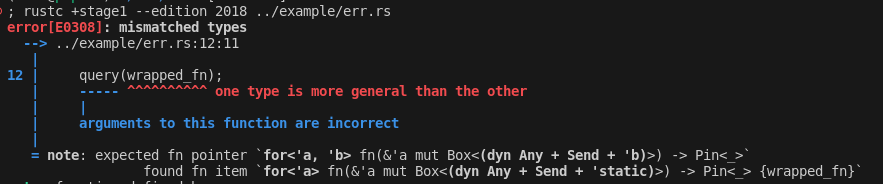
this diff from the test suite is also quite nice imo:
```diff
`@@` -4,8 +4,8 `@@` error[E0308]: mismatched types
LL | debug_assert_eq!(iter.next(), Some(value));
| ^^^^^^^^^^^ expected `Option<<I as Iterator>::Item>`, found `Option<&<I as Iterator>::Item>`
|
- = note: expected enum `Option<<I as Iterator>::Item>`
- found enum `Option<&<I as Iterator>::Item>`
+ = note: expected enum `Option<_>`
+ found enum `Option<&_>`
```
privacy: visit trait def id of projections
Fixes#117997.
A refactoring in #117076 changed the `DefIdVisitorSkeleton` to avoid calling `visit_projection_ty` for `ty::Projection` aliases, and instead just iterate over the args - this makes sense, as `visit_projection_ty` will indirectly visit all of the same args, but in doing so, will also create a `TraitRef` containing the trait's `DefId`, which also gets visited. The trait's `DefId` isn't visited when we only visit the arguments without separating them into `TraitRef` and own args first.
Eventually this influences the reachability set and whether a function is encoded into the metadata.
according to a poll of gay people in my phone, purple is the most popular color to use for highlighting

| color      | percentage |
| ---------- | ---------- |
| bold white | 6%         |
| blue       | 14%        |
| cyan       | 26%        |
| purple     | 37%        |
| magenta    | 17%        |

unfortunately, purple is not supported by 16-color terminals, which rustc apparently wants to support for some reason.
until we require support for full 256-color terms (e.g. by doing the same feature detection as we currently do for urls), we can't use it.

instead, i have collapsed the purple votes into magenta on the theory that they're close, and also because magenta is pretty.
Introduce support for `async gen` blocks

I'm delighted to demonstrate that `async gen` block are not very difficult to support. They're simply coroutines that yield `Poll<Option<T>>` and return `()`.

**This PR is WIP and in draft mode for now** -- I'm mostly putting it up to show folks that it's possible. This PR needs a lang-team experiment associated with it or possible an RFC, since I don't think it falls under the jurisdiction of the `gen` RFC that was recently authored by oli (https://github.com/rust-lang/rfcs/pull/3513, https://github.com/rust-lang/rust/issues/117078).

### Technical note on the pre-generator-transform yield type:

The reason that the underlying coroutines yield `Poll<Option<T>>` and not `Poll<T>` (which would make more sense, IMO, for the pre-transformed coroutine), is because the `TransformVisitor` that is used to turn coroutines into built-in state machine functions would have to destructure and reconstruct the latter into the former, which requires at least inserting a new basic block (for a `switchInt` terminator, to match on the `Poll` discriminant).

This does mean that the desugaring (at the `rustc_ast_lowering` level) of `async gen` blocks is a bit more involved. However, since we already need to intercept both `.await` and `yield` operators, I don't consider it much of a technical burden.

r? `@ghost`
never_patterns: Parse match arms with no body

Never patterns are meant to signal unreachable cases, and thus don't take bodies:
```rust
let ptr: *const Option<!> = ...;
match *ptr {
    None => { foo(); }
    Some(!),
}
```
This PR makes rustc accept the above, and enforces that an arm has a body xor is a never pattern. This affects parsing of match arms even with the feature off, so this is delicate. (Plus this is my first non-trivial change to the parser).

~~The last commit is optional; it introduces a bit of churn to allow the new suggestions to be machine-applicable. There may be a better solution? I'm not sure.~~ EDIT: I removed that commit

r? `@compiler-errors`
A refactoring in #117076 changed the `DefIdVisitorSkeleton` to avoid
calling `visit_projection_ty` for `ty::Projection` aliases, and instead
just iterate over the args - this makes sense, as `visit_projection_ty`
will indirectly visit all of the same args, but in doing so, will also
create a `TraitRef` containing the trait's `DefId`, which also gets
visited. The trait's `DefId` isn't visited when we only visit the
arguments without separating them into `TraitRef` and own args first.

Signed-off-by: David Wood <david@davidtw.co>
Resolve associated item bindings by namespace
This is the 3rd commit split off from #118360 with tests reblessed (they no longer contain duplicated diags which were caused by 4c0addc80a) & slightly adapted (removed supertraits from a UI test, cc #118040).
> * Resolve all assoc item bindings (type, const, fn (feature `return_type_notation`)) by namespace instead of trying to resolve a type first (in the non-RTN case) and falling back to consts afterwards. This is consistent with RTN. E.g., for `Tr<K = {…}>` we now always try to look up assoc consts (this extends to supertrait bounds). This gets rid of assoc tys shadowing assoc consts in assoc item bindings which is undesirable & inconsistent (types and consts live in different namespaces after all)
> * Consolidate the resolution of assoc {ty, const} bindings and RTN (dedup, better diags for RTN)
> * Fix assoc consts being labeled as assoc *types* in several diagnostics
> * Make a bunch of diagnostics translatable
Fixes#112560 (error → pass).
As discussed
r? `@compiler-errors`
---
**Addendum**: What I call “associated item bindings” are commonly referred to as “type bindings” for historical reasons. Nowadays, “type bindings” include assoc type bindings, assoc const bindings and RTN (return type notation) which is why I prefer not to use this outdated term.
discard invalid spans in external blocks
Fixes#116203
This PR has discarded the invalid `const_span`, thereby making the format more neat.
r? ``@Nilstrieb``
compile-time evaluation: detect writes through immutable pointers

This has two motivations:
- it unblocks https://github.com/rust-lang/rust/pull/116745 (and therefore takes a big step towards `const_mut_refs` stabilization), because we can now detect if the memory that we find in `const` can be interned as "immutable"
- it would detect the UB that was uncovered in https://github.com/rust-lang/rust/pull/117905, which was caused by accidental stabilization of `copy` functions in `const` that can only be called with UB

When UB is detected, we emit a future-compat warn-by-default lint. This is not a breaking change, so completely in line with [the const-UB RFC](https://rust-lang.github.io/rfcs/3016-const-ub.html), meaning we don't need t-lang FCP here. I made the lint immediately show up for dependencies since it is nearly impossible to even trigger this lint without `const_mut_refs` -- the accidentally stabilized `copy` functions are the only way this can happen, so the crates that popped up in #117905 are the only causes of such UB (in the code that crater covers), and the three cases of UB that we know about have all been fixed in their respective crates already.

The way this is implemented is by making use of the fact that our interpreter is already generic over the notion of provenance. For CTFE we now use the new `CtfeProvenance` type which is conceptually an `AllocId` plus a boolean `immutable` flag (but packed for a more efficient representation). This means we can mark a pointer as immutable when it is created as a shared reference. The flag will be propagated to all pointers derived from this one. We can then check the immutable flag on each write to reject writes through immutable pointers.

I just hope perf works out.
Enforce `must_use` on associated types and RPITITs that have a must-use trait in bounds
Warn when an RPITIT or (un-normalized) associated type with a `#[must_use]` trait in its bounds is unused.
This is pending T-lang approval, since it changes the semantics of the `#[must_use]` attribute slightly, but I think it strictly catches more strange errors.
I could also limit this to just RPITITs, but that seems less useful.
Fixes#118444
tip for define macro name after `macro_rules!`
Fixes#118295
~Note that there are some bad case such as `macro_rules![]` or `macro_rules!()`. However, I think these are acceptable as they are likely to be seldom used (feel free to close this if you think its shortcomings outweigh its benefits)~
Edit: this problem was resolved by utilizing the `source_map.span_to_next_source`.
r? `@petrochenkov`
Use the glob binding in resolve_rustdoc_path process
Fixes#117920
Returning `None` seems enough.
I reproduces and tests this locally by `cargo +stage1 build`, but I cannot reproduce this ICE by putting [the following code](https://play.rust-lang.org/?version=nightly&mode=debug&edition=2021&gist=8b3ca8f4a7676eb90baf30437ba041a2) into `tests/ui/...` and then compiling it using `rustc +stage1 /path/to/test.rs` or `x.py test`:
```rust
#![crate_type = "lib"]
use super::Hasher;
/// [`Hasher`]
pub use core:#️⃣:*;
```
r? `@petrochenkov`
Provide context when `?` can't be called because of `Result<_, E>`
When a method chain ending in `?` causes an E0277 because the expression's `Result::Err` variant doesn't have a type that can be converted to the `Result<_, E>` type parameter in the return type, provide additional context of which parts of the chain can and can't support the `?` operator.
```
error[E0277]: `?` couldn't convert the error to `String`
--> $DIR/question-mark-result-err-mismatch.rs:27:25
|
LL | fn bar() -> Result<(), String> {
| ------------------ expected `String` because of this
LL | let x = foo();
| ----- this has type `Result<_, String>`
...
LL | .map_err(|_| ())?;
| ---------------^ the trait `From<()>` is not implemented for `String`
| |
| this can't be annotated with `?` because it has type `Result<_, ()>`
|
= note: the question mark operation (`?`) implicitly performs a conversion on the error value using the `From` trait
= help: the following other types implement trait `From<T>`:
<String as From<char>>
<String as From<Box<str>>>
<String as From<Cow<'a, str>>>
<String as From<&str>>
<String as From<&mut str>>
<String as From<&String>>
= note: required for `Result<(), String>` to implement `FromResidual<Result<Infallible, ()>>`
```
Fix#72124.
Remove `#[rustc_host]`, use internal desugaring

Also removed a way for users to explicitly specify the host param since that isn't particularly useful. This should eliminate any pain with encoding attributes across crates and etc.

r? `@compiler-errors`
Added shadowed hint for overlapping associated types
Previously, when you tried to set an associated type that is shadowed by an associated type in a subtrait, like this:
```rust
trait A {
type X;
}
trait B: A {
type X; // note: this is legal
}
impl<Y> Clone for Box<dyn B<X=Y, X=Y>> {
fn clone(&self) -> Self {
todo!()
}
}
you got a confusing error message, that says nothing about the shadowing:
error[E0719]: the value of the associated type `X` (from trait `B`) is already specified
--> test.rs:9:34
|
9 | impl<Y> Clone for Box<dyn B<X=Y, X=Y>> {
| --- ^^^ re-bound here
| |
| `X` bound here first
error[E0191]: the value of the associated type `X` (from trait `A`) must be specified
--> test.rs:9:27
|
2 | type X;
| ------ `X` defined here
...
9 | impl<Y> Clone for Box<dyn B<X=Y, X=Y>> {
| ^^^^^^^^^^^ help: specify the associated type: `B<X=Y, X=Y, X = Type>`
error: aborting due to 2 previous errors
Some errors have detailed explanations: E0191, E0719.
For more information about an error, try `rustc --explain E0191`.
```
Now instead, the error shows that the associated type is shadowed, and suggests renaming as a potential fix.
```rust
error[E0719]: the value of the associated type `X` in trait `B` is already specified
--> test.rs:9:34
|
9 | impl<Y> Clone for Box<dyn B<X=Y, X=Y>> {
| --- ^^^ re-bound here
| |
| `X` bound here first
error[E0191]: the value of the associated type `X` in `A` must be specified
--> test.rs:9:27
|
2 | type X;
| ------ `A::X` defined here
...
6 | type X; // note: this is legal
| ------ `A::X` shadowed here
...
9 | impl<Y> Clone for Box<dyn B<X=Y, X=Y>> {
| ^^^^^^^^^^^ associated type `X` must be specified
|
help: consider renaming this associated type
--> test.rs:2:5
|
2 | type X;
| ^^^^^^
help: consider renaming this associated type
--> test.rs:6:5
|
6 | type X; // note: this is legal
| ^^^^^^
```
error: aborting due to 2 previous errors
Some errors have detailed explanations: E0191, E0719.
For more information about an error, try `rustc --explain E0191`.
The rename help message is only emitted when the trait is local. This is true both for the supertrait as for the subtrait.
There might be cases where you can use the fully qualified path (for instance, in a where clause), but this PR currently does not deal with that.
fixes#100109
(continues from #117642, because I didn't know renaming the branch would close the PR)


