## User-facing changes

- Intra-doc links to primitives that currently go to rust-lang.org/nightly/std/primitive.x.html will start going to channel that rustdoc was built with. Nightly will continue going to /nightly; Beta will link to /beta; stable compilers will link to /1.52.1 (or whatever version they were built as).
- Cross-crate links from std to core currently go to /nightly unconditionally. They will start going to /1.52.0 on stable channels (but remain the same on nightly channels).
- Intra-crate links from std to std (or core to core) currently go to the same URL they are hosted at; they will continue to do so. Notably, this is different from everything else because it can preserve the distinction between /stable and /1.52.0 by using relative links.

Note that "links" includes both intra-doc links and rustdoc's own
automatically generated hyperlinks.

 ## Implementation changes

- Update the testsuite to allow linking to /beta and /1.52.1 in docs
- Use an html_root_url for the standard library that's dependent on the channel

  This avoids linking to nightly docs on stable.

- Update rustdoc to use channel-dependent links for primitives from an
  unknown crate

- Set DOC_RUST_LANG_ORG_CHANNEL from bootstrap to ensure it's in sync
- Include doc.rust-lang.org in the channel
Since PR #69251, the `#[track_caller]` attribute has been supported on
traits. However, it only has an effect on direct (monomorphized) method
calls. Calling a `#[track_caller]` method on a trait object will *not*
propagate caller location information - instead, `Location::caller()` will
return the location of the method definition.

This PR forwards caller location information when `#[track_caller]` is
present on the method definition in the trait. This is possible because
`#[track_caller]` in this position is 'inherited' by any impls of that
trait, so all implementations will have the same ABI.

This PR does *not* change the behavior in the case where
`#[track_caller]` is present only on the impl of a trait.
While all implementations of the method might have an explicit
`#[track_caller]`, we cannot know this at codegen time, since other
crates may have impls of the trait. Therefore, we keep the current
behavior of not forwarding the caller location, ensuring that all
implementations of the trait will have the correct ABI.

See the modified test for examples of how this works
Support for force-warns

Implements https://github.com/rust-lang/rust/issues/85512.

This PR adds a new command line option `force-warns` which will force the provided lints to warn even if they are allowed by some other mechanism such as `#![allow(warnings)]`.

Some remaining issues:
* https://github.com/rust-lang/rust/issues/85512 mentions that `force-warns` should also be capable of taking lint groups instead of individual lints. This is not implemented.
* If a lint has a higher warning level than `warn`, this will cause that lint to warn instead. We probably want to allow the lint to error if it is set to a higher lint and is not allowed somewhere else.
* One test is currently ignored because it's not working - when a deny-by-default lint is allowed, it does not currently warn under `force-warns`. I'm not sure why, but I wanted to get this in before the weekend.

r? `@nikomatsakis`
Reland - Report coverage `0` of dead blocks

Fixes: #84018

With `-Z instrument-coverage`, coverage reporting of dead blocks
(for example, blocks dropped because a conditional branch is dropped,
based on const evaluation) is now supported.

Note, this PR relands an earlier, reverted PR that failed when compiling
generators. The prior issues with generators has been resolved and a new
test was added to prevent future regressions.

Check out the resulting changes to test coverage of dead blocks in the
test coverage reports in this PR.

r? `@tmandry`
fyi: `@wesleywiser`
This commit updates wasm target specs to use `simd_types_indirect: true`
again. Long ago this was added since wasm simd types were always
translated to `v128` under-the-hood in LLVM, meaning that it didn't
matter whether that target feature was enabled or not. Now, however,
`v128` is conditionally used in codegen depending on target features
enabled, meaning that it's possible to get linker errors about different
signatures in code that correctly uses simd types. The fix is the same
as for all other platforms, which is to pass the type indirectly.
Improve debugging experience for enums on windows-msvc
This PR makes significant improvements over the status quo of debugging enums on the windows-msvc platform with either WinDbg or Visual Studio in three ways:
1. Improves the debugger experience for directly tagged enums.
2. Fixes a bug which caused the debugger to sometimes show the wrong debug info for niche layout enums. For example, `Option<&u32>` could sometimes use the debug info for `Option<&f64>` instead leading to nonsensical variable values in the debugger.
3. Significantly improves the debugger experience for niche-layout enums.
Let's look at a few examples:
```rust
pub enum CStyleEnum {
Base = 2,
Exponent = 16,
}
pub enum NicheLayoutEnum {
Tag1,
Data { my_data: CStyleEnum },
Tag2,
Tag3,
Tag4,
}
pub enum OtherEnum<T> {
Case1(T),
Case2(T),
}
fn main() {
let a = Some(CStyleEnum::Base);
let b = Option::<CStyleEnum>::None;
let c = NicheLayoutEnum::Tag1;
let d = NicheLayoutEnum::Data { my_data: CStyleEnum::Exponent };
let e = NicheLayoutEnum::Tag2;
let f = Some(&1u32);
let g = Option::<&'static u32>::None;
let h = Some(&2u64);
let i = Option::<&'static u64>::None;
let j = Some(12u32);
let k = Option::<u32>::None;
let l = Some(12.34f64);
let m = Option::<f64>::None;
let n = CStyleEnum::Base;
let o = CStyleEnum::Exponent;
let p = Some("IAMA optional string!".to_string());
let q = OtherEnum::Case1(42u32);
}
```
This is what WinDbg Preview shows using the latest rustc nightly:
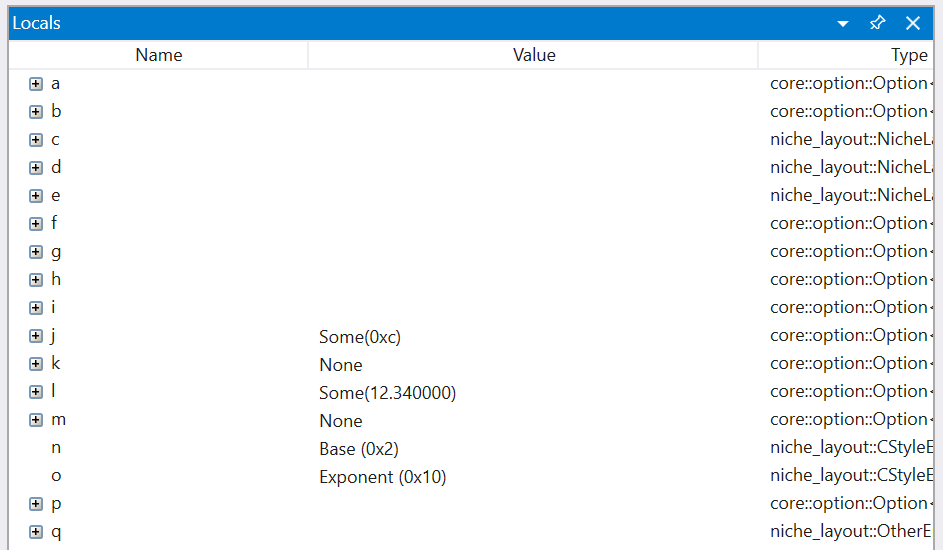
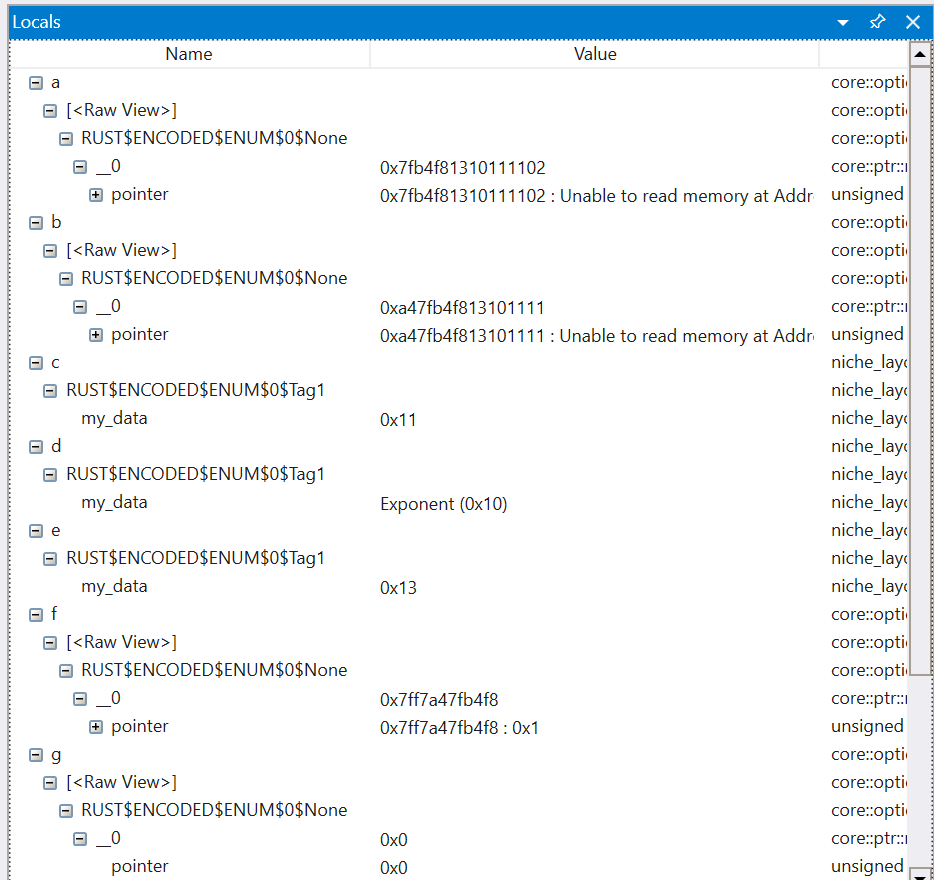
Most of the variables don't show a meaningful value expect for a few cases that we have targeted natvis definitions covering. Even worse, drilling into many of these variables shows information that can be difficult to interpret without an understanding of the layout of Rust types:
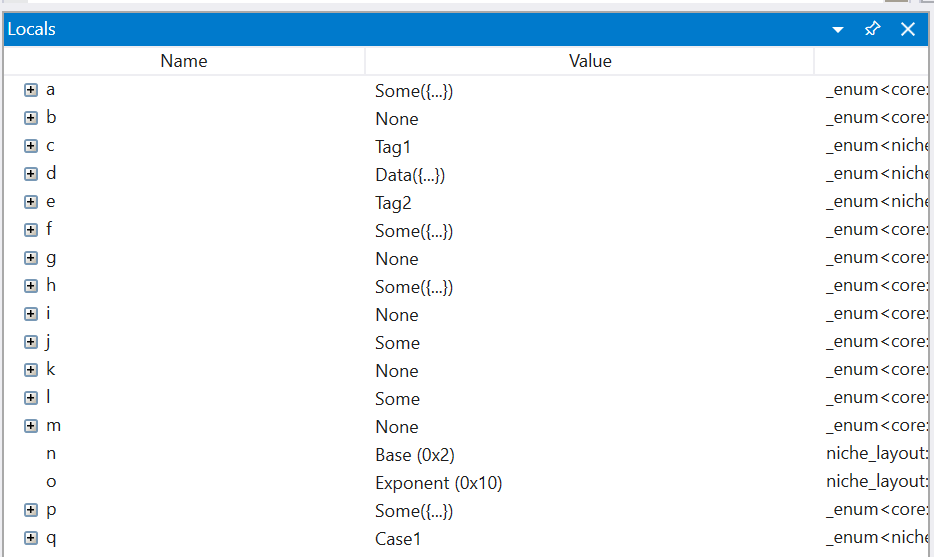
With the changes in this PR, we're able to write two natvis definitions that cover all enum cases generally. After building with these changes, WinDbg now shows this instead:
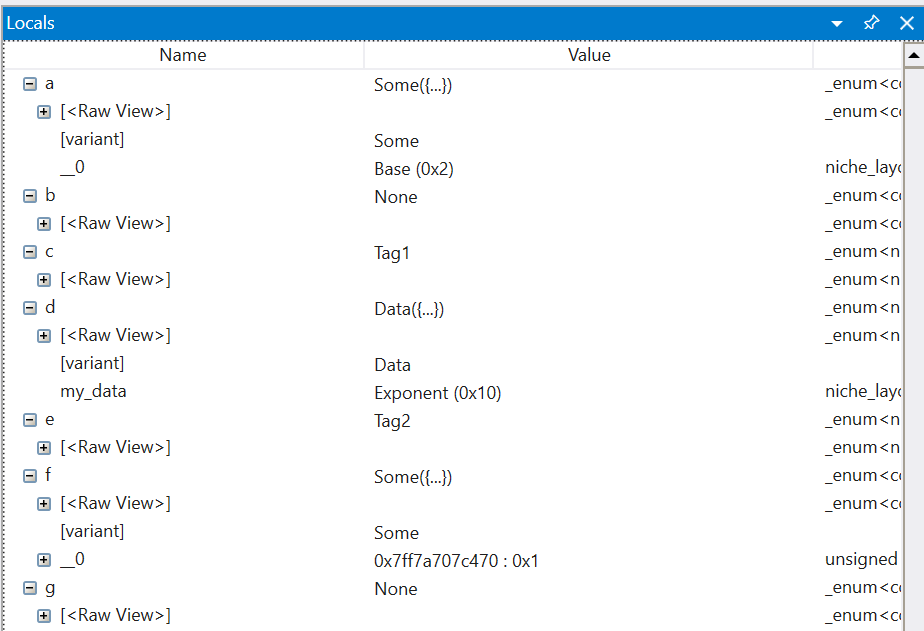
Drilling into the same variables, we can see much more useful information:
Fixes#84670Fixes#84671
rustc: Allow safe #[target_feature] on wasm

This commit updates the compiler's handling of the `#[target_feature]`
attribute when applied to functions on WebAssembly-based targets. The
compiler in general requires that any functions with `#[target_feature]`
are marked as `unsafe` as well, but this commit relaxes the restriction
for WebAssembly targets where the attribute can be applied to safe
functions as well.

The reason this is done is that the motivation for this feature of the
compiler is not applicable for WebAssembly targets. In general the
`#[target_feature]` attribute is used to enhance target CPU features
enabled beyond the basic level for the rest of the compilation. If done
improperly this means that your program could execute an instruction
that the CPU you happen to be running on does not understand. This is
considered undefined behavior where it is unknown what will happen (e.g.
it's not a deterministic `SIGILL`).

For WebAssembly, however, the target is different. It is not possible
for a running WebAssembly program to execute an instruction that the
engine does not understand. If this were the case then the program would
not have validated in the first place and would not run at all. Even if
this were allowed in some hypothetical future where engines have some
form of runtime feature detection (which they do not right now) any
implementation of such a feature would generate a trap if a module
attempts to execute an instruction the module does not understand. This
deterministic trap behavior would still not fall into the category of
undefined behavior because the trap is deterministic.

For these reasons the `#[target_feature]` attribute is now allowed on
safe functions, but only for WebAssembly targets. This notably enables
the wasm-SIMD intrinsics proposed for stabilization in #74372 to be
marked as safe generally instead of today where they're all `unsafe` due
to the historical implementation of `#[target_feature]` in the compiler.
Sidebar unification

This PR does a few things:
 * Put crates list at all levels (before, it was only on the "top" items)
 * Fix bug in module sidebar: the list of items was from the parent module.

The other changes (on bootstrap mostly) were to allow to generate multiple crates in a same folder so that we can ensure that clicking on the crates in the sidebar works as expected.

I added a rustdoc-gui test to ensure everything is where it should be.

r? `@jyn514`
Clean up dom

The commits come from #84480.

They were errors reported by the `tidy` script that we will use to ensure that the HTML generated by rustdoc is valid.

I checked carefully that there were no difference so in principle it should be exactly the same rendering but a double-check would be very appreciated in case I missed something.

Extra note: `<h4>` and some `<h3>` tags were replaced by `<div>` because they're not supposed to contain tags as they currently do.

r? `@jsha`
build-fail test for simd type with an element type that's a wide pointer
test for SIMD element type of optional nonnull ptr to extern type
test that wide ptr simd element type of *mut [u8] fails





