Implement repr(transparent)

r? @eddyb for the functional changes. The bulk of the PR is error messages and docs, might be good to have a doc person look over those.

cc #43036
cc @nox
No longer parse it.
Remove AutoTrait variant from AST and HIR.
Remove backwards compatibility lint.
Remove coherence checks, they make no sense for the new syntax.
Remove from rustdoc.
Remove deprecated unstable attribute #[simd]

The `#[simd]` attribute has been deprecated since c8b6d5b23c back in 2015. Any nightly crates using it have had ample time to switch to `#[repr(simd)]`, and if they didn't they're likely broken by now anyway.

r? @eddyb
type error method suggestions use whitelisted identity-like conversions
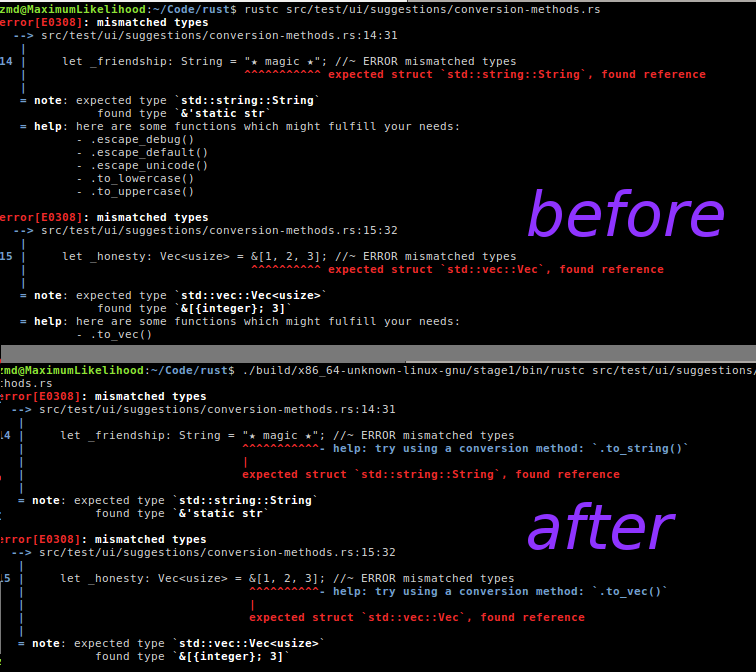
Previously, on a type mismatch (and if this wasn't preëmpted by a
higher-priority suggestion), we would look for argumentless methods
returning the expected type, and list them in a `help` note. This had two
major shortcomings: firstly, a lot of the suggestions didn't really make
sense (if you used a &str where a String was expected,
`.to_ascii_uppercase()` is probably not the solution you were hoping
for). Secondly, we weren't generating suggestions from the most useful
traits! We address the first problem with an internal
`#[rustc_conversion_suggestion]` attribute meant to mark methods that keep
the "same value" in the relevant sense, just converting the type. We
address the second problem by making `FnCtxt.probe_for_return_type` pass
the `ProbeScope::AllTraits` to `probe_op`: this would seem to be safe
because grep reveals no other callers of `probe_for_return_type`.
Also, structured suggestions are pretty and good for RLS and friends.
Unfortunately, the trait probing is still not all one would hope for: at a
minimum, we don't know how to rule out `into()` in cases where it wouldn't
actually work, and we don't know how to rule in `.to_owned()` where it
would. Issues #46459 and #46460 have been filed and are ref'd in a FIXME.
This is hoped to resolve#42929, #44672, and #45777.
The `#[simd]` attribute has been deprecated since c8b6d5b23c back in 2015. Any nightly crates using it have had ample time to switch to `#[repr(simd)]`, and if they didn't they're likely broken by now anyway.
Previously, on a type mismatch (and if this wasn't preëmpted by a
higher-priority suggestion), we would look for argumentless methods
returning the expected type, and list them in a `help` note.
This had two major shortcomings. Firstly, a lot of the suggestions didn't
really make sense (if you used a &str where a String was expected,
`.to_ascii_uppercase()` is probably not the solution you were hoping
for). Secondly, we weren't generating suggestions from the most useful
traits!
We address the first problem with an internal
`#[rustc_conversion_suggestion]` attribute meant to mark methods that keep
the "same value" in the relevant sense, just converting the type. We
address the second problem by making `FnCtxt.probe_for_return_type` pass
the `ProbeScope::AllTraits` to `probe_op`: this would seem to be safe
because grep reveals no other callers of `probe_for_return_type`.
Also, structured suggestions are preferred (because they're pretty, but
also for RLS and friends).
Also also, we make the E0055 autoderef recursion limit error use the
one-time-diagnostics set, because we can potentially hit the limit a lot
during probing. (Without this,
test/ui/did_you_mean/recursion_limit_deref.rs would report "aborting due to
51 errors").
Unfortunately, the trait probing is still not all one would hope for: at a
minimum, we don't know how to rule out `into()` in cases where it wouldn't
actually work, and we don't know how to rule in `.to_owned()` where it
would. Issues #46459 and #46460 have been filed and are ref'd in a FIXME.
This is hoped to resolve#42929, #44672, and #45777.
Implements RFC 1937: `?` in `main`

This is the first part of the RFC 1937 that supports new
`Termination` trait in the rust `main` function.

Thanks @nikomatsakis, @arielb1 and all other people in the gitter channel for all your help!

The support for doctest and `#[test]` is still missing, bu as @nikomatsakis said, smaller pull requests are better :)
The Generics now contain one Vec of an enum for the generic parameters,
rather than two separate Vec's for lifetime and type parameters.

Additionally, places that previously used Vec<LifetimeDef> now use
Vec<GenericParam> instead.
Implement non-mod.rs mod statements

Fixes https://github.com/rust-lang/rust/issues/45385, cc https://github.com/rust-lang/rust/issues/44660

This will fail tidy right now because it doesn't recognize my UI tests as feature-gate tests. However, I'm not sure if compile-fail will work out either because compile-fail usually requires there to be error patterns in the top-level file, which isn't possible with this feature. What's the recommended way to handle this?
show in docs whether the return type of a function impls Iterator/Read/Write
Closes#25928
This PR makes it so that when rustdoc documents a function, it checks the return type to see whether it implements a handful of specific traits. If so, it will print the impl and any associated types. Rather than doing this via a whitelist within rustdoc, i chose to do this by a new `#[doc]` attribute parameter, so things like `Future` could tap into this if desired.
### Known shortcomings
~~The printing of impls currently uses the `where` class over the whole thing to shrink the font size relative to the function definition itself. Naturally, when the impl has a where clause of its own, it gets shrunken even further:~~ (This is no longer a problem because the design changed and rendered this concern moot.)
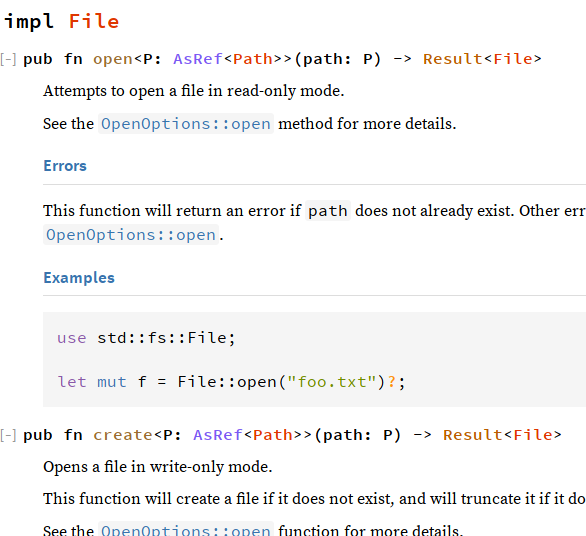
The lookup currently just looks at the top-level type, not looking inside things like Result or Option, which renders the spotlights on Read/Write a little less useful:
<details><summary>`File::{open, create}` don't have spotlight info (pic of old design)</summary>
</details>
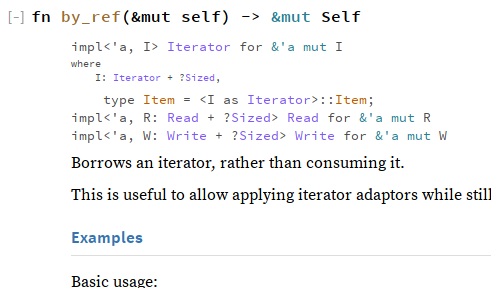
All three of the initially spotlighted traits are generically implemented on `&mut` references. Rustdoc currently treats a `&mut T` reference-to-a-generic as an impl on the reference primitive itself. `&mut Self` counts as a generic in the eyes of rustdoc. All this combines to create this lovely scene on `Iterator::by_ref`:
<details><summary>`Iterator::by_ref` spotlights Iterator, Read, and Write (pic of old design)</summary>
</details>
This commit adds a new target to the compiler: wasm32-unknown-unknown. This
target is a reimagining of what it looks like to generate WebAssembly code from
Rust. Instead of using Emscripten which can bring with it a weighty runtime this
instead is a target which uses only the LLVM backend for WebAssembly and a
"custom linker" for now which will hopefully one day be direct calls to lld.

Notable features of this target include:

* There is zero runtime footprint. The target assumes nothing exists other than
  the wasm32 instruction set.
* There is zero toolchain footprint beyond adding the target. No custom linker
  is needed, rustc contains everything.
* Very small wasm modules can be generated directly from Rust code using this
  target.
* Most of the standard library is stubbed out to return an error, but anything
  related to allocation works (aka `HashMap`, `Vec`, etc).
* Naturally, any `#[no_std]` crate should be 100% compatible with this new
  target.

This target is currently somewhat janky due to how linking works. The "linking"
is currently unconditional whole program LTO (aka LLVM is being used as a
linker). Naturally that means compiling programs is pretty slow! Eventually
though this target should have a linker.

This target is also intended to be quite experimental. I'm hoping that this can
act as a catalyst for further experimentation in Rust with WebAssembly. Breaking
changes are very likely to land to this target, so it's not recommended to rely
on it in any critical capacity yet. We'll let you know when it's "production
ready".

---

Currently testing-wise this target is looking pretty good but isn't complete.
I've got almost the entire `run-pass` test suite working with this target (lots
of tests ignored, but many passing as well). The `core` test suite is still
getting LLVM bugs fixed to get that working and will take some time. Relatively
simple programs all seem to work though!

---

It's worth nothing that you may not immediately see the "smallest possible wasm
module" for the input you feed to rustc. For various reasons it's very difficult
to get rid of the final "bloat" in vanilla rustc (again, a real linker should
fix all this). For now what you'll have to do is:

    cargo install --git https://github.com/alexcrichton/wasm-gc
    wasm-gc foo.wasm bar.wasm

And then `bar.wasm` should be the smallest we can get it!

---

In any case for now I'd love feedback on this, particularly on the various
integration points if you've got better ideas of how to approach them!
If the feature is enabled, allow method `self` types to be any type
that auto-derefs to `self`.
- Currently, this supports inherent methods as well as trait methods.
The plan AFAIK is to only allow this for trait methods, so I guess it
won’t stay this way
- Dynamic dispatch isn’t implemented yet, so the compiler will ICE if
you define a trait method that takes `self: Rc<Self>` and try to call
it on an `Rc<Trait>`. I will probably just make those methods
non-object-safe initially.
Copy all `AsciiExt` methods to the primitive types directly in order to deprecate it later

**EDIT:** [this PR is ready now](https://github.com/rust-lang/rust/pull/44042#issuecomment-333883548). I edited this post to reflect the current status of discussion, which is (apart from code review) pretty much settled.

---

This is my current progress in order to prepare stabilization of #39658. As discussed there (and in #39659), the idea is to deprecated `AsciiExt` and copy all methods to the type directly. Apparently there isn't really a reason to have those methods in an extension trait¹.

~~This is **work in progress**: copy&pasting code while slightly modifying the documentation isn't the most exciting thing to do. Therefore I wanted to already open this WIP PR after doing basically 1/4 of the job (copying methods to `&[u8]`, `char` and `&str` is still missing) to get some feedback before I continue. Some questions possibly worth discussing:~~

1. ~~Does everyone agree that deprecating `AsciiExt` is a good idea? Does everyone agree with the goal of this PR?~~ => apparently yes
2. ~~Are my changes OK so far? Did I do something wrong?~~
3. ~~The issue of the unstable-attribute is currently set to 0. I would wait until you say "Ok" to the whole thing, then create a tracking issue and then insert the correct issue id. Is that ok?~~
4. ~~I tweaked `eq_ignore_ascii_case()`: it now takes the argument `other: u8` instead of `other: &u8`. The latter was enforced by the trait. Since we're not bound to a trait anymore, we can drop the reference, ok?~~ => I reverted this, because the interface has to match the `AsciiExt` interface exactly.

¹ ~~Could it be that we can't write `impl [u8] {}`? This might be the reason for `AsciiExt`. If that is the case: is there a good reason we can't write such an impl block? What can we do instead?~~ => we couldn't at the time this PR was opened, but Simon made it possible.

/cc @SimonSapin @zackw
Right now symbol exports, particularly in a cdylib, are handled by
assuming that `pub extern` combined with `#[no_mangle]` means "export
this". This isn't actually what we want for some symbols that the
standard library uses to implement itself, for example symbols related
to allocation. Additionally other special symbols like
`rust_eh_personallity` have no need to be exported from cdylib crate
types (only needed in dylib crate types).

This commit updates how rustc handles these special symbols by adding to
the hardcoded logic of symbols like `rust_eh_personallity` but also
adding a new attribute, `#[rustc_std_internal_symbol]`, which forces the
export level to be considered the same as all other Rust functions
instead of looking like a C function.

The eventual goal here is to prevent functions like `__rdl_alloc` from
showing up as part of a Rust cdylib as it's just an internal
implementation detail. This then further allows such symbols to get gc'd
by the linker when creating a cdylib.




